How Electricity Tariffs Affect Solar Payback in India (Real Examples 2026)
Imagine this.
Two friends decide to install a 5kW rooftop solar system. Both have almost the same monthly electricity consumption. Both install similar quality systems. Even the installation cost is nearly identical.
Although they live in different regions, the sunlight intensity is almost similar.
But there’s a surprising result.
The first friend, living in a metro city, recovers his investment in just 4–5 years.
The second friend, living in a smaller town, takes around 6–7 years to break even.
But here’s something most people don’t know — payback isn’t always calculated correctly. Read: “Simple Payback vs Real Payback in Solar: What Homeowners Must Know Before Investing”
Now pause and think. How is this possible?
- The system size is the same.
- Energy generation is almost the same.
- The installation cost is also similar.
So why is there such a big difference in solar payback? This is exactly where most people get confused.
They assume solar payback depends only on system cost and generation. But in reality, there is one factor that silently controls everything — and that is your electricity tariff, or simply, the price you pay per unit of electricity.
In many Indian cities, electricity tariffs can go as high as ₹8–₹10 per unit. In the case of Nagpur, it is close to ₹15 per unit if you consume 600 units or above per month, while in smaller towns or subsidized regions, it may be around ₹4–₹5 per unit.
And this single difference completely changes the economics of solar.
In this article, we will break this concept down step by step and see how the electricity tariff directly impacts your solar savings and payback period — using simple examples that you can relate to.
What is an Electricity Tariff (and why it matters for solar)?
Before we go deeper, let’s simplify one thing.
Your electricity tariff is simply the price you pay for each unit (kWh) of electricity.
For example:
- If your tariff is ₹8/unit, every 100 units costs you ₹800
- If your tariff is ₹5/unit, the same 100 units costs ₹500
Simple.
But here’s where it gets interesting.
In cities like Delhi, electricity tariffs are usually higher, especially once your usage crosses certain limits. This means that every unit of electricity you replace with solar saves you more money.
On the other hand, in smaller towns with lower tariffs, each unit saved is worth less.
And that’s exactly why two similar solar systems can have completely different payback periods.
“Solar doesn’t save units — it saves money. And money depends on your tariff.”
How Electricity Tariffs Directly Change Your Solar Savings
Here’s the most important idea you need to understand:
Solar doesn’t just generate electricity — it replaces expensive electricity.
And how “expensive” that electricity is depends entirely on your tariff.
Let’s break this down with a simple example.
Imagine your solar system generates 500 units per month.
Now see what happens in two different cases:
Case 1: Higher Tariff (Metro City like Mumbai)
- Tariff: ₹9 per unit
- Monthly solar generation: 600 units
- Savings = 600 × ₹9 = ₹5,400 per month
Case 2: Lower Tariff (Smaller Town)
- Tariff: ₹5 per unit
- Same generation: 600 units
- Savings = 600 × ₹5 = ₹3,000 per month
Same solar system, same sunlight and same cost.
But…
One person saves ₹5,400/month or ₹64,800 per year
The other saves ₹3,000/month or ₹36,000 per year
That’s a ₹2,400 difference every month. Over time, this difference becomes huge. ₹2,400/month = ₹28,800/year difference.
What does this mean for payback?
- Higher tariff → higher savings → faster payback
- Lower tariff → lower savings → slower payback
Imagine a 5kW solar system costs ₹2,40,000 after subsidy. As shown in the graph below, the metro user breaks even much faster due to higher tariffs.”
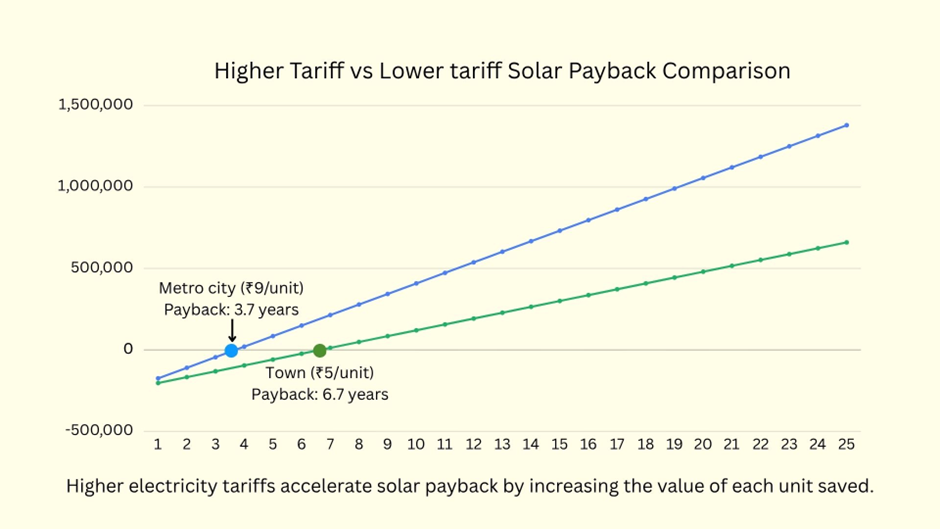
That alone can reduce your payback period by 3 years
The key takeaway: Your solar ROI is directly proportional to your electricity tariff.
Or in simple terms:
The more you pay per unit, the more solar saves you.
“This is why people with ₹8000 bills recover their solar investment much faster than those with ₹2000 bills.”
₹2000 vs ₹8000 Bill: Real Solar Payback Comparison
Now let’s look at a real-world scenario. Two homeowners in Mumbai are considering solar.
Case 1: ₹2000 Monthly Electricity Bill
- Monthly bill: ₹2000
- Approx usage: ~350 units
- Average tariff: ~₹5.5/unit (mixed slab)
- Recommended solar system ~3kW (cost ~₹1.6 lakh)
- Savings: Monthly ≈ ₹2000 and Yearly savings ≈ ₹24,000
- Payback period: ~6 to 7 years
Case 2: ₹8000 Monthly Electricity Bill
- Monthly bill: ₹8000
- Approx usage: ~800 units
- Higher slab tariff: ~₹9–₹10/unit
- Recommended solar system: ~7kW (cost: ~₹3.5 lakh)
- Savings: Monthly savings ≈ ₹8,000 and Yearly savings ≈ ₹96,000
- Payback period: ~3 to 4 years
Now compare the difference:
| Factor | ₹2000 Bill | ₹8000 Bill |
|---|---|---|
| System Size | 3kW | 7kW |
| Cost | ₹1.6L | ₹3.5L |
| Yearly Savings | ₹24K | ₹96K |
| Payback | 6–7 yrs | 3–4 yrs |
What’s really happening here?
At first glance, you might think: “Higher system cost = longer payback”
But the opposite happens.
Why?
Because higher consumption pushes you into higher tariff slabs.
So, every unit your solar system generates replaces more expensive electricity
The key insight: Solar becomes more profitable as your electricity bill increases
This is why:
- ₹2000 bill → moderate returns
- ₹8000 bill → strong financial investment
Important takeaway: if your bill is:
- Below ₹2000 → Solar may not be financially attractive
- ₹3000–₹5000 → decent investment
- ₹5000+ → strong ROI opportunity
Final thought: Two people can install solar…But the one paying higher electricity rates will always win faster.
Important: These payback numbers look simple, but real returns are often different from what installers claim. Read: “Why ‘5-year payback’ claims are mathematically misleading”
Conclusion
By now, one thing should be clear:
Solar is not just about panels — it’s about your electricity cost.
Two homes can install the same system…
But the one paying higher tariffs will always:
- save more money
- recover investment faster
- earn better long-term returns
So, is solar worth it?
Here’s a simple way to think about it:
- If your monthly bill is below ₹2000: Solar may not make strong financial sense
- If your bill is ₹3000–₹5000: Solar can be a decent long-term investment
- If your bill is ₹5000+: Solar becomes a high-return decision
⚡ The truth most people ignore is that solar doesn’t work the same for everyone.
And that’s exactly why:
- Some people recover their money in 3–4 years
- While others take 6–7 years
Before You Install Solar, Do This
Don’t guess.
Don’t rely only on installer promises.
Run the numbers based on your own electricity bill.
Because one small difference in tariff can change your returns by years.
Want to Know Your Exact Solar Payback?
If you’re a homeowner with a ₹3000–₹10,000 electricity bill…
I can help you calculate:
- Your ideal system size
- Your yearly savings
- Your exact payback period
Here’s what to do next: Write your “monthly electricity bill” in the comment section. I’ll help you understand whether solar is actually worth it for YOU — not in general.
Want a Detailed Solar Financial Report?
If you don’t just want a rough estimate…
And want a clear, numbers-backed decision
I offer a Solar Financial Analysis Service (SFS) where I calculate:
- ✔ Exact system size for your home
- ✔ Real yearly savings (based on your tariff)
- ✔ Accurate payback period
- ✔ 20–25year return projection
Who is this for?
This is for you if:
- Your electricity bill is ₹3000–₹10,000
- You’re seriously considering solar
- You don’t want to make a wrong investment
What makes this different?
This is NOT a sales pitch
This is a pure financial breakdown based on your data
So, you can decide: “Should I install solar or not?”
How to get it
👉 Message me “SFS” or Comment “REPORT”
I’ll share the details with you.
Or
If you want to DIY, then with a few basic inputs, you can get your Solar sizing and ROI within minutes through my Solar Feasibility Spreadsheet
Solar is not a yes or no decision — it’s a numbers decision.