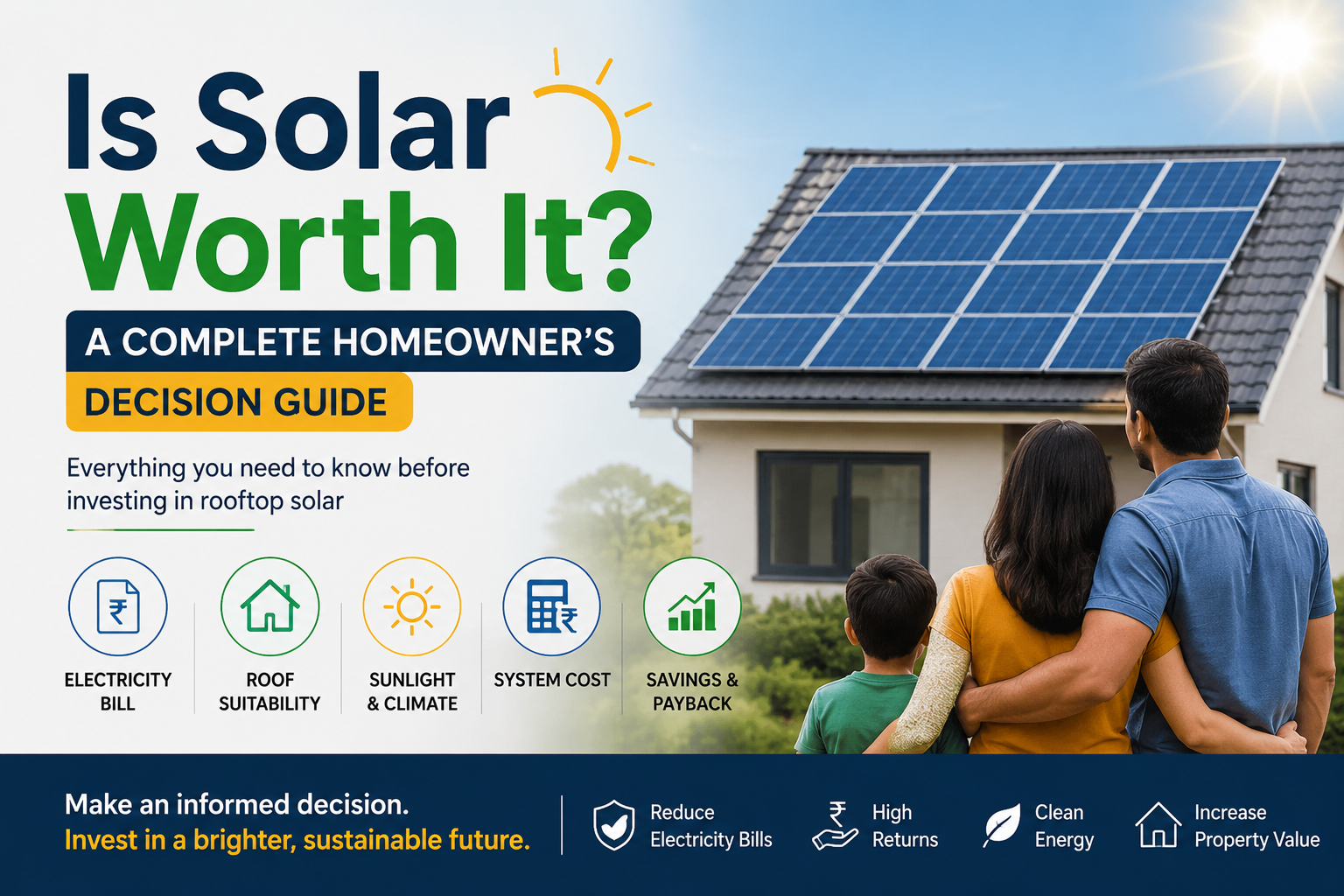
Is Solar Worth it? A Complete Homeowner’s Decision Guide
Are you planning to install on your rooftop? Then this guide will help you in making the decision. This guide will help you decide whether solar is the right investment decision for your home by evaluating the cost, savings, payback, roof suitability, and long-term saving.
Quick Decision Summary
Yes, a rooftop solar system is usually worth it if you/r:
- own a house
- electricity bill is moderate to high
- have sufficient shade-free rooftop area available
- roof receives an ample amount of sunlight
- plan to live in your home for several years
- have net metering or a similar export compensation policy available in your area.
- consume a significant portion of your electricity during the daytime.
And solar may not be worth it for a homeowner if:
- Heavy roof shading
- Very low electricity bill
- Planning to change the home
- Unsuitable roof
The following points will help in designing a Homeowner Decision Framework:
Is My Roof Suitable for Solar?
The roof suitability is the ability of your roof to safely, efficiently, and economically support the solar power system throughout its lifetime.
Before installing a solar power system, the first step is to determine whether your roof is suitable. A suitable roof can safely support the solar panels, receive adequate sunlight, and generate enough electricity to make the investment worthwhile.
While evaluating your roof for solar, the following points should be considered:
Good Structural Strength and Weather-Resistance
Your roof should be structurally strong enough to safely support the weight of the solar panels and mounting structure throughout the system’s expected life of 25 years or more.
It should also be in good condition and capable of withstanding local weather conditions, including strong winds, heavy rainfall, snowfall (where applicable), and prolonged exposure to sunlight.
The roof should be free of major structural damage or leaks, and proper drainage should be in place to prevent rainwater from accumulating around the solar installation.
Available shade-free area
Your roof should have sufficient shade-free space to accommodate the required number of solar panels. The usable roof area may be reduced by obstructions such as water tanks, skylights, chimneys, roof access doors, parapet walls, outdoor AC units, or other rooftop equipment.
In addition to providing enough space for the solar panels, the installation should also allow safe access for inspection, cleaning, maintenance, and future repairs.
A narrow clearance should be maintained around rooftop structures and access pathways so that both the solar system and existing rooftop equipment can be serviced without difficulty.
A well-planned layout not only improves safety and maintenance but also helps maximize energy generation while making efficient use of the available roof space.
Shade-free Sunlight
A rooftop solar system performs best when the panels receive ample direct sunlight throughout the day. Before installing solar, check whether nearby trees, buildings, water tanks, chimneys, mobile towers, or any other permanent or temporary obstructions shade your roof.
Even partial shading on a few panels can reduce the energy generated by the entire system.
Since solar panels are expected to generate electricity for 25 years or more, it is equally important to consider future shading.
For example, if there is an empty plot nearby that is likely to be developed into a multi-storey building, or if large trees are expected to grow significantly over time, these factors may affect the long-term performance of your solar system.
💡Practical Tip
One simple way to get a rough idea of your roof’s shading pattern is to take photographs from the same location on your roof at different times of the day—for example, around 10:00 AM, 1:00 PM, and 4:00 PM on a clear day. Comparing these photos will help you identify areas that remain shaded during different parts of the day.
💡Planning Ahead
If you expect future buildings or other structures to cast shadows on your roof, discuss this with your solar installer during the design stage. In some situations, using a higher mounting structure or adjusting the panel layout may help reduce future shading losses. However, the feasibility depends on structural, wind-load, and local installation requirements.
Roof Orientation
The ideal solar panel orientation depends on the roof type and the hemisphere in which your home is located.
Flat Roofs: On flat roofs, which are common in countries like India, the mounting structure is designed so that solar panels face south to get the maximum sunlight.
Sloped roofs: On pitched or sloped roofs, which are common in many countries such as the USA, Canada, Europe, and Australia, the roof’s orientation plays a more significant role because the panels are often installed parallel to the roof surface.
In the Northern Hemisphere, south-facing roofs generally receive the highest annual solar radiation, while in the Southern Hemisphere, north-facing roofs are usually preferred.
Even if your roof does not face the ideal direction, east-, west-, and many other orientations can still produce good results depending on local conditions, electricity usage patterns, and system design.
Roof Type
The type of roof determines how the solar panels are installed. Different roof types require different mounting systems to ensure a safe, durable, and waterproof installation.
- Concrete Flat Roof: The most common roof type in countries like India. Solar mounting structures are typically secured using reinforced concrete foundations.
- Metal Roof: Common in industrial buildings and many homes in countries such as the USA, Canada, and Australia. Solar mounting structures are generally fixed directly to the metal roof using specially designed clamps or brackets, bolts, and waterproof fasteners, depending on the roof profile.
- Tile Roof: Common in many parts of Europe, Australia, and the USA. Special roof hooks or brackets are installed beneath the tiles to support the mounting rails while minimizing damage to the roof.
The mounting method should always be selected according to the roof type to ensure long-term structural safety, weather resistance, and reliable system performance.
Upcoming posts
i) How to Check if Your Roof Is Suitable for Solar Panels.
ii) How Are Solar Panels Installed on Different Roof Types?
How much solar do I need?
Choosing the right solar system size is one of the most important decisions in the entire solar journey. An undersized system may not meet your electricity needs, while an oversized system can increase the initial investment without providing proportional financial benefits. Therefore, accurately estimating your energy consumption is the foundation of selecting the right solar system.
Step 1: Determine Your Average Electricity Consumption
The best way to estimate your energy requirement is to calculate your average monthly electricity consumption over the last 12 months.
Many homeowners estimate the solar system size using a single month’s electricity bill. However, this approach can be misleading because electricity consumption varies throughout the year due to seasonal changes, air conditioner usage, heaters, holidays, and occupancy.
Instead:
- Collect your last 12 months’ electricity bills.
- Add the monthly electricity consumption (kWh or units).
- Divide the total by 12 to obtain your average monthly consumption.
- Divide the average monthly consumption by 30 to estimate your average daily energy consumption.
This provides a much more reliable basis for sizing your solar system.
Step 2: Estimate the Solar System Size
Once you know your average daily electricity consumption, estimate the required solar system size by dividing it by the average daily energy generated by a 1 kW solar system in your location.
Example
Average daily electricity consumption = 19 kWh/day
Average daily generation from a 1 kW solar system = 4 kWh/day
Therefore,
Required system size
= 19 ÷ 4
≈ 4.75 kW
A 5kW solar system would generally be an appropriate choice.
Important
The actual energy generated by a 1 kW solar system depends on several factors, including:
- Location
- Solar radiation (PSH)
- Weather conditions
- Roof orientation
- Roof tilt
- System losses
- Panel efficiency
Therefore, the value of 4 kWh/day per kW should only be considered a general example, not a universal rule.
How much will solar cost?
The cost of a rooftop solar system is one of the most important factors in determining whether solar is a worthwhile investment. However, there is no single price that applies to every home. The total cost depends on your electricity requirements, the system size, equipment selection, roof characteristics, and local installation conditions.
A well-designed solar system should not simply be the cheapest option—it should provide the best balance between cost, performance, reliability, and long-term value.
What determines the cost?
The total project cost depends on several factors, including:
- Required system size (kW)
- Solar panel brand and technology
- Inverter type and brand
- Mounting structure
- Roof type and installation complexity
- Net metering requirements
- Electrical accessories and protection devices
- Labour and installation charges
- Local regulations and administrative costs
Where does your money go?
Understanding the approximate cost distribution helps homeowners compare quotations and identify unusually high or low pricing.
| Component | Approximate Share |
| Solar Panels | 50–55% |
| Inverter | 18–20% |
| Installation & Labour | 16–18% |
| Mounting Structure, Wiring, Protection Devices & Other Components | 8–15% |
Don’t Consider Only the Initial Cost
One of the biggest mistakes homeowners make is comparing only the initial installation price.
The true cost of owning a solar system includes:
- Initial installation
- Routine maintenance
- Inverter replacement (if applicable)
- Component repairs
- Cleaning (where required)
Evaluating the life-cycle cost rather than only the purchase price provides a much more realistic picture of the financial return from your investment.
The Average Cost
For example, in India, the installed cost of a typical residential grid-connected solar system generally falls within a broad range depending on system size, technology, location, and available subsidies.
Factors that influence the final price include:
- Government subsidies
- Solar panel technology
- Inverter selection
- Roof type
- Installation complexity
- Net-metering requirements
Personalized Cost Estimate
Every home is different.
For a personalized estimate of:
- System cost
- Maintenance cost
- Equipment replacement cost
- Lifetime project cost
- Levelized cost of electricity
- ROI
- Payback
Use:
Solar Feasibility Spreadsheet – India Edition
Solar Feasibility Spreadsheet – USA Edition
Decision Tip
If two installers quote ₹2.8 lakh and ₹3.5 lakh for the same 5 kW system, don’t choose the cheaper one immediately.
Compare:
- Panel brand
- Inverter brand
- Mounting structure
- Warranty
- Safety equipment
- Installation quality
- Service support
A lower price today may result in lower performance or higher maintenance costs later.
How much money will I save?
For most homeowners, the biggest benefit of installing rooftop solar is the long-term reduction in electricity bills. However, the amount you save depends on several technical and financial factors. Two homes with the same solar system size can achieve very different savings depending on how they use electricity and local electricity prices.
The Biggest Factors That Affect Your Savings
Your Electricity Consumption Pattern
The more solar electricity you consume directly during the daytime, the greater your savings because every unit of solar electricity replaces a unit purchased from the grid.
If a large portion of your solar electricity is exported to the grid, your financial savings depend on the applicable net-metering or feed-in tariff policy. In many locations, exported electricity may be compensated at a lower rate than the price you pay for imported grid electricity.
Decision Tip: Try to run high-energy appliances such as washing machines, dishwashers, or water pumps during sunny hours whenever practical.
Your Electricity Tariff
Generally, homeowners with higher electricity bills save more because they replace more expensive grid electricity with lower-cost solar electricity.
As electricity prices increase over time, the financial value of every unit generated by your solar system also increases, improving your long-term savings.
System Performance and Maintenance
A well-maintained solar system continues to generate electricity efficiently for many years.
Regular cleaning, performance monitoring, and prompt repair of faults help maximize energy generation and increase lifetime savings.
Ignoring maintenance may reduce energy production and lower your overall financial return.
System Design
Choosing the right system size, minimizing shading, and selecting quality components all influence the amount of electricity your system generates and, consequently, the money you save.
Every Home Is Different
Although average savings can provide a general idea, your actual savings depend on factors such as:
- Your electricity consumption
- Local electricity tariff
- Solar resource at your location
- System size
- Net-metering policy
- Maintenance practices
Therefore, the most reliable way to estimate your savings is through a personalized financial analysis rather than using national averages.
Calculate Your Personalized Savings
To estimate your lifetime savings based on your own electricity consumption and local conditions, use:
These tools estimate:
- Annual savings
- Lifetime savings
- ROI
- Payback period
- Cash flow
- Equipment replacement costs
Solar panels generate electricity, but homeowners save money only when that electricity creates financial value by replacing or offsetting grid electricity.
What is my Payback Period?
The payback period is the amount of time it takes for the savings from your solar system to recover your initial investment. It provides a quick and easy way to estimate how long it will take before your solar system has effectively “paid for itself.”
For example, suppose you install a 5kW rooftop solar system:
- Initial system cost (after subsidy): ₹2,40,000
- Average daily generation: 20 kWh
- Grid electricity price: ₹7 per kWh
Step 1: Calculate Daily Savings
20 × ₹7 = ₹140 per day
Step 2: Calculate Annual Savings
₹140 × 365 ≈ ₹51,100 per year
Step 3: Calculate Payback
Payback Period = Initial Investment ÷ Annual Savings
₹2,40,000 ÷ ₹51,100 ≈ 4.7 years
So, the system would recover its initial investment in approximately 5 years.
What affects the payback period?
The payback period is not fixed. It depends on several factors.
1. Initial System Cost
A higher installation cost generally increases the payback period, while government subsidies or competitive pricing can shorten it.
2. Electricity Tariff
The higher the price of grid electricity, the greater the value of every unit generated by your solar system. Rising electricity prices can therefore improve the financial return over time.
3. Annual Energy Generation
A well-designed system with good sunlight exposure and minimal shading generates more electricity, increasing annual savings and reducing the payback period.
4. Electricity Consumption Pattern
Homes that consume a larger share of their solar electricity during the daytime typically achieve higher savings, which can shorten the payback period.
5. Financing Method
If the system is purchased through a loan, interest payments increase the overall project cost, which may extend the time required to recover the investment.
6. Maintenance and System Performance
Regular cleaning, performance monitoring, and timely repairs help maintain energy production and protect long-term savings.
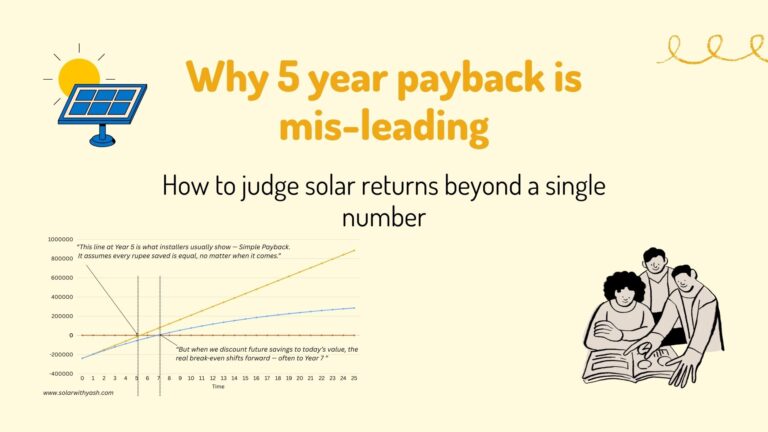
A Limitation of the Simple Payback Period
Although the payback period is easy to understand, it has an important limitation.
It does not consider the time value of money. In other words, it treats ₹1 saved today as being equal to ₹1 saved ten years from now. It also ignores factors such as future electricity price increases, inflation, equipment replacement costs, financing costs, and changes in system performance over time.
Therefore, the payback period should be viewed as a quick screening tool, not a complete financial evaluation.
Want a more accurate financial analysis?
“If you want to go beyond the simple payback period and evaluate your investment using discounted cash flow methods (which account for the time value of money), use the Solar Feasibility Spreadsheet…”
These tools provide a more comprehensive financial analysis than the simple payback method.
Payback is an important metric, but it should not be the only factor in your decision. Two systems may have the same payback period but deliver very different lifetime savings, cash flows, or investment returns.
Which solar panels should I buy?
Choosing the right solar panels is one of the most important decisions in a rooftop solar system. Solar panels are responsible for converting sunlight into electricity and typically account for more than half of the total project cost. Since they are expected to operate for 25 years or more, selecting the right panels requires looking beyond just efficiency or the latest technology.
The best solar panel is not necessarily the most expensive or the newest—it is the one that best matches your climate, budget, performance expectations, and long-term reliability.
Factors to Consider
1. Brand Reliability
Choose a manufacturer with a strong market reputation, proven product quality, and a history of honoring warranties. Since solar panels are expected to last 25–30 years, long-term company stability is an important consideration.
2. Product and Performance Warranties
Compare both:
- Product Warranty
- Performance Warranty
A longer warranty from a reliable manufacturer provides greater confidence in the long-term performance of your investment.
3. Your Local Climate
Climate plays a significant role in panel selection.
Homeowners living in hot climates may benefit from panels with a better temperature coefficient of power, as these panels lose less power at higher operating temperatures.
In cooler climates, the performance difference between different panel technologies is often much smaller.
4. Technology Is Not Everything
Many homeowners assume that the newest technology is automatically the best choice.
That is not always true.
For example:
For example, a homeowner in Shimla, where temperatures remain relatively moderate, may see only a small performance advantage from solar panels with a lower (better) temperature coefficient compared to panels with a moderate temperature coefficient. In such cases, paying a premium for panels with a better temperature coefficient may not provide a meaningful financial return.
On the other hand, in hot regions such as Jaipur, where solar panels operate at higher temperatures for much of the year, panels with a better temperature coefficient may deliver higher energy generation over their lifetime, potentially offering greater long-term value.
5. Budget and Return on Investment
The most efficient panel is not always the most economical.
If a lower-cost panel provides similar lifetime financial returns under your local conditions, it may be the better investment.
Always evaluate the additional cost against the expected improvement in energy generation and financial savings.
Decision Summary
The best solar panel for your home depends on:
- Your local climate
- Your budget
- Your electricity requirements
- Long-term reliability
- Warranty support
- Expected financial return
Therefore, the best solar panel is not necessarily the one with the latest technology or the highest efficiency. Instead, the right choice depends on balancing performance, local climate, and cost to achieve the best long-term value for your investment.
Upcoming next Guide: TOPCon vs HJT vs Mono PERC: Which Technology Is Best for Your Home?
Which Inverter should I buy?
The inverter is the control center of a rooftop solar system. While solar panels generate direct current (DC) electricity, most household appliances operate on alternating current (AC). The inverter performs this conversion, allowing your home to use the electricity generated by your solar panels safely and efficiently.
Choosing the right inverter is therefore just as important as selecting the right solar panels.
1. Choose the Right Type of Inverter
The first decision is selecting the inverter that best matches your electricity needs.
Grid-Tied Inverter
A grid-tied inverter is the most common choice for residential rooftop solar systems.
It is suitable if:
- Your area has a reliable electricity supply.
- You do not require battery backup.
- Your primary objective is to reduce your electricity bill.
A grid-tied inverter automatically shuts down during a power outage for safety reasons. Therefore, your solar system will not power your home during a blackout, even if the sun is shining.
Hybrid Inverter
A hybrid inverter is designed to work with both solar panels and battery storage.
It is a better choice if:
- Your area experiences frequent power outages.
- You want backup power during grid failures.
- You plan to install batteries now or in the future.
During a power outage, the hybrid inverter disconnects from the utility grid and supplies electricity from the battery to selected household loads, allowing essential appliances to continue operating.
Planning for future battery storage? Installing a hybrid inverter at the beginning is often more economical than replacing a grid-tied inverter later.
2. Choose the Correct Phase
The inverter should match your home’s electrical connection.
- Single-phase connection → Single-phase inverter
- Three-phase connection → Three-phase inverter
Selecting the correct phase ensures compatibility with your electrical system and utility requirements.
4. Think About Future Expansion
Before purchasing an inverter, consider not only your current needs but also your plans.
For example:
- Will you add battery storage later?
- Do you expect your electricity consumption to increase?
- Are you planning to install an electric vehicle charger in the future?
Choosing an inverter that supports future expansion can save significant upgrade costs later.
5. Warranty and After-Sales Service
A solar inverter is expected to operate reliably for many years, but like any electronic equipment, it may require servicing or replacement during its lifetime. Therefore, don’t choose an inverter based only on price or features.
Before making your decision, consider:
- Product warranty offered by the manufacturer.
- Availability of local service centres and technical support.
- Brand reputation and track record in the market.
- Availability of spare parts and software updates, if required.
- Responsiveness of after-sales service in case of faults or warranty claims.
A slightly higher-priced inverter from a reputable brand with strong after-sales support may provide better long-term value than a cheaper product with limited service availability.
Decision Summary
The best inverter for your home depends on:
- Grid reliability in your area
- Whether you need battery backup
- Your electrical connection (single-phase or three-phase)
- Local climate and system design
- Your future energy plans
- Warranty and after-sales service.
- Long-term reliability and support.
There is no single “best” inverter for every homeowner.
Do you need a battery?
Not every homeowner needs a battery.
If your area has a reliable electricity supply and your primary goal is to reduce your electricity bill, a grid-tied solar system without a battery is often the most economical choice.
However, if your home experiences frequent power outages or you require backup power for essential appliances, installing a battery-compatible hybrid inverter allows you to add battery storage either now or in the future.
Want to know if a battery is worth the additional investment?
Read our upcoming guide: Should I Install a Solar Battery?
What Factors Decide Whether Solar Is Worth It?
Whether rooftop solar is a worthwhile investment depends on several technical, financial, and personal factors. The more of the following conditions that apply to your home, the more likely solar is to provide significant long-term benefits.
Solar is generally worth considering if:
✅ Your roof receives ample shade-free sunlight throughout the day.
Solar panels perform best when they receive unobstructed sunlight for most of the day.
✅ You have sufficient roof space for the required solar system.
The available roof area should comfortably accommodate the number of panels needed to meet your energy requirements.
✅ Your electricity bill is moderate to high.
Homes with higher electricity bills generally achieve greater financial savings because more expensive grid electricity is replaced with solar power.
✅ You consume a significant portion of your electricity during the daytime.
Using solar electricity as it is generated usually provides greater financial savings than exporting large amounts of electricity to the grid, especially where export compensation is lower than the retail electricity tariff.
✅ You plan to stay in your home for several years.
Since rooftop solar is a long-term investment, homeowners who expect to remain in the same property are more likely to recover their investment and enjoy years of reduced electricity bills.
✅ Your roof is in good structural condition.
A roof expected to last for many years reduces the likelihood of costly panel removal and reinstallation for repairs.
✅ You want to reduce your dependence on grid electricity.
Besides lowering electricity bills, solar can provide greater energy independence and protection against rising electricity prices.
✅ Your local solar resource is good.
Homes located in regions with higher solar radiation generally produce more electricity, improving both savings and investment returns.
✅ You are looking for a long-term investment rather than immediate profits.
Rooftop solar is an infrastructure investment. Its value comes from generating electricity and reducing electricity bills over many years, rather than delivering quick financial returns.
Solar May Be Less Suitable If:
- Your roof is heavily shaded for most of the day.
- Your electricity consumption is very low.
- Your roof has very limited usable space.
- You plan to move to another home in the near future.
- The installation cost is significantly higher than average.
Final Thought
There is no universal answer to whether solar is worth it.
The right decision depends on your roof, your electricity consumption, your local climate, your electricity tariff, your budget, and your long-term goals.
A personalized technical and financial analysis is the most reliable way to determine whether rooftop solar is the right investment for your home.
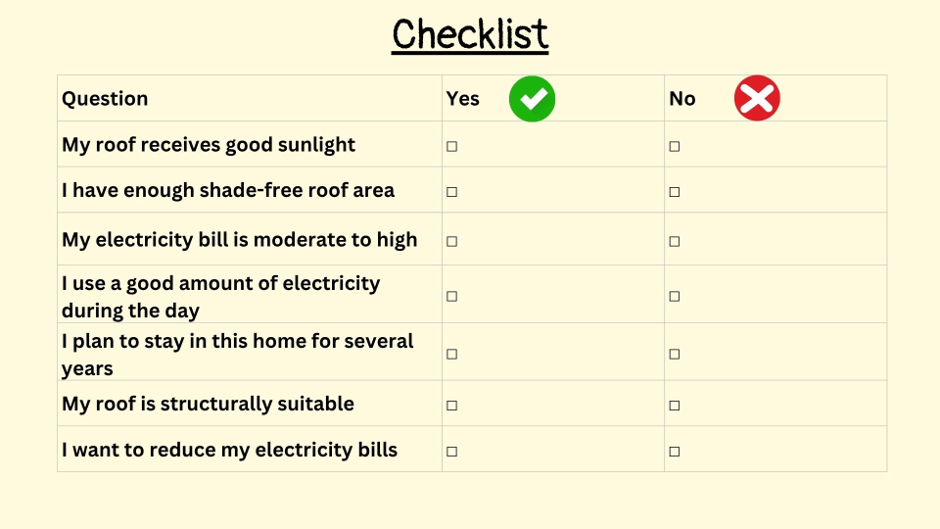
Solar Worthiness Checklist:
If your score is:
- 6–7 Yes: Solar is likely to be a strong investment for your home.
- 4–5 Yes: Solar may still be worthwhile, but a detailed technical and financial assessment is recommended.
- 0–3 Yes: Solar may not currently be the best option, or additional evaluation is needed.
🧮 Solar Decision Tools
If you’ve gone through this guide and answered the Solar Worthiness Checklist, the next step is to evaluate your home using real technical and financial data.
Our Solar Feasibility Spreadsheet (SFS) helps you make a personalized solar decision based on your own location, electricity consumption, and financial assumptions.
🇮🇳 SFS – India Edition
Designed specifically for Indian homeowners, it provides:
- ✓ District-wise solar resource (PSH) database
- ✓ Optimum solar system sizing
- ✓ System cost estimation
- ✓ Annual and lifetime electricity generation
- ✓ Annual and lifetime savings
- ✓ Payback period
- ✓ ROI and discounted financial analysis
- ✓ Equipment replacement and maintenance costs
- ✓ Cash flow analysis
→ Find out whether solar is worth it for your home in India.
🇺🇸 SFS – USA Edition
Designed specifically for homeowners in the United States, it includes:
- ✓ County-wise solar resource database
- ✓ Personalized solar system sizing
- ✓ System cost estimation
- ✓ Annual and lifetime electricity generation
- ✓ Annual and lifetime savings
- ✓ Payback period
- ✓ ROI and discounted financial analysis
- ✓ Equipment replacement and maintenance costs
- ✓ Cash flow analysis
→ Make an informed solar investment decision for your home in the USA.
Final Thought
This guide explains how to evaluate whether solar is worth it. However, every home is different. The most reliable decision comes from analyzing your own roof, electricity consumption, local solar resource, and financial situation.
Use the Solar Feasibility Spreadsheet to make a data-driven decision before investing in rooftop solar.
Common Mistakes That Can Reduce Your Solar ROI
❌ Choosing the cheapest quotation without comparing quality
A lower upfront price may come at the cost of lower-quality components, poor workmanship, or inadequate after-sales support.
❌ Choosing the wrong system size
An undersized system may not meet your electricity needs, while an oversized system may increase the initial investment without delivering proportional financial benefits.
❌ Selecting products based only on the latest technology
The newest technology is not always the best choice. The right equipment depends on your climate, budget, and expected financial return.
❌ Ignoring roof suitability
Installing solar on a shaded or structurally unsuitable roof can significantly reduce system performance and increase future maintenance costs.
❌ Looking only at the initial installation cost
Always consider maintenance, equipment replacement, warranty, and lifetime ownership costs—not just the purchase price.
❌ Ignoring future energy needs
Think ahead. If you plan to buy an electric vehicle, install air conditioners, or add battery storage later, your solar system should be designed with future expansion in mind.
❌ Expecting identical results to your neighbour
Solar performance depends on your roof orientation, shading, electricity consumption, tariff, and local solar resource. Every home is unique.
Continue Your Home Energy Decision Journey
- Solar ROI & Payback in Different States
- Savings, ROI & Payback
- System Size & Design
- Equipment Selection
Conclusion
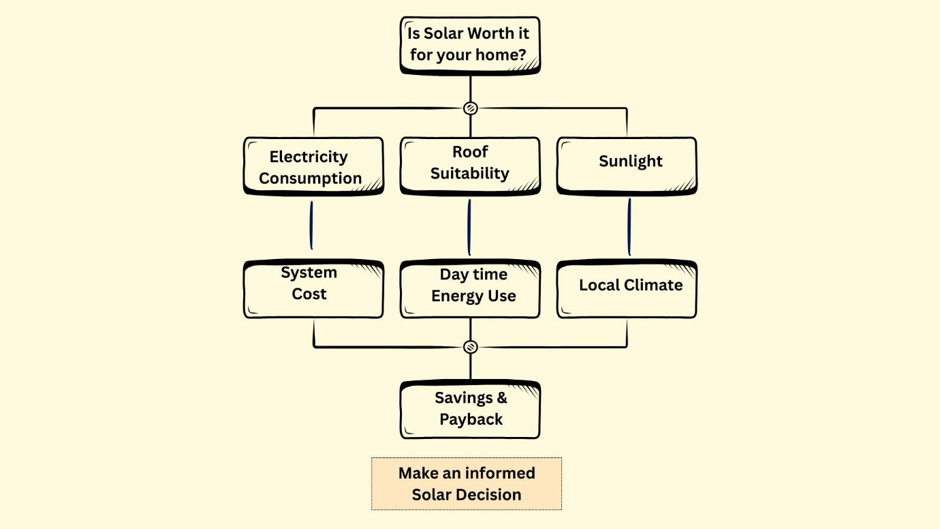
Before investing in rooftop solar, assess your home’s solar potential, current and future energy needs, affordability, local climatic conditions, and expected return on investment (ROI). A thoughtful evaluation of these factors will help you choose the right solar system, maximize long-term savings, and make a confident, data-driven energy decision.
FAQ
1. Is solar worth it with a ₹2,000 monthly electricity bill?
It may be. A ₹2,000 monthly bill alone is not enough to determine whether solar is worthwhile. Your electricity consumption, roof suitability, local solar resource, and financial goals should all be evaluated before making a decision.
2. Will solar work during a power cut?
A standard grid-tied solar system automatically shuts down during a power cut for safety. To use solar power during outages, you need a hybrid solar system with battery storage.
3. How long do solar panels last?
Most solar panels have a lifespan of 25–30 years and continue generating electricity beyond this period with gradual performance degradation.
4. What happens on cloudy days?
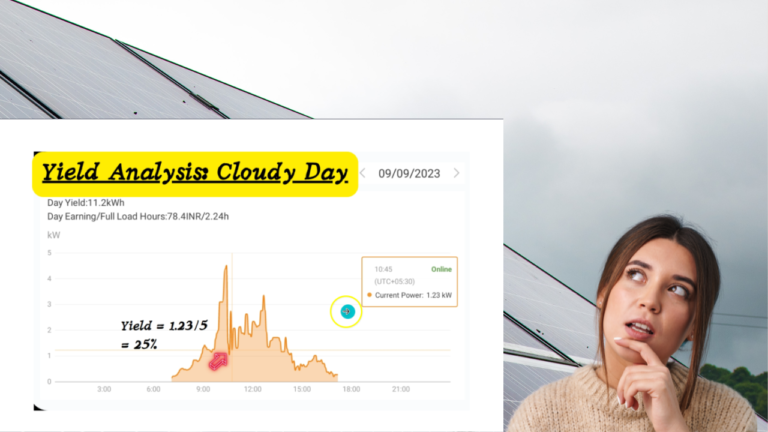
Solar panels continue to generate electricity on cloudy days, but at a lower output than on clear sunny days.
5. Can I install solar on a flat roof?
Yes. Solar panels can be installed on flat roofs using mounting structures that provide the appropriate tilt angle for efficient energy generation.
6. How much maintenance does rooftop solar require?
Rooftop solar systems require very little maintenance. Regular cleaning and periodic inspections are usually sufficient to maintain good performance.
7. Can I expand my solar system later?
Yes, in many cases. Expansion depends on the available roof space, inverter capacity, and local regulations.
8. How long does installation take?
Most residential rooftop solar systems are installed and commissioned within a week, depending on the system size, site conditions, and required approvals.
9. Is a battery compulsory?
No. A battery is optional and is generally recommended only if you need backup power during electricity outages or want to store excess solar energy.
10. Is rooftop solar safe?
Yes. A professionally designed and properly installed rooftop solar system is safe, reliable, and designed to meet applicable electrical and safety standards.
11. Will solar eliminate my electricity bill?
Not necessarily. Your savings depend on your system size, electricity consumption, local solar resource, and applicable net-metering or export compensation policies.
12. Does solar increase property value?
In many cases, yes. A well-designed rooftop solar system can make a home more attractive to buyers by reducing future electricity costs.
13. What is the ideal roof for rooftop solar?
A roof with ample shade-free space, good structural condition, and adequate sunlight throughout the day is generally the most suitable for solar installation.
14. Can I install solar if my roof is partially shaded?
Yes, but shading can reduce electricity generation. A professional site assessment can determine the impact and recommend the most suitable system design.
15. How do I know if solar is worth it for my home?
The best way is to evaluate your solar potential, energy needs, affordability, local climate, and expected return on investment (ROI) using a personalized technical and financial assessment.