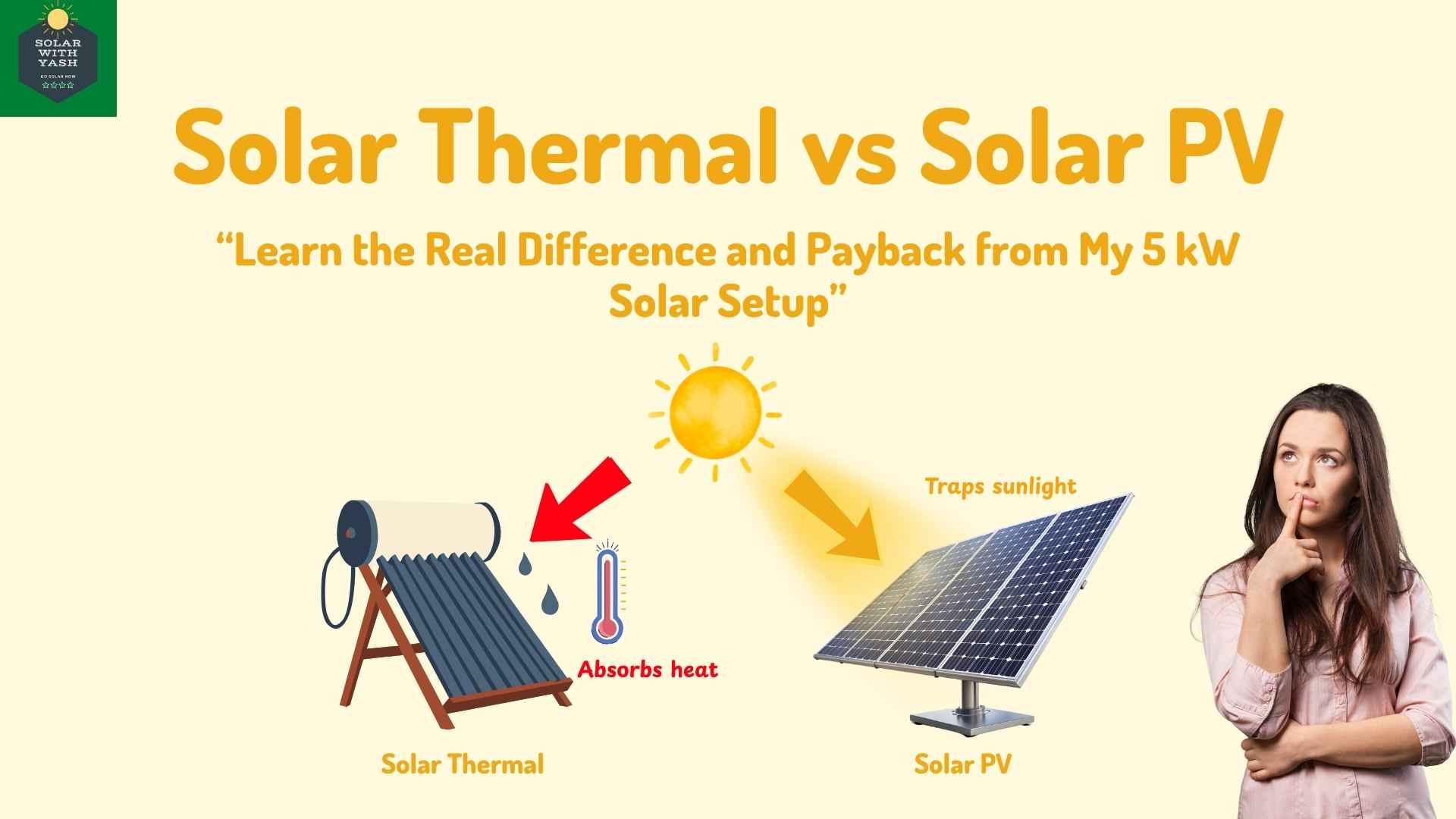
Solar Thermal vs Solar PV: Which is Better for Homes in India?
Over the years, I’ve been asked one question more than any other by homeowners and students alike —
“Yash, solar panels toh sab ek jaise hi hote hain na?”
Actually, not quite. There are two main types of solar technologies — Solar Thermal and Solar Photovoltaic (PV) — and while both harness sunlight, they do it in entirely different ways. One captures the sun’s heat, the other converts sunlight into electricity.
Knowing this difference matters before you invest in solar because it affects everything — from cost and performance to savings and purpose.
In India, where sunlight is abundant and power bills keep rising, understanding how to choose the right system can literally change how your home consumes energy.
In this post, I’ll break it down for you in the simplest way possible. You’ll learn how both systems work, where each one excels, and I’ll also share real insights from my own 5 kW grid-tied solar installation (set up in August 2023 in Uttar Pradesh) — including its cost, savings, and performance so far.
To make it even clearer, I’ve added simple diagrams and real-world comparisons throughout this article so you can visualize the differences easily.
Let’s begin.
What is Solar Thermal Energy?
Think of solar thermal as nature’s own water heater.
Instead of producing electricity, it captures heat energy directly from the sun using collectors — either flat-plate or evacuated tube types. These collectors absorb sunlight and transfer heat to a circulating fluid, which then warms up water stored in an insulated tank.
During our college days, one of my friend’s fathers installed a solar water heater at their home. I still remember being fascinated to see it providing piping hot water even on slightly cloudy days. That experience made me realize how thoughtfully we can harness the sun’s energy for our everyday needs — clean, free, and endlessly available.
Solar thermal systems are simple, reliable, and last for years with minimal care. They’re especially effective in sunny states like Karnataka, Gujarat, and Rajasthan, where sunlight is strong and consistent.
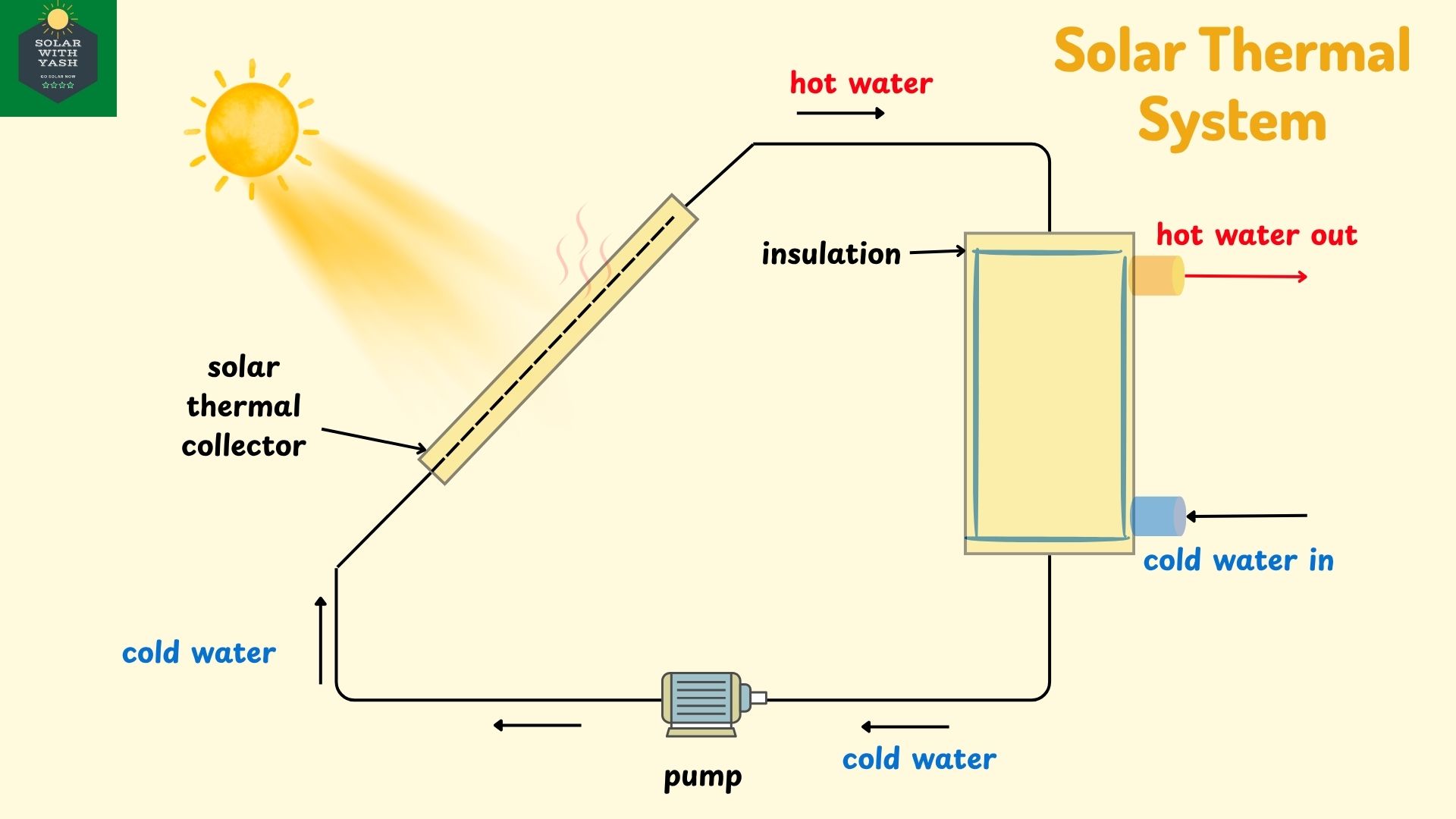
If your primary need is hot water, whether for bathing, cleaning, or space heating, a solar thermal system is one of the most cost-effective ways to tap into the power of the sun.
What is Solar PV Energy?
Now let’s come to the technology that’s transforming rooftops across India — Solar PV (Photovoltaic).
PV systems convert sunlight directly into electricity using semiconductor materials (mainly silicon). When sunlight hits these cells, electrons get energized, producing an electric current — a phenomenon known as the photovoltaic effect. I installed my own 5 kW grid-tied solar PV system on August 22, 2023, at my home in Uttar Pradesh.
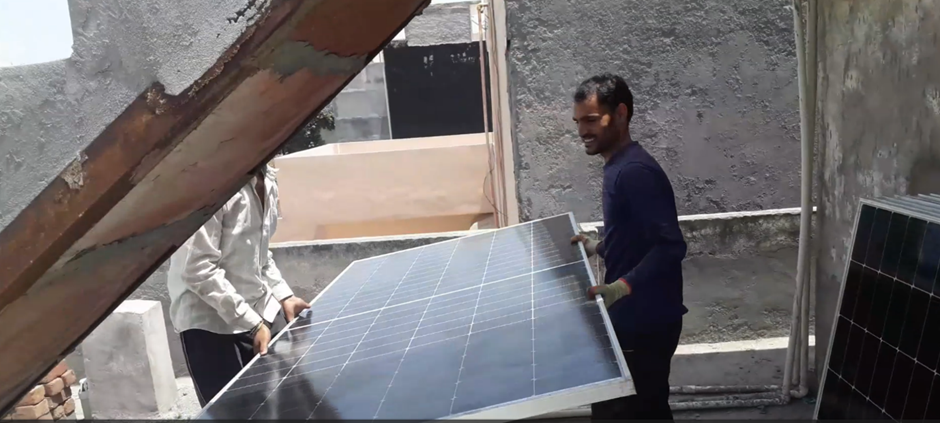
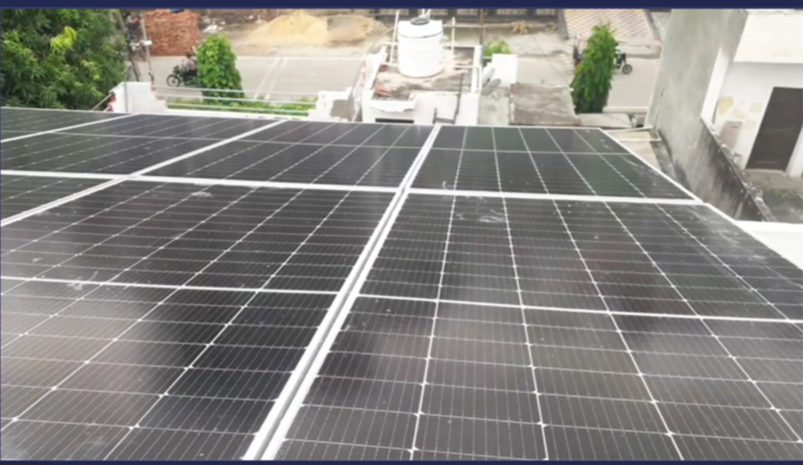
It cost around ₹2.4 lakhs after subsidy, and in just over a year, it has already saved me ₹1.15 lakh on my electricity bills. The expected payback period is about 4–5 years, after which it’s nearly free electricity for the next two decades or more. My setup uses MonoPERC half-cut solar panels with about 21% efficiency. These panels are engineered to reduce heating losses — their split-cell design lowers internal resistance, maintaining stable output even on hot days.
Yes, solar panels generally lose a little efficiency in extreme heat, but in India, the strong sunlight intensity often compensates for that, keeping overall generation strong throughout the year.

If your average monthly bill is above ₹3,000, I can confidently say — go for solar PV. It’s one of the smartest investments for long-term savings and sustainability.
Solar Thermal vs Solar PV: How they work?
Both systems start with sunlight, but what happens afterward is entirely different.
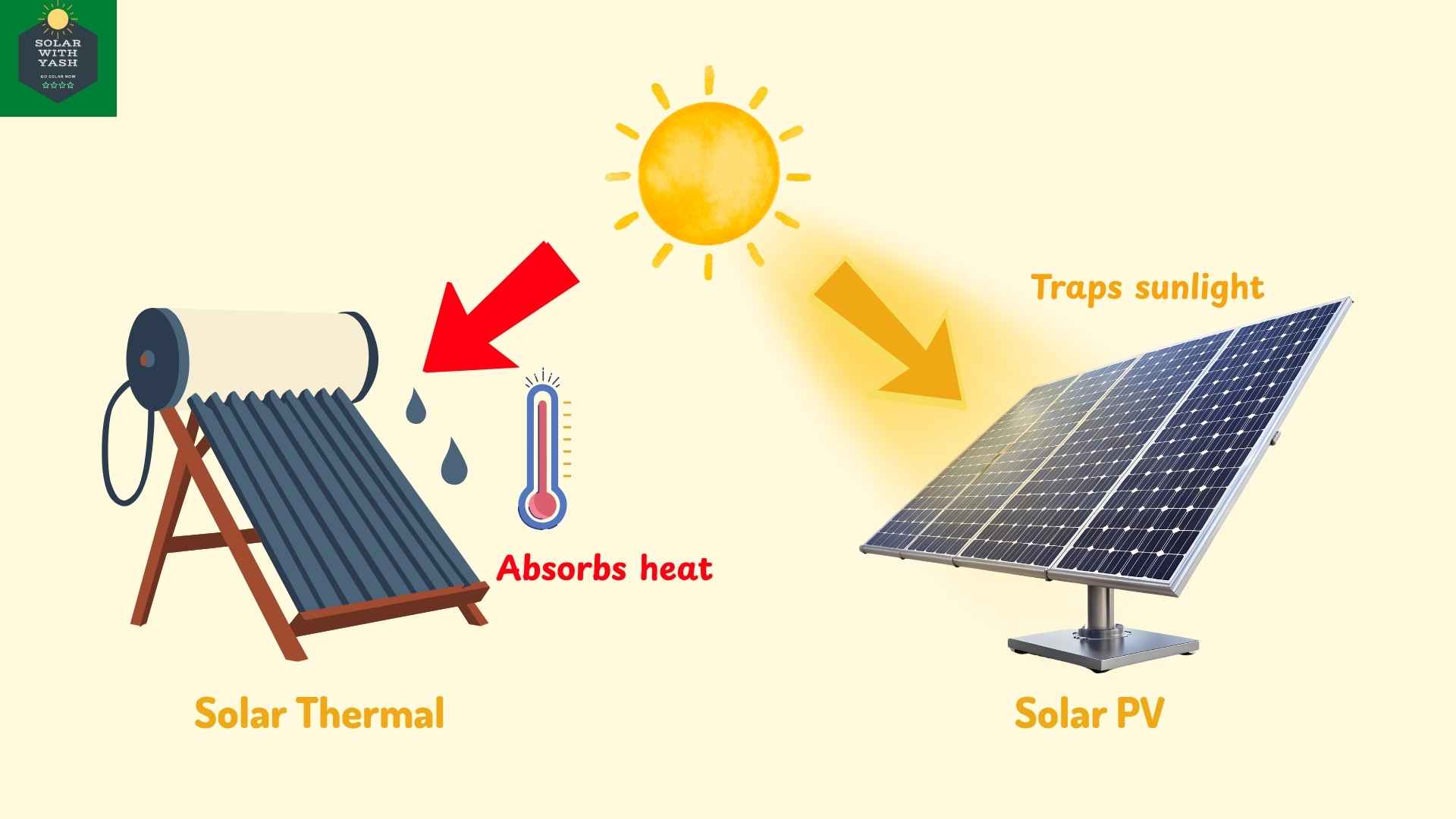
In Solar Thermal System:
- Sunlight is absorbed by collectors.
- The absorbed heat warms a circulating fluid (usually water or glycol).
- The heated fluid transfers its energy to a storage tank.
- The stored hot water is then ready for use.
In Solar PV System:
- Sunlight hits semiconductor cells inside the solar panels.
- This excites electrons and generates DC electricity.
- The DC power flows to an inverter, converting it into AC electricity.
- The AC power runs your home or feeds into the grid.
From my own data, I’ve noticed that PV generation dips slightly on cloudy days, while solar thermal systems maintain steadier performance since they depend on sunlight intensity more than brightness.
Both are efficient in their own way — one provides heat, the other electricity.
Applications (Domestic, Industrial, Utility)
Both technologies are incredibly versatile but serve different purposes.
At the household level, solar thermal systems are perfect for heating water in homes, hostels, hotels, and hospitals. A 100–200 LPD system can easily meet daily needs and significantly cut down on electricity or LPG consumption.
Solar PV, on the other hand, powers homes, offices, and small businesses. My 5kW system comfortably supports our lighting, fans, and major appliances. Through net metering, I even export surplus energy and receive bill credits — a policy that works wonderfully in Uttar Pradesh.
In industries, solar thermal systems are used for process heating in dairies, textiles, and food processing plants. Meanwhile, PV systems power industrial rooftops, cold storage, and data centers.
At the utility scale, large PV farms feed clean power into national grids, while CSP (Concentrated Solar Power) plants use mirrors to focus sunlight for high-temperature steam generation.
In many modern systems, both technologies now work together — combining heat and power to maximize output.
Efficiency Comparison
Efficiency is often misunderstood. Solar Thermal systems convert 60–80% of sunlight into heat, while Solar PV systems convert 18–23% into electricity.
However, electricity is far more versatile — you can use it anytime, store it in batteries, or export it to the grid.
In my case, with 21% efficient Mono-PERC half-cut panels, I’ve been pleasantly surprised by how stable performance remains even during India’s hot months.
The half-cut design reduces internal heating, and the high solar irradiance in Uttar Pradesh actually overshadows minor temperature-related efficiency drops.
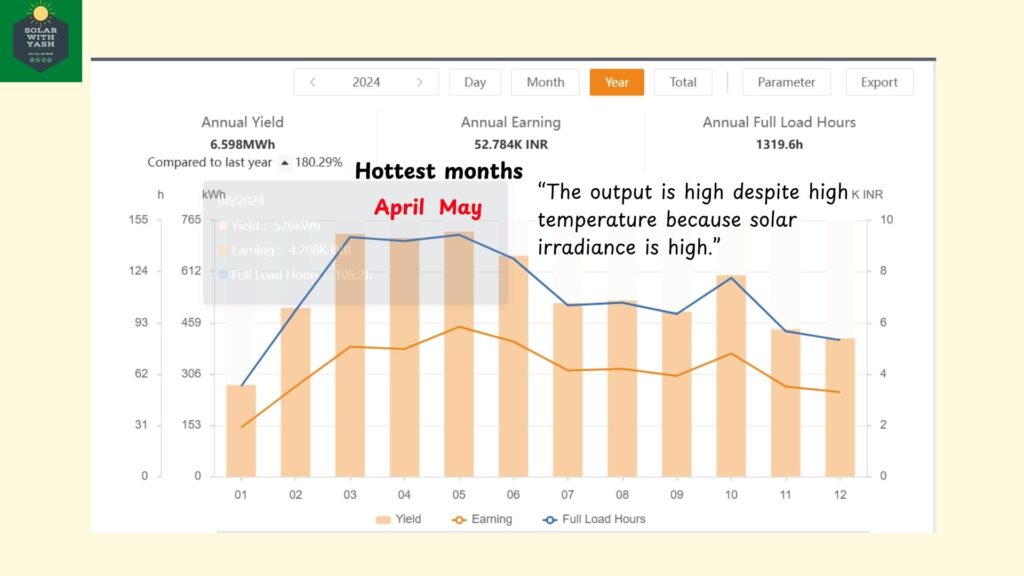
So, while thermal wins in raw efficiency numbers, PV wins in practical, year-round performance and financial benefit — especially for homeowners focused on electricity savings.
Cost and Maintenance
Let’s talk about money and maintenance — the two factors every homeowner cares about.
A solar water heater (100–200 LPD) typically costs between ₹25,000 and ₹50,000 and lasts well over 15 years with very little upkeep — mainly cleaning the collectors and checking water flow. In contrast, my 5kW solar PV system, which cost ₹2.4 lakh after subsidy, started saving from day one. In just a year, it’s already recovered almost half its cost — ₹1.15 lakh in savings so far.
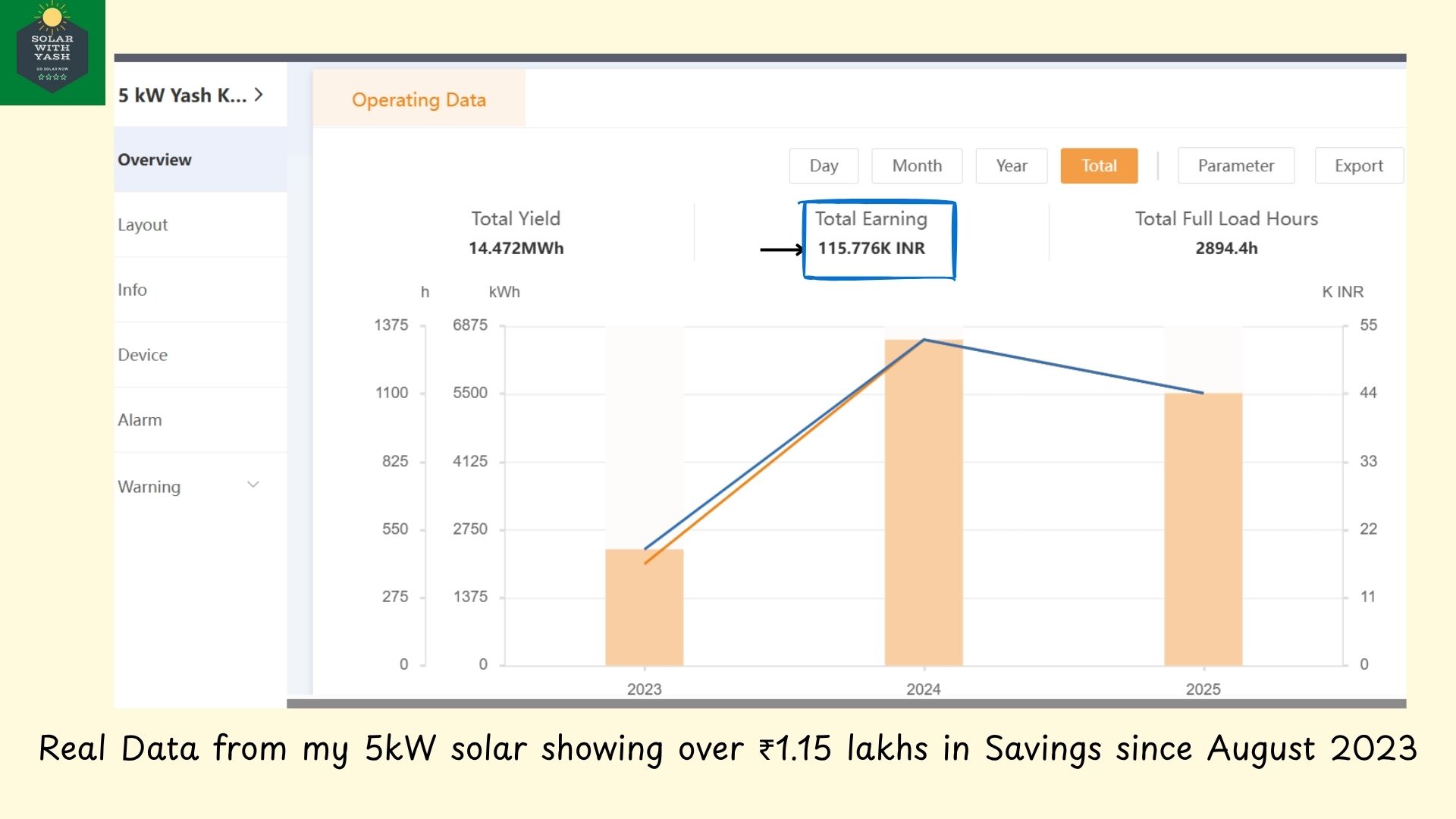
Maintenance? Extremely low. I clean my panels every 10–15 days and occasionally check the inverter.
Here’s what I recommend to anyone installing solar PV:
- Size your system correctly according to energy use.
- Choose an experienced, certified installer.
- Keep your rooftop shade-free.
Use high-quality components — panels, inverter, wiring, and structure.
📊 Your rooftop pays you back:
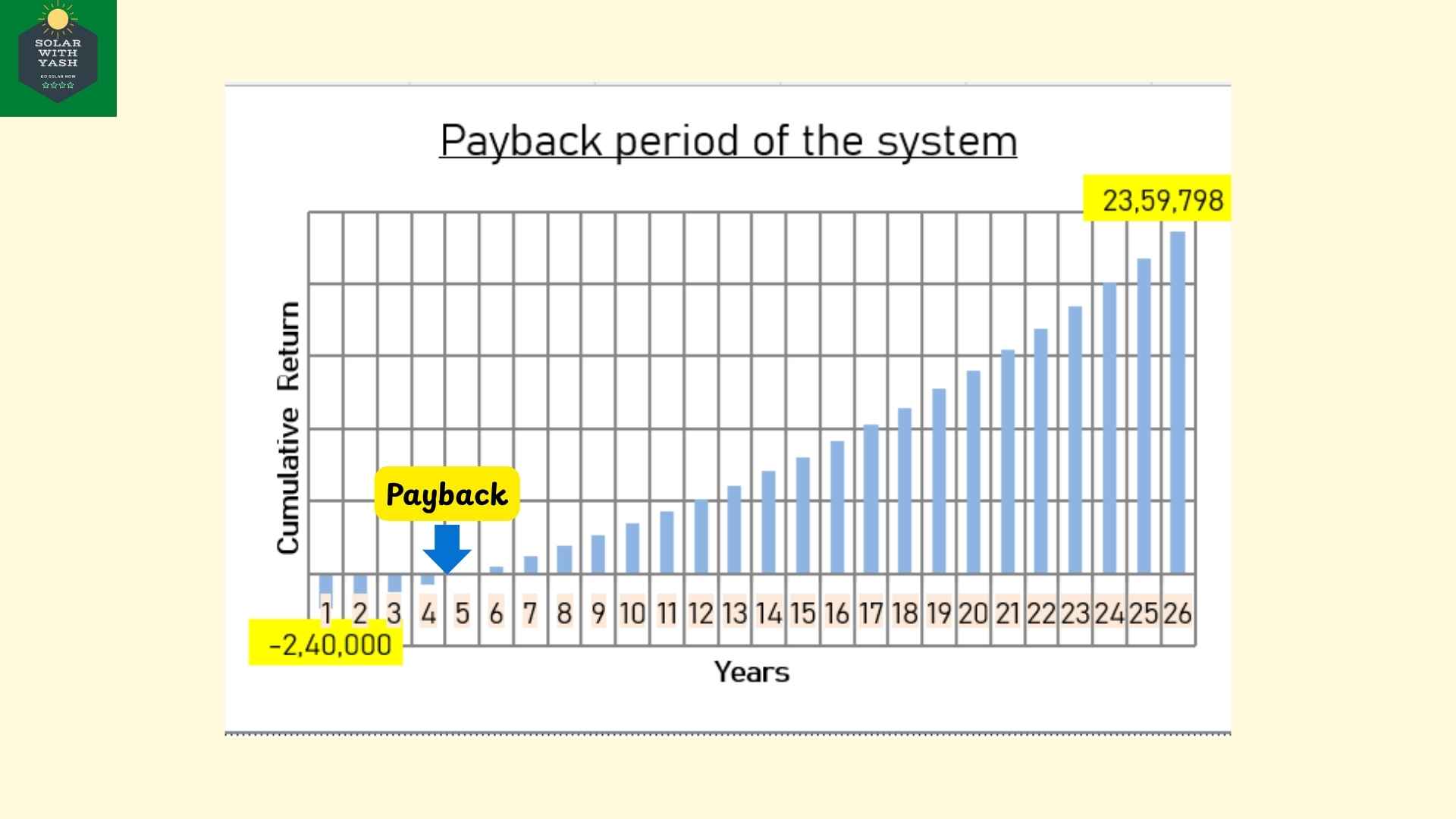
A timeline chart showing ₹2.4 lakh investment (Year 0), savings each year, and break-even in 4–5 years, followed by 20+ years of free electricity.
If these basics are followed, a good PV system can easily deliver reliable energy for 25+ years.
Which is Better for Homes in India?
If your goal is to save on electricity bills, Solar PV is your clear winner.
It directly offsets grid power, gives you billing credits, and pays for itself in just a few years.
However, if your household uses a lot of hot water — especially in colder or hilly areas — solar thermal remains unbeatable in efficiency and simplicity.
The smartest approach? Use both.
Many homeowners, including several I’ve guided, have installed solar PV for electricity and solar thermal for hot water, achieving near-complete solar independence.
From my experience, my PV setup meets nearly 80–90% of my home’s annual electricity needs, and if I add a thermal system, it would handle our entire hot-water load too.
“If your electricity bill crosses ₹3,000 per month, start with solar PV. Add a solar water heater later for comfort and total energy independence.”
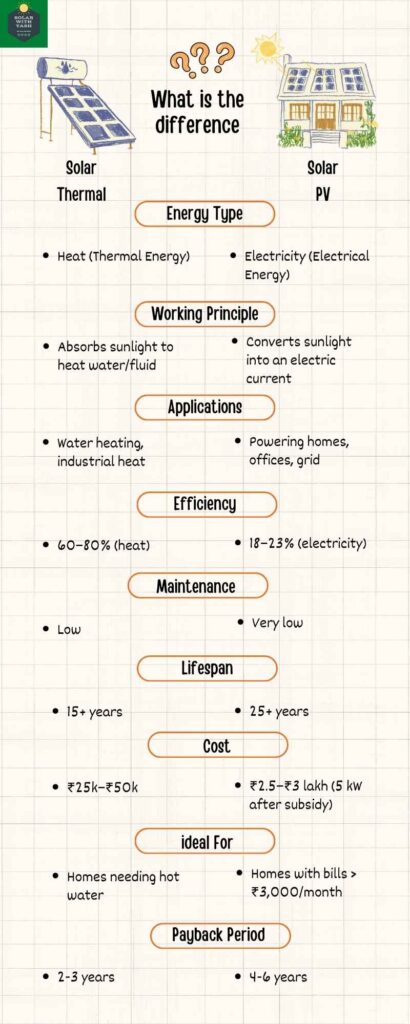
Key Differences at Glance
| Parameter | Solar Thermal | Solar PV |
|---|---|---|
| Energy Type | Heat (Thermal Energy) | Electricity (Electrical Energy) |
| Working Principle | Absorbs sunlight to heat water/fluid | Converts sunlight into an electric current |
| Applications | Water heating, industrial heat | Powering homes, offices, grid |
| Efficiency | 60–80% (heat) | 18–23% (electricity) |
| Maintenance | Low | Very low |
| Lifespan | 15+ years | 25+ years |
| Cost (Home System) | ₹25k–₹50k | ₹2.5–₹3 lakh (5 kW after subsidy) |
| Ideal For | Homes needing hot water | Homes with bills > ₹3,000/month |
| Payback Period | 2–3 years | 4–5 years |
Future Outlook
The future of solar energy in India looks incredibly bright.
Solar PV continues to evolve rapidly with bifacial panels, perovskite cells, and smart microinverters that make systems more efficient and intelligent.
Meanwhile, solar thermal is making a comeback in industrial heating, cooling, and desalination.
New hybrid PV-T systems are combining both technologies — generating heat and electricity together, improving total efficiency by up to 40%.
From my own journey with solar, I can confidently say: the reliability, monitoring tools, and quality of systems available today are far superior to what existed even five years ago.
With India’s Net Zero by 2070 mission, both PV and thermal will be vital — PV powering homes and industries, thermal supporting heat-intensive processes.
Soon, every rooftop will double as a micro power plant — saving money, generating clean energy, and contributing to a sustainable nation.
Conclusion
To sum it up — both Solar Thermal and Solar PV help us harness the same sunlight, but they serve different needs.
Solar Thermal provides heat; Solar PV produces electricity.
For most Indian households, grid-tied solar PV is the best starting point. It reduces bills, increases property value, and offers true energy freedom.
From my own experience with a 5 kW, 21% efficient Mono-PERC half-cut solar system, I can confidently say — solar works beautifully in India when designed and installed thoughtfully.
If you’re planning to go solar, don’t rely on guesswork — use real data.
👉 Try my Solar Feasibility Sheet (SFS) at SolarWithYash.com.
It helps you size your system, estimate payback, and calculate ROI in minutes.
Harness the sunlight not just to power your home — but to power your savings, confidence, and a cleaner planet.
FAQ: Solar Thermal vs Solar PV
1. What is the main difference between Solar Thermal and Solar PV?
Solar Thermal uses sunlight to produce heat for water or space heating, while Solar PV converts sunlight directly into electricity to power appliances.
2. Which system is better for homes in India?
For most homes, Solar PV is better because it reduces electricity bills and provides long-term savings. Solar Thermal is ideal if you mainly need hot water.
3. How efficient are solar PV panels compared to solar thermal systems?
Solar PV panels convert about 18–23% of sunlight into electricity, while solar thermal systems can convert 60–80% into heat. However, PV electricity is more versatile and valuable.
4. Do solar panels work on cloudy days?
Yes, both systems work on cloudy days, but performance drops slightly. PV panels still generate electricity from diffused sunlight, and thermal systems produce moderate heat.
5. What is the average cost and payback time?
A 5kW solar PV system costs around ₹2.4–₹3 lakh after subsidy with a payback of 4–5 years. A solar water heater costs ₹25,000–₹50,000 and pays back in 2–3 years.
6. How much maintenance do these systems need?
Both systems need minimal maintenance — mainly cleaning panels or tubes every few weeks and ensuring shade-free sunlight.
7. Can I install both solar PV and solar thermal together?
Absolutely! Installing both gives you electricity and hot water from the same rooftop, making your home nearly energy-independent.
8. Which type of solar panel is best for homes?
MonoPERC half-cut solar panels are highly efficient (around 21%) and perform well in India’s hot climate by reducing heat losses.
9. Does high temperature reduce solar panel efficiency?
Slightly, yes. But in India, the higher sunlight intensity compensates for the temperature loss, keeping overall generation strong.
10. Where can I calculate my solar savings or payback?
You can try my Solar Feasibility Sheet (SFS) on SolarWithYash.com to instantly calculate system size, ROI, and payback period.