Top 10 Energy-Saving Tips for Indian Homes
Introduction
During my second semester of Master’s in Renewable Energy and Environment, I learned something delightful: tiny changes in energy habits create giant impacts. From star-rated appliances to plugging those sneaky air leaks, every decision can save electricity…and our bank accounts!
I walk the talk too. In August 2023, I installed a 5kW rooftop solar system at home and, as of today, it has already saved me ₹1,15,000+. Electricity bills plummeted. My home feels smarter and future-proofed. Along the journey, I found leaky windows, lazy ceiling fans, and lights that stayed ON longer than needed. Fixing these gave surprising savings and a burst of energy pride.
Electricity tariffs are rising across India. Bills increase not only because rates go up but because homes are often energy-inefficient by design. If you are building a new home, designing with efficiency from Day 1 pays you back for decades.
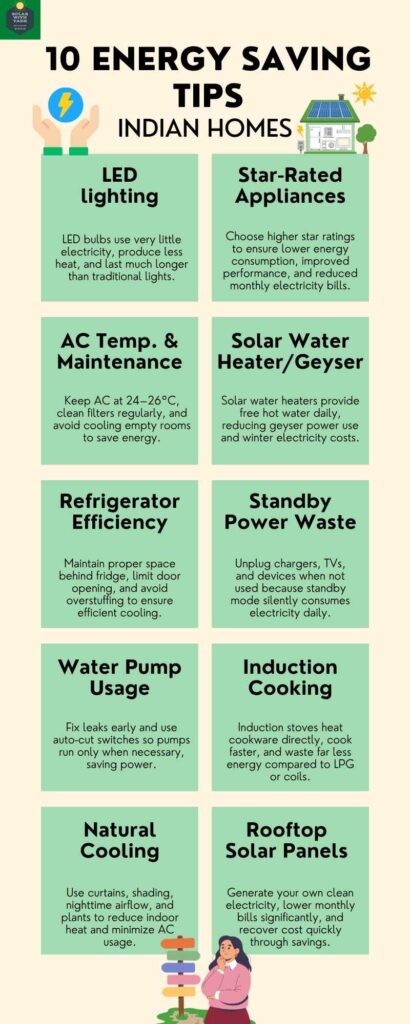
Here are my Top 10 Energy-Saving Tips, backed with real math for the Indian household.
Choose Star-Rated Appliances
Many people hold on to very old appliances thinking they are “saving money.” In reality, those tired refrigerators, fans, and ACs silently drain electricity every single day. The extra units they consume become a recurring monthly penalty on your electricity bill. There is also a big fear of upfront investment. So, when it is finally time to replace an appliance, we quickly pick the cheaper low-star option. It feels economical in the moment, but the math tells a different story. A 5-star appliance pays you back every month and keeps paying for years.
Cheaper low-star = expensive electricity forever.
| Appliance | 3-Star AC | 5-Star AC |
|---|---|---|
| Annual Units | 1,100 | 800 |
| Yearly Cost (@₹7/unit) | ₹7,700 | ₹5,600 |
| Savings/Year | — | ₹2,100 |
| Extra Cost | — | ₹4,000 |
| Payback Period | — | < 2 years |
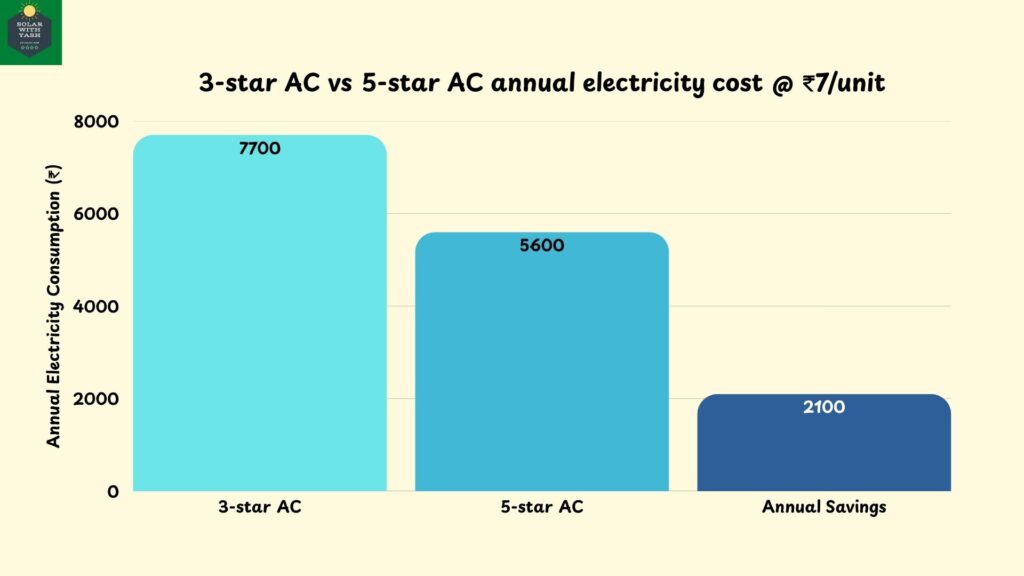
After payback, every rupee saved is profit. Same comfort, less power. I suggest replacing older appliances at the natural end of life with 5-star efficiency champions. Your electricity bill will shrink and your home will feel future-ready.
💡 Annual potential savings: ₹5,000–₹10,000 (AC + fridge upgrade).
LED Lighting Everywhere
LEDs are like the evolution of bulbs: brighter, smarter, and energy-friendly. They use far less power and keep glowing faithfully for years. In many Indian homes, lights stay ON longer than needed, so LEDs instantly cut wasted units.
Choosing the right brightness matters. A tiny store room does not need a stadium-level bulb. Match LEDs to room size for best comfort and savings:
| Room Type | Suggested LED Wattage |
|---|---|
| Bedroom/Study | 9–12 W |
| Living Room | 12–15 W |
| Kitchen | 12–15 W |
| Bathroom/Store Room | 5–7 W |
This avoids over-lighting and unnecessary consumption. Cleaning LED fixtures once or twice a month keeps dust from blocking brightness, so the room feels fresher without increasing wattage.
| Type | Power | Daily Use | Monthly Units | Monthly Cost |
|---|---|---|---|---|
| CFL | 20 W | 6h | 3.6 | ₹25 |
| LED | 9 W | 6h | 1.6 | ₹11 |
| Saving | ₹14/month |
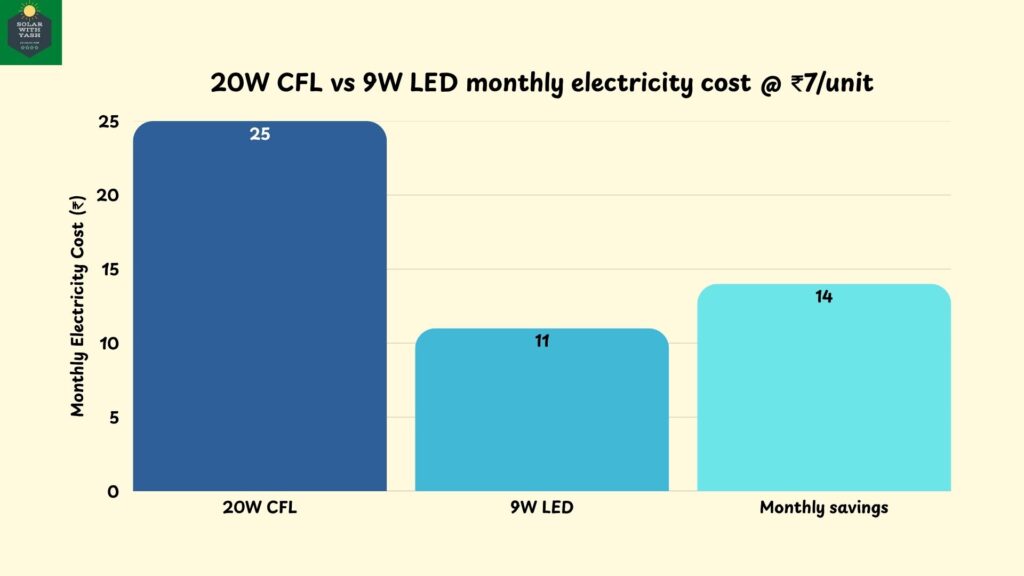
Replacing 10 CFLs with 10 LEDs → You Save ₹14 x 10 = ₹140/month
Annual savings: ₹1,700
LEDs also generate less heat indoors, reducing AC load in summer. Motion sensors in washrooms and corridors save even more—no more Bollywood-level drama over “Switch off the lights!”
Cost recovery typically happens within 6–8 months.
💡 Annual potential savings: ₹1,500–₹3,000
Smarter Fan Management
In most Indian homes, ceiling fans run longer than ACs. In North India especially, fans are used for at least 8 months a year, sometimes even more. That means they quietly become one of the biggest contributors to the electricity bill. Many homes still use old 75 W induction fans, which consume a lot of power compared to modern BLDC fans that use only 28 W.
| Fan Type | Power | Daily Units | Monthly Cost | Saving/Month |
| Regular | 75 W | 0.75 | ₹157 | — |
| BLDC | 28 W | 0.28 | ₹59 | ₹98 |
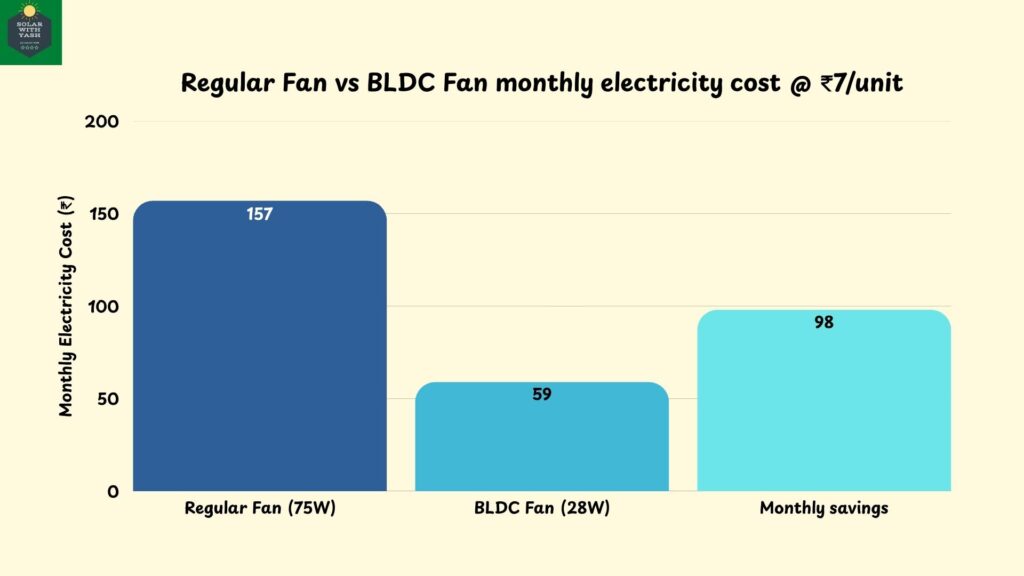
Upgrade 4 fans → Save ₹392/month
Yearly = ₹4,700+
A small lifestyle shift also helps:
Try having meals together in one room at dining time. Fans and lights run only in one space rather than 3–4 separate rooms while everyone scrolls their phones alone. This creates family bonding and cuts energy waste at the same time.
✅ Additional tips
• Clean fan blades regularly for better airflow
• Use smart regulators and turn OFF when leaving the room
• Prefer lighter-colored ceilings for better light reflection and less load on fan airflow
💡 Annual potential savings: ₹4,000–₹6,000
Solar Water Heater or Instant Geyser
Winter showers often bring a surprise…not the cold water, but the hot electricity bill that follows! A solar water heater solves that beautifully by using sunlight instead of electricity to heat water.
How does it work?
• Sunlight falls on solar collector tubes or panels installed on the roof
• These absorb heat and warm the water inside them
• Hot water moves into an insulated storage tank, ready for use
• No electricity needed for heating in most models
This means even during power cuts, you still get hot water…a big relief in many Indian cities and towns.
| Option | Annual Units | Cost/Year | System Cost | Payback |
|---|---|---|---|---|
| Electric Geyser | 1,800 | ₹12,600 | — | — |
| Solar Water Heater | ~200 | ₹1,400 | ~₹25,000 | 2 years |
If your home has good rooftop sun exposure and a family of 3–6 members, this upgrade pays back quickly and keeps savings flowing year after year. In areas where installation is difficult, instant geysers minimize wastage by heating only what you need.
💡 Annual potential savings: ₹10,000–₹15,000
💡 Bonus: Hot water even without electricity
Go Solar and Minimize Your Electricity Bills
This is my favorite because I live the results every day. A 5kW rooftop grid-tied solar system generates around 7,000 units per year.
| System Size | Annual Units | Yearly Savings @₹7/unit | Total Cost | Payback |
|---|---|---|---|---|
| 5 kW | 7,000 | ₹49,000 | ₹2,10,000–₹2,40,000 | 3.5–4.5 years |
Since August 2023, my home has saved ₹1,16,000+. Bills often show Zero, especially in sunny months.
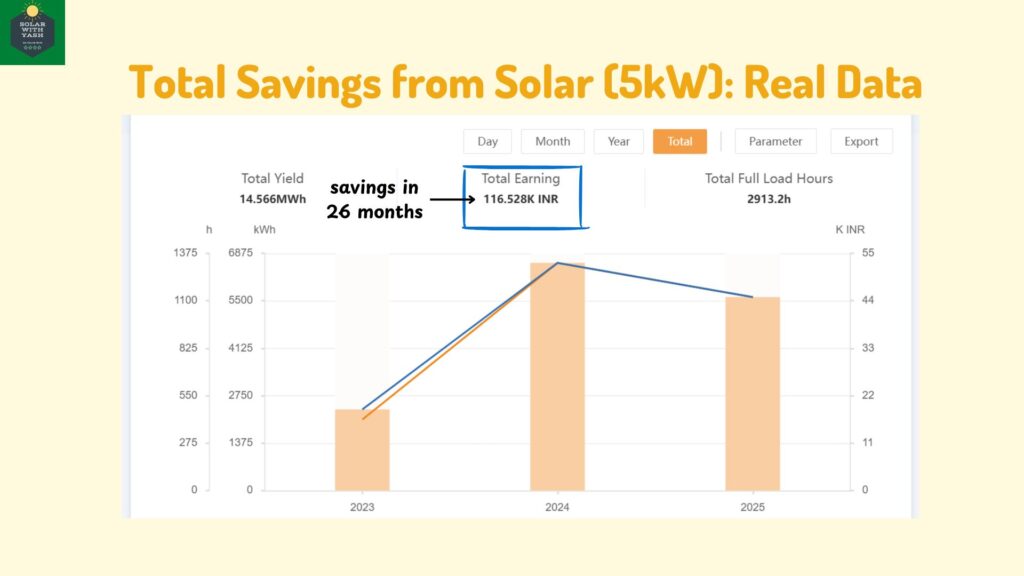
Policies like net metering make solar even more powerful.
✅ Works for most Indian homes with bills ₹2,000/month and above
Get my Solar Feasibility Spreadsheet (SFS) to check your own bill savings and payback in minutes!
Annual potential savings: ₹40,000–₹60,000
Smart AC Usage = Smart Cooling
AC doesn’t need to turn your room into Shimla to make you comfortable. Most of the energy is wasted by overcooling and oversized ACs that run inefficiently. Cooling smart is cooling right.
- Set the temperature at 24–26°C
- Clean filters every month for free efficiency
- Shade windows and the outdoor AC unit from direct sun
- Prevent heat gain with curtains and light-coloured paint
- Size your AC correctly for your room
- 1 Ton → up to 120 sq ft
- 1.5 Ton → 120–180 sq ft
- 2 Ton → 180–240 sq ft
If the AC is too small, it overworks and consumes extra electricity.
If it is too big, it cools too quickly and switches on and off more often, wasting energy.
| Setting | Monthly Units | Monthly Bill |
|---|---|---|
| 22°C | 200 | ₹1,400 |
| 26°C | 150 | ₹1,050 |
Savings: ₹350/month
Annual: ₹4,200 for just one AC
Two AC homes save ₹8,000+ yearly
I sealed gaps behind my outdoor unit and saw improved cooling in 30 minutes. Zero cost, instant reward! 💡 Annual potential savings: ₹4,000–₹10,000
Standby Power: The Silent Power Consumer
Even when appliances look “off,” many of them continue to draw a small trickle of electricity just to stay ready for instant use. This is called standby power or vampire load. It includes tiny things like glowing red lights, clock displays, and background sensors — all silently adding to your bill while you sleep.
Common standby energy consumers at home:
| Device | Standby Power | Cost/Month |
|---|---|---|
| TV + Set-Top Box | 10 W | ₹50 |
| Wi-Fi Router | 8 W | ₹40 |
| Chargers | 5 W | ₹25 |
Switch OFF these devices from the plug at night or use smart power strips that cut power completely. These small steps stop your home from leaking electricity around the clock.
Savings: ₹150–₹200 per month
Annual savings: ₹2,000+ with almost zero effort
A tiny habit change. A big impact on your bill.
💡 Annual potential savings: ₹2,000–₹3,000
Energy Smart Cooking
Indian kitchens are the heart of the home and often the biggest energy consumers. We prepare 3 full meals a day, boil milk, make tea twice (or more 😄), slow-cook dals, fry pakoras, and heat chapatis. This daily love for fresh food translates into high LPG or electricity use. Luckily, a few smart choices can cut costs without cutting taste.
✅Use pressure cookers to reduce cooking time by 50–70%
✅ Pan lids trap heat efficiently
✅ Induction cooktops operate at 85% efficiency vs LPG at ~40%
✅ Match burner size to utensil base to avoid heat loss
✅ Marinate or pre-soak foods like chana and rajma for faster cooking
✅ Cook in batches to reduce reheating
| Appliance | Efficiency | Remark |
|---|---|---|
| Induction | 85% | Faster & cleaner |
| LPG Stove | 40% | More losses |
If you have rooftop solar, shifting daytime cooking to induction turns sunlight into savings…literally cooking from the sun!
Energy-smart kitchens support both home comfort and monthly bill control.
💡 Annual potential savings: ₹3,000–₹6,000
Seal Gaps: Stop AC Air Escaping
When you cool your room, the AC expects the chilled air to stay indoors. Sadly, tiny gaps in doors and windows allow cold air to escape and hot air to sneak in. This forces the AC to run longer, consuming more electricity without improving comfort. Many Indian homes have wooden doors and window frames. During monsoon, wood absorbs moisture and expands, and once the season ends, it shrinks back. This natural expansion and contraction often creates small air gaps around the edges. Over time, hinges loosen, rubber beading wears out, and even new homes start leaking precious cool air.
✅ How to fix these leaks
- Install weather strips or foam tapes around door edges
- Use silicone sealants for window frame gaps
- Add door sweeps to block air from below
- Check for leaks by holding a tissue near edges; if it waves, air is leaking
| Fix | Cost | Yearly Savings |
|---|---|---|
| Door/Window Sealing | ₹500–₹1,500 | ₹1,200–₹2,500 |
| Reflective Films | ₹3,000 | ₹1,000–₹1,500 |
I personally found gaps near my windows last summer. A ₹500 sealing strip reduced the cooling load and made the room more comfortable almost instantly.
💡 Annual potential savings: ₹1,500–₹4,000
Efficient Water Pump Usage
Water pumps are often overlooked energy guzzlers in Indian homes. They run longer than necessary because we forget to switch them off, or because water tanks overflow silently. Every extra minute is wasted electricity, wasted water, and wasted money.
In many parts of India, especially in the North, we have another mischievous twist. Monkeys love opening rooftop tank taps! I have personally faced this. Once the tap is open, the water overflows nonstop and the motor keeps working overtime while no one notices. The result: a surprising spike in the electricity bill.
Smart Improvements:
- Install float switches to automatically stop the motor when the tank is full
- Add a tank overflow alarm for an audible alert
- Fix pipe leaks immediately
- Check rooftop taps frequently (especially if monkeys are your neighbors 😄)
- Use a correctly sized pump for your building height
| Action | Savings/Year | Cost | Payback |
|---|---|---|---|
| Leak fixing | ₹500–₹800 | ₹100–₹300 | Less than 1 month |
| Float switch | ₹1,000–₹2,000 | ₹500–₹700 | 4–6 months |
| Overflow alarm | ₹1,000 | ₹300–₹500 | 3–4 months |
A little vigilance protects both money and water resources.
💡 Annual potential savings: ₹1,000–₹3,000
Bonus Tip: Track What You Use
“What gets measured gets improved.”
Smart plugs, energy meters, and monitoring apps help you see exactly where power is wasted.
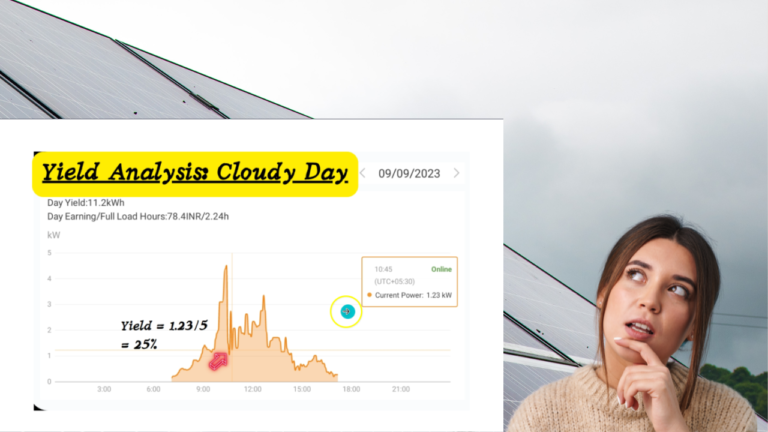
I check my daily solar generation and bill reduction regularly. It feels like I’m winning a long-term game against rising electricity prices.
💡 Annual potential savings: ₹2,000–₹5,000
Conclusion
Energy efficiency isn’t about sacrifice. It is a celebration of a smarter lifestyle. I am learning all of this during my Master’s in Renewable Energy and Environment, and I apply it every day at home.
Start with LEDs and sealing gaps. Upgrade appliances when needed. Let fans and ACs behave wisely. Pair everything with solar. Your home will thank you with comfort and your wallet will smile every month.
Small steps today. Big savings tomorrow.
🌟 Ready to calculate your savings?
👉 Get my Solar Feasibility Spreadsheet (SFS) and find your own rooftop solar savings like my ₹1,15,000+ success story.
FAQ: Energy Saving Tips
How much can I save using these tips?
₹10,000 to ₹40,000 per year depending on lifestyle and appliance usage.
Can renters apply these tips?
Absolutely. LEDs, sealing leaks, and standby power cuts are easily reversible.
Does solar make sense if my bill is small?
Best returns start with ₹2,000+ monthly bills.
Should I upgrade appliances right away?
Replace when older appliances become inefficient or fail.
What’s the simplest tip to start?
LED upgrade + AC temperature shift + standby control = Instant savings.