Peak Sun Hours (PSH) Explained: Variation, Calculation & Impact on Solar ROI
Ever wondered why the same solar panels can produce different outputs at different times of the day or in different locations? The secret lies in a key solar metric called Peak Sun Hours (PSH).
In this post, we’ll break down what Peak Sun Hours mean, the top reasons they vary across states and seasons, and — most importantly — how these variations impact your solar system’s ROI and payback period.
Whether you’re a homeowner or a student, this guide will help you understand why checking PSH is the first step before sizing your solar power system.
Peak Sun Hours and Solar Irradiance: Relation with GHI, DNI, DHI and Insolation
1 Peak Sun Hour = 1000 watts/m² and its value is derived from solar irradiance.
The solar irradiance is the amount of sunlight falling over a 1m² area in a given time. And it is measured in Watts/m².
It is an instantaneous value; a value obtained at a particular moment.
It can be 1000 W/m² at noon, 250 Watts/m² at 6:30 am, or maybe 100 Watts/m² on a cloudy day at a given time.
Do you know?
The Sun emits 3.8 × 10²⁶ joules of energy every second.
Earth receives only a tiny fraction of it, and much is absorbed or reflected by the atmosphere.
By the time sunlight reaches us, its intensity drops to about 1367 W/m² at the top of the atmosphere.
Types of Solar Irradiance
There are three types of solar irradiance:
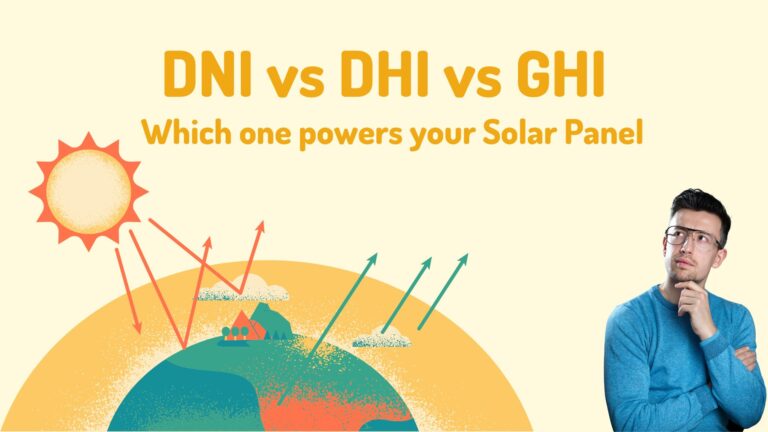
- Direct Normal Irradiance (DNI): That part of the sunlight which comes straight from the sun without scattering.
- Diffuse Horizontal Irradiance (DHI): Sunlight reaching the Earth’s surface after being scattered by the dust particles, moisture, and clouds is called Diffuse Horizontal Irradiance.
- Global Horizontal Irradiance (GHI): It is the total sunlight (direct + diffuse) falling on the Earth’s surface.
Now, you might be wondering which one is used for measuring the Peak Sun Hours. It is the GHI value that is used for calculating Peak Sun Hours in a region.
But before this, let us understand the concept of solar insolation.
GHI values, when integrated (or added) over a time period (such as hour/day/month/year), give us solar insolation.
It is measured in Wh/m² or kWh/m².
An Example: Calculating PSH from GHI

Upon adding all the values from sunrise to sunset, we get solar insolation for the day.
| Time | GHI (W/m²) | Energy (Wh/m²) |
|---|---|---|
| 6:00 | 100 | 100 |
| 7:00 | 200 | 200 |
| 8:00 | 350 | 350 |
| 9:00 | 475 | 475 |
| 10:00 | 600 | 600 |
| 11:00 | 800 | 800 |
| 12:00 | 1000 | 1000 |
| 13:00 | 850 | 850 |
| 14:00 | 700 | 700 |
| 15:00 | 550 | 550 |
| 16:00 | 300 | 300 |
| 17:00 | 200 | 200 |
| 18:00 | 150 | 150 |
| Total (solar insolation) | 6275 | 6275 |
| PSH (Total ÷ 1000) | 6.28 hours |
- Here, the daily insolation = 6275 Wh/m².
- Dividing by 1000 gives the Peak Sun Hours = 6.28 h/day.
Why Peak Sun Hours Matter for Solar System Sizing and ROI
The solar panel power rating (Pmax) is calibrated by assuming that the earth’s surface receives 1000 watts/m² of Peak Sun Hours in a clear sky.
(*The other standard conditions are: cell temperature 25° and air-mass index is 1.5).
Higher PSH means your panels generate more electricity with fewer panels, lowering system costs. This leads to a shorter payback period and better return on investment (ROI), making PSH the most important factor in solar feasibility.
Top Reasons Why Peak Sun Hours Vary by Location, Season & Climate
Peak Sun Hours are not the same everywhere. The main reasons for this variation are:
How Earth’s Shape and Location Affect Peak Sun Hours (PSH)
Because the Earth is spherical, sunlight does not fall equally on all regions.

- At the equator, sunlight strikes almost directly, so intensity is highest.
- As we move toward the poles, sunlight becomes more slanted and travels a longer path through the atmosphere, reducing its intensity.
Location strongly influences the solar radiation a region receives.
Dry regions usually get more sunlight because the air is clearer and less humid.

Coastal and humid regions have more water vapor and droplets in the air, which scatter and absorb sunlight, reducing the amount reaching the ground.

Kozikode, despite being closer to the equator, has less PSH than Rajasthan’s Churu district.
The reason: Kozhikode’s coastal climate is humid, while Churu’s desert climate is dry and clear, allowing more sunlight to reach the surface.
In such areas, it’s best to install high-efficiency, salt-mist, and moisture-resistant solar panels for reliable performance.
Although regions near the equator receive higher Peak Sun Hours, they also tend to have higher temperatures. Elevated temperatures reduce the efficiency of solar panels, causing power losses. So, while the high PSH is a big advantage, the heat effect slightly reduces output.
Even then, the overall impact remains favourable, making equatorial regions good for solar power.
How Altitude Affects Peak Sun Hours (PSH)
- At higher altitudes, the air is thinner (less atmosphere above).
- Result: Less scattering and absorption of sunlight → higher irradiance.
- This means PSH generally increases with elevation, even if the location is far from the equator.
Example:
Jammu, India (≈ 1,073 feet altitude) gets 5.27 PSH/day despite being at a northern latitude of 32.73⁰.

- A nearby lowland city at the same latitude might get 4.5–5.0 PSH/day.
Earth’s Rotation and Day-Night Variation in Peak Sun Hours

- The Earth rotates once every 24 hours, giving us day and night.
- This rotation causes sunlight intensity (irradiance) to vary throughout the day:
- Highest at noon, when the sun is closest to overhead (zenith)
- Lowest at sunrise and sunset (sunlight comes at a shallow angle).
Mathematically
The solar insolation at any time in a day is calculated as:
I = I₀ cosθ

where θ is the angle between the sun’s actual position and the zenith.
- At sunrise/sunset → θ = 90°, cos 90° = 0 → I = 0 (minimum)
- At noon → θ = 0°, cos 0° = 1 → I = I₀ (maximum)
From sunrise to noon, irradiance increases; from noon to sunset, it decreases.
Adding up these values from sunrise to sunset gives the daily solar insolation (PSH).

Earth’s Revolution and Seasonal Variation in Peak Sun Hours

- The Earth also revolves around the Sun once every year.
- Its axis is tilted by 23.5°, which is the main reason for seasons.
- Because of this tilt:
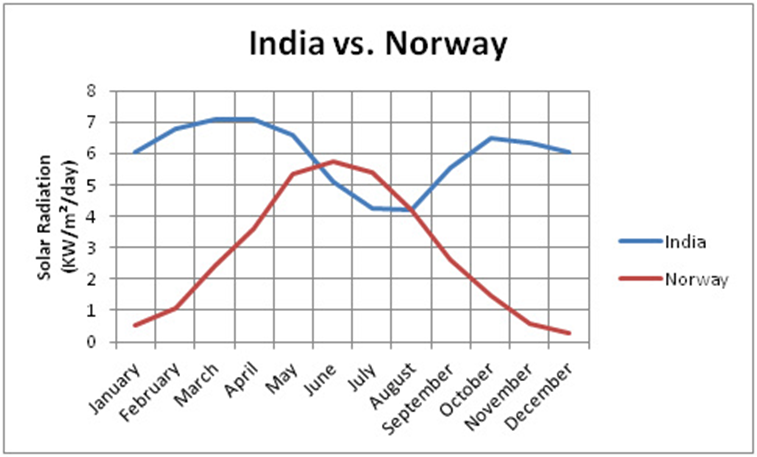
- In summer, your location gets longer days and the sun is higher in the sky → higher PSH.
- In winter, days are shorter and the sun is lower in the sky → lower PSH.
Note: The Earth’s orbit is elliptical, so the distance from the Sun does change slightly. But this effect is much smaller compared to the tilt of the Earth’s axis. Seasons are primarily caused by the tilt, not distance.
In Summary:
- Rotation of the Earth → Day-night cycle → Hourly variation in PSH.
- Revolution of the Earth (with tilt) → Seasonal changes → Monthly variation in PSH.
How do Peak Sun Hours Decide Solar Panel Size?
The number of solar radiations is very helpful in sizing the panels of your solar PV system.
A person living in a sunshine place will need fewer solar panels to meet her/his energy needs than another person with the same energy needs, living in a sunlight-deficient region.
For example, two persons, A and B, with the same energy needs of 12 kWh units per day, living in different locations with PSH of 4 and 6, respectively.
(Ignoring all the losses)
Person A: Panel size: 12 units/4 = 3 kW
Person B panel size: 12 units/6 = 2 kW
Peak Sun Hours and Solar ROI: Why Higher PSH Improves Payback
The solar power system is an investment, and its return depends on the cost. Solar panels are the major cost component in any system. With good sunlight, you can meet your energy needs with fewer panels.
Fewer solar panels mean reduced system costs. Now, you have faster payback and improved annual returns from the system.
Therefore, good sunlight improves the financial feasibility of the solar power system.
Best for homeowners, solar energy students, and newbie solar entrepreneurs
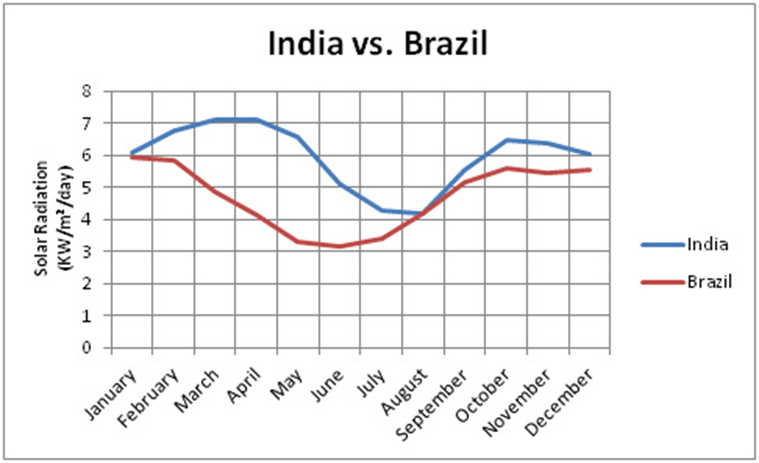
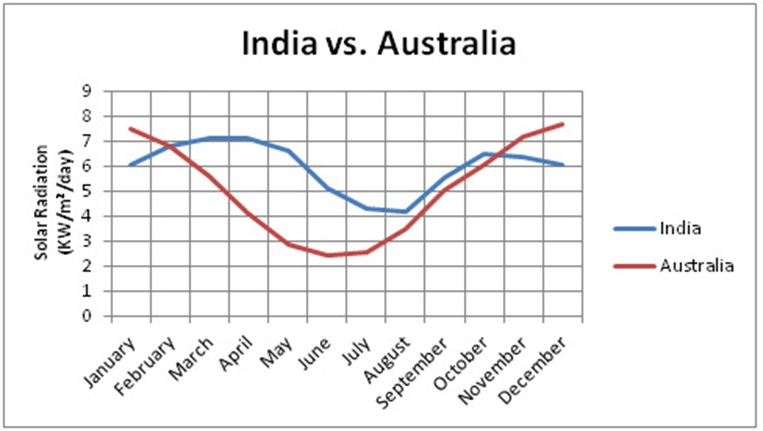
A few comparisons of Peak Sun Hours values of different countries
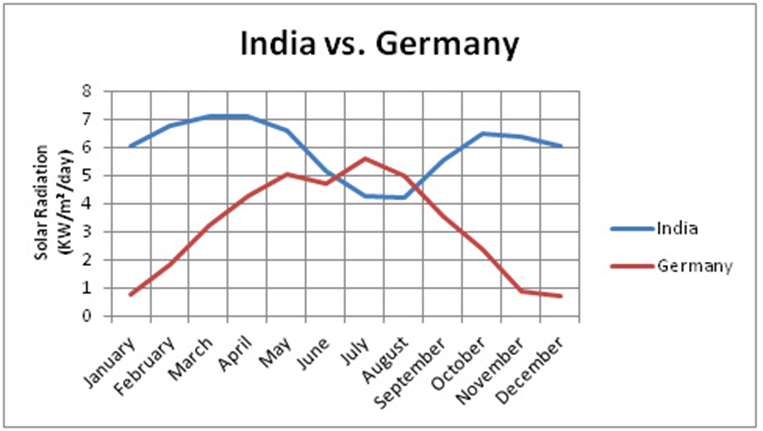
Conclusion: Why Understanding Peak Sun Hours is Essential for Solar Success
Knowing Peak Sun Hours (PSH) is the first step of solar energy planning. It represents how much usable sunlight your location receives and directly influences the size, cost, and payback of your solar system.
We’ve seen that PSH varies due to multiple factors like Earth’s rotation (day-night cycle), revolution and tilt (seasonal changes), latitude, altitude, and local climate (humid vs. dry regions).
For example, a desert city may get more PSH than a coastal city at the same latitude, and high-altitude regions often enjoy stronger irradiance despite colder conditions.
For homeowners, this means that checking PSH is an indispensable part of designing your solar system.
Higher PSH means fewer panels, lower system cost, faster payback, and better ROI. For students and solar professionals, PSH is the first building block in accurate solar design and feasibility analysis.
In short: Peak Sun Hours = Solar Potential. The more you understand it, the smarter your solar investment decisions will be.
Peak Sun Hours (PSH): Frequently Asked Questions
Q1. What are Peak Sun Hours (PSH)?
Peak Sun Hours (PSH) are the equivalent number of hours per day when solar irradiance averages 1000 W/m². It helps standardize sunlight into usable hours for solar panel sizing.
Q2. Why do Peak Sun Hours vary by location?
PSH varies due to latitude, altitude, climate, and weather conditions. Dry deserts and high-altitude areas usually record higher PSH than humid coastal regions.
Q3. How can I check Peak Sun Hours for my location?
You can check PSH using government or international datasets like NREL, MNRE, or NASA POWER. Solar maps and tools such as the Solar Snap Tool or feasibility spreadsheets are also helpful.
Q4. What is considered a good PSH value for solar?
A PSH of 4–5 hours/day is moderate, while 5–6+ hours/day is excellent and ideal for solar investments. Anything below 4 hours/day typically requires larger or higher-efficiency systems.
Q5. Can Peak Sun Hours vary within the same state?
Yes. Microclimates, coastal effects, and elevation differences mean PSH can differ even within the same state. For example, Rajasthan’s deserts receive more PSH than its humid regions.
Q6. How do seasons affect Peak Sun Hours?
Seasonal changes impact PSH. In summer, days are longer and the sun is higher in the sky, giving higher PSH. In winter, shorter days and a lower sun angle reduce PSH.
Q7. Why are Peak Sun Hours important for ROI?
Higher PSH means more energy generation per panel. This reduces the number of panels required, lowers system costs, shortens payback time, and improves solar ROI.