Solar vs Fixed Deposit: Which Gives Better Returns in India (2026)?
Should you invest in solar or fixed deposit? This guide compares real returns, savings, and ROI with practical examples to help you make the right decision.
Why do two similar solar systems have different payback periods? This guide explains how electricity tariffs directly impact your savings, ROI, and solar payback in India with real examples.
Rooftop solar can significantly reduce electricity bills in Bihar. This analysis explains the cost, savings, payback period, and long-term financial benefits of installing a 5 kW rooftop solar system in Bihar.
Solar installers and websites often promote “average solar savings” to explain the benefits of rooftop solar. But in reality, solar economics depends on several factors such as solar radiation, electricity tariffs, and system cost. In this article, we explore why average solar savings can be misleading and how homeowners should evaluate solar using financial metrics like payback period, IRR, and NPV.
First-year solar savings often look impressive, but they rarely tell the full financial story. This article explains how lifetime ROI is shaped by degradation, tariff behavior, maintenance costs, and realistic feasibility modeling — helping homeowners make more informed solar decisions.
Solar ROI numbers can look very attractive in spreadsheets — but real-world performance tells a different story. This analytical guide explains the technical and financial assumptions that make solar returns appear higher on paper, and how homeowners can evaluate realistic ROI before investing.
Oversizing solar panels may look attractive on paper, but it often reduces real savings.
This guide explains when oversizing hurts ROI, when it doesn’t, and how to check oversizing risk before installing solar.
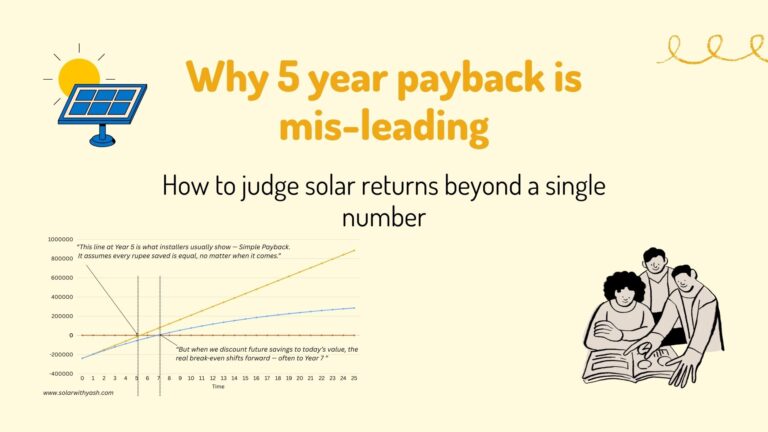
Many solar systems are sold using a “5-year payback” claim. This article explains why simple payback is mathematically incomplete, how it ignores real cash flows, and how homeowners should evaluate solar more realistically.
Most solar payback calculations look accurate on paper but fall short in the real world. This article explains why payback is often delayed by 2–3 years and what a realistic solar payback analysis must include before investing.
Solar payback periods often take longer than promised due to hidden lifecycle costs that installers rarely discuss. This article explains the real factors that reduce solar savings over time—and how informed homeowners can manage them to achieve a more realistic ROI.