How Much Does Rooftop Solar Cost? A Complete Homeowner’s Decision Guide
If you are planning to install a rooftop solar system, one of the first questions that probably comes to your mind is:
“How much does rooftop solar cost?”
At first glance, the answer may seem simple. You may come across average per-watt installation costs for rooftop solar in India, the United States, or other countries. However, these figures are only broad market estimates and should not be used as the basis for making your investment decision.
The actual cost of a rooftop solar system is different for every homeowner because it depends on several factors, including your current electricity consumption, expected future energy needs, roof type, available shade-free area, your geographical location and available solar resource, equipment selection, battery requirements, installation complexity, and the long-term cost of owning and maintaining the system.
In other words, the objective is not to find the average cost of rooftop solar, but to determine the right cost for your home.
In this guide, we will explain each factor that influences the cost of a rooftop solar system, why two homeowners may receive different quotations even for similar system sizes, and how to estimate the true lifecycle cost of rooftop solar before making your investment.
By the end of this guide, you will understand not only how much rooftop solar costs, but also why it costs that amount and how to determine whether the investment is financially worthwhile for your home.
Quick Decision Summary
The solar rooftop will cost you more:
- If you need a larger system
- You choose premium solar panels and an inverter
- Your roof is complex and requires additional mounting work
- Your roof does not have uniform sunlight throughout
- You need battery storage
- Your place has higher installation and labour charges (generally in hilly terrain)
Let us discuss each cost parameter individually and its impact on the cost:
1. Solar System Size
The size of a rooftop solar system depends primarily on your electricity consumption and energy needs. In general, homes that consume more electricity require larger solar systems to generate enough energy to offset a greater portion of their grid consumption.
However, the cost of a solar system does not increase in a perfectly linear manner. While larger systems cost more overall, they often have a lower cost per watt due to economies of scale.
This happens because many installation costs—such as labour, mounting structures, wiring, transportation, and system commissioning—are relatively fixed and are spread across a larger number of solar panels. As a result, the average cost per watt generally decreases as the system size increases.
Example
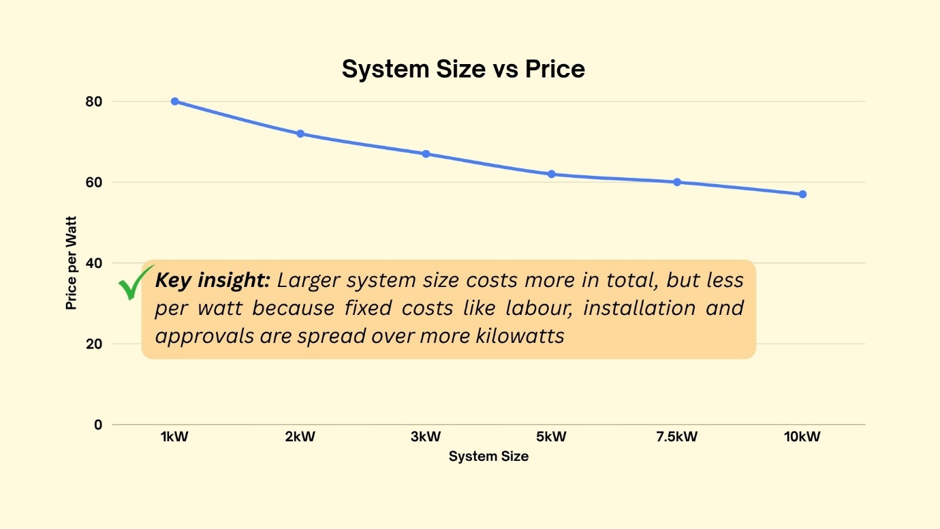
Illustrative Trend: Larger solar systems generally have a lower cost per watt.
| System Size | Typical Cost Trend |
|---|---|
| 1 kW | Highest cost per watt |
| 2 kW | High cost per watt |
| 3 kW | Moderate cost per watt |
| 5 kW | Lower cost per watt |
| 7.5 kW | Lower cost per watt |
| 10 kW | Lowest cost per watt (among residential systems) |
Note: This table illustrates the general pricing trend. Actual costs vary depending on equipment quality, installer, roof type, location, and applicable government subsidies.
2. Solar Panels
Solar panels are the most visible component of a rooftop solar system and account for a significant portion of the overall system cost. However, not all solar panels are the same. Their price varies depending on several factors, including efficiency, brand, technology, and warranty.
(i) Efficiency
Solar panel efficiency refers to the percentage of sunlight that a solar panel converts into electricity. In general, higher-efficiency solar panels cost more because they produce more electricity from the same roof area.
For homeowners with limited roof space, high-efficiency panels can generate more power per square metre, making them a practical choice despite their higher upfront cost.
(ii) Brand
The manufacturer of a solar panel also influences its price. Well-established brands often charge a premium because they have built a reputation for product quality, reliability, and after-sales support over many years.
These companies typically offer:
- Proven product performance
- Strong dealer and service networks
- Better quality control
- Greater confidence in warranty support
Many homeowners are willing to pay a higher price for the added assurance that comes with a trusted brand.
(iii) Technology
Solar panel technology is another important factor affecting cost.
Newer technologies generally offer better performance and therefore tend to cost more than conventional panels.
Some examples include:
- Mono PERC – Widely used and offers good performance.
- TOPCon – Higher efficiency and improved performance, especially at higher temperatures.
- HJT (Heterojunction) – Premium technology with excellent efficiency, lower degradation, and better long-term energy production.
- Half-cut cell panels – Designed to reduce electrical losses and improve performance under partial shading and high temperatures.
Although advanced technologies usually increase the initial cost, they may generate more electricity over the system’s lifetime.
(iv) Warranty
Solar panels typically come with two types of warranties:
Product Warranty
This covers manufacturing defects and ensures the panel is free from material or workmanship issues.
Performance Warranty This guarantees that the panel will continue producing a specified percentage of its original output over time, typically for 25 to 30 years.
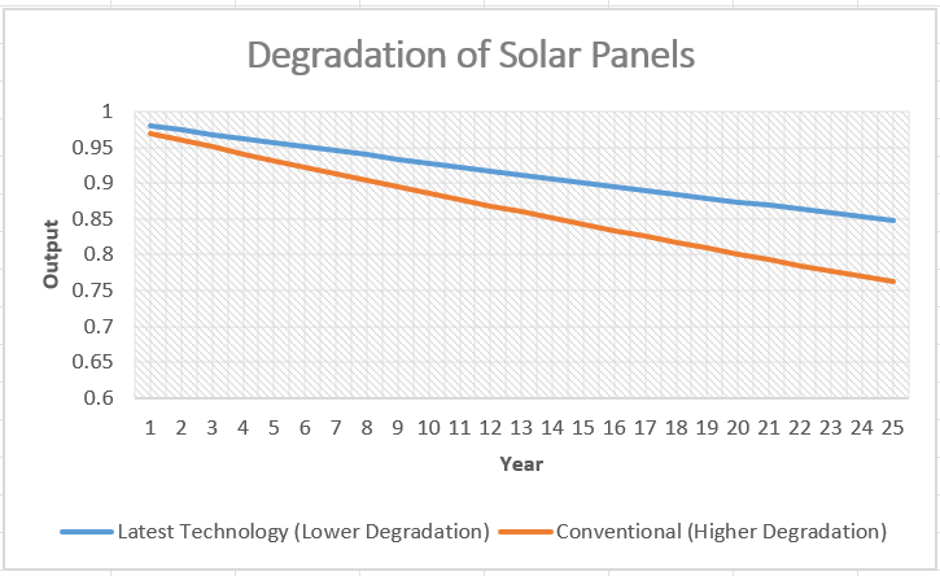
In general, panels with longer warranty periods often cost more because they provide homeowners with greater long-term confidence and protection.
Typical Warranty Periods
- Product Warranty: 10–25 years (depending on the manufacturer)
- Performance Warranty: 25–30 years
Key Takeaway
Higher-priced solar panels often offer better efficiency, advanced technology, longer warranties, and stronger brand support. The right choice depends on your budget, roof space, and long-term energy goals rather than simply choosing the cheapest or the most expensive option.
3. Solar Inverter
The solar inverter is one of the most important components of a rooftop solar system. Its primary function is to convert the direct current (DC) electricity generated by solar panels into alternating current (AC) electricity that can be used by household appliances.
The type of inverter you choose has a significant impact on the total cost of the solar system. Different inverter technologies offer different levels of performance, flexibility, and features.
The four most common types of solar inverters are:
- Central Inverter
- String Inverter
- Microinverter
- Hybrid Inverter
The most suitable inverter depends on your budget, roof layout, shading conditions, future expansion plans, and whether you require battery backup.
(i) Central Inverter
Central inverters are one of the oldest and most widely used inverter technologies. A single inverter manages the entire solar system, making it a cost-effective choice for installations with large, unshaded roof areas.
Because only one inverter is required, central inverter systems generally have a lower upfront cost than other inverter configurations.
However, they offer less flexibility for future expansion and may be less suitable for roofs with multiple orientations or significant shading.
(ii) String Inverter
A string inverter system divides the solar panels into separate groups (strings), with each string connected to its own inverter or MPPT.
Compared with a central inverter, string inverter systems usually cost more but provide greater design flexibility, improved energy harvesting, and easier troubleshooting.
They are well suited for medium to large residential systems and are often the most common choice for modern rooftop solar installations.
(iii) Micro Inverter
In a microinverter system, each solar panel has its own inverter installed behind the panel.
This design maximizes energy production because each panel operates independently, making it particularly suitable for roofs with partial shading or multiple roof orientations.
However, microinverter systems are generally the most expensive option because every panel requires its own inverter.
(iv) Hybrid Inverter
A hybrid inverter is designed for homeowners who want to integrate battery storage with their rooftop solar system.
Unlike a conventional grid-tied inverter, a hybrid inverter can manage electricity from solar panels, batteries, and the utility grid.
Hybrid inverters are more expensive than standard grid-tied inverters, but they provide the additional capability of battery backup during grid outages (when configured with an appropriate battery system).
They are particularly suitable for areas with frequent power cuts or homeowners planning to install battery storage in the future.
Key Takeaway
The choice of inverter affects not only the initial cost of a rooftop solar system but also its flexibility, energy performance, and future upgrade options. The best inverter is not necessarily the cheapest or the most expensive—it is the one that best matches your roof conditions, energy needs, and long-term plans.
| Inverter Type | Relative Cost | Best Suited For |
|---|---|---|
| Central Inverter | Lowest | Large, unshaded installations |
| String Inverter | Moderate | Most residential homes |
| Microinverter | Highest | Shaded or complex roofs |
| Hybrid Inverter | High | Homes requiring battery backup |
4. Mounting Structure
The mounting structure is the foundation of a rooftop solar system. It securely supports the solar panels, maintains the required tilt and orientation, and ensures that the system can withstand environmental conditions throughout its lifetime.
A well-designed mounting structure helps maximize energy generation while keeping the solar panels safely attached to the roof. On the other hand, a poorly designed or weak structure can compromise the performance, safety, and durability of the entire solar installation.
The cost of the mounting structure depends on several factors, including the roof type, structural design, material used, and local environmental conditions.
(i) Roof Type
The type of roof significantly influences the design and cost of the mounting structure.
Common residential roof types include:
- RCC (Reinforced Cement Concrete) roof
- Metal roof
- Tile roof
Each roof type requires different mounting methods, hardware, and installation techniques. As a result, the mounting structure cost can vary from one home to another.
(ii) Roof Design and Shading
The layout of the roof also affects the mounting structure.
For example, if nearby buildings, water tanks, or trees cast shadows on the roof, installers may recommend elevated mounting structures to reduce shading and improve solar energy generation.
These customized structures require additional material and engineering, increasing the overall installation cost.
(iii) Material of the Mounting Structure
Mounting structures are commonly manufactured using hot-dip galvanized steel or aluminium.
The choice of material depends on factors such as strength requirements, corrosion resistance, project budget, and local environmental conditions.
Premium corrosion-resistant materials generally cost more but may offer better durability and a longer service life.
(iv) Climate and Environmental Conditions
Local weather conditions also influence the design and cost of the mounting structure.
For example:
- Coastal regions, such as Kerala, Goa, Tamil Nadu, and Maharashtra in India, or Florida, California, and the Gulf Coast in the United States, often require highly corrosion-resistant mounting structures because of the salty environment.
- High wind-speed regions, such as Gujarat’s coastal areas or Odisha in India, and parts of Florida, Texas, and the Atlantic coast in the United States, may require stronger foundations and additional structural reinforcement to withstand extreme wind loads.
- Regions with heavy snowfall, such as Jammu & Kashmir, Himachal Pradesh, and Uttarakhand in India, or states like Colorado, Minnesota, Michigan, and New York in the United States, may require mounting structures designed to safely withstand snow loads.
These additional engineering requirements increase the cost but help ensure the long-term safety and reliability of the solar installation.
Key Takeaway
The mounting structure is much more than a frame for holding solar panels. It is a critical structural component that affects the safety, durability, and long-term performance of the entire rooftop solar system. Factors such as roof type, roof layout, shading, climate, and material selection all influence its cost.
(v) Comparison Table
| Factor | Effect on Mounting Structure Cost |
|---|---|
| RCC Roof | Standard mounting design |
| Metal Roof | Specialized clamps and mounting hardware |
| Tile Roof | More complex installation and additional care |
| Partial Shading | May require elevated structures |
| Coastal Area | Corrosion-resistant materials increase cost |
| High Wind Zone | Stronger structure and foundation increase cost |
5. Battery Storage
Battery storage is one of the biggest factors that can increase the cost of a rooftop solar system. While batteries provide backup power during electricity outages, they also require additional equipment, making the overall system significantly more expensive.
Choosing battery storage also affects the choice of inverter. Instead of a conventional grid-tied inverter, homeowners require a hybrid inverter that can manage electricity from the solar panels, batteries, and the utility grid. Since hybrid inverters are more expensive than standard grid-tied inverters, they further increase the overall system cost.
As a result, a solar system with battery storage can cost 50% or more than a comparable grid-tied system without batteries, depending on the battery capacity and technology selected.
When is Battery Storage Worth Extra Cost?
Battery storage may be a worthwhile investment if one or more of the following situations apply:
Frequent Power Outages
If your area experiences regular or prolonged power cuts, battery storage can provide backup electricity and improve energy reliability.
Work-from-Home Requirements
If you work from home and rely on devices such as laptops, internet routers, desktop computers, or video conferencing platforms, uninterrupted electricity can help maintain productivity during grid outages.
Elderly Family Members
Homes with elderly family members may benefit from a reliable electricity supply for lighting, fans, air conditioning, and other essential household appliances that enhance comfort and convenience.
Medical Requirements
Some homes rely on electrical equipment or temperature-sensitive medications that require uninterrupted power.
For example, certain medicines, such as insulin, may need refrigeration to remain effective. Battery backup can help maintain power to refrigerators or other essential medical equipment during outages.
Key Takeaway
Battery storage is not essential for every homeowner. If your electricity supply is reliable and net metering is available, a conventional grid-tied solar system is often the more economical choice.
However, if uninterrupted electricity is important because of frequent power outages, work requirements, or essential medical needs, the additional investment in battery storage may be justified.
| Situation | Recommendation |
| Reliable grid + Net Metering | Grid-tied solar is usually sufficient |
| Frequent power cuts | Consider battery storage |
| Work from home | Battery storage may be beneficial |
| Medical equipment or refrigerated medicines | Battery storage is recommended |
| Planning future energy independence | Consider a hybrid-ready system |
6. Installation and Labour
Once the solar panels, inverter, mounting structure, and other components are selected, they must be installed correctly to ensure the system operates safely and efficiently throughout its lifetime.
Installation involves assembling the mounting structure, securely fixing it to the roof, installing the solar panels, connecting the electrical components, carrying out safety checks, and finally testing and commissioning the system.
Installation and labour charges form an important part of the total cost of a rooftop solar system.
(i) Experience of the Installer
The experience and expertise of the installer can significantly influence installation costs.
Experienced installers may charge more than less experienced contractors, but they are often better equipped to design the system correctly, follow safety standards, and minimize installation errors.
A properly installed system is generally more reliable and may reduce maintenance issues over its lifetime.
(ii) Complexity of the Installation
Not every rooftop is equally easy to install on.
Installation costs may increase when:
- The roof has multiple levels or complex layouts.
- The installation area is difficult to access.
- Additional safety equipment or scaffolding is required.
- Longer cable runs are needed between the solar panels and the inverter.
These factors increase the time, labour, and equipment required for installation.
(iii) Location
The installation cost may also vary depending on the location of the property.
For example:
- Remote locations may involve higher transportation costs for materials and installation teams.
- Hilly or difficult-to-access regions may require additional labour and logistics.
(iv) Testing and Commissioning
After installation, the system must be tested and commissioned to ensure that all components operate safely and efficiently.
This process includes electrical testing, system verification, and confirming that the solar system is ready for operation.
These activities are also included in the overall installation cost.
Key Takeaway
Installation is much more than simply placing solar panels on the roof. The quality of installation directly affects the safety, reliability, and long-term performance of the entire solar system. While experienced installers may charge more, professional installation is often a worthwhile investment that helps avoid costly problems in the future.
7. Government Subsidies
Government subsidies help reduce the upfront cost of installing a rooftop solar system, making solar more affordable for homeowners. By lowering the initial investment, subsidies also improve the financial attractiveness of solar and shorten the payback period.
Although rooftop solar is financially viable for many homeowners even without subsidies, government incentives make the investment more accessible and accelerate the recovery of the initial cost.
The subsidy amount is generally linked to the eligible system size under the applicable government scheme. As system size increases, the subsidy typically rises to a specified limit. Beyond this limit, the subsidy amount typically remains fixed, even if a larger solar system is installed.
Therefore, while larger systems generate more electricity, they do not always receive proportionally higher subsidies.
Note: Government subsidy schemes, eligibility criteria, and subsidy amounts may change over time. Always refer to the latest official guidelines before making an investment decision.
Key Takeaway
Government subsidies reduce the initial investment required for rooftop solar and can significantly improve the project’s financial return. However, the long-term value of solar still depends on factors such as electricity consumption, system performance, maintenance, and local electricity tariffs—not on subsidies alone.
Note: Many countries, including India and the United States, offer financial incentives such as subsidies, tax credits, rebates, or other support mechanisms to encourage rooftop solar adoption. The availability and structure of these incentives vary by country, state, and local regulations.
8. Location of Installation
The location of your home influences the cost of a rooftop solar system in more than one way.
(i) Installation Logistics
Homes located in hilly, remote, or difficult-to-access areas often have higher installation costs because transporting equipment, arranging skilled labour, and completing the installation require additional time and resources.
Examples include remote parts of Himachal Pradesh, Uttarakhand, Ladakh, or similar mountainous regions.
(ii) Local Solar Resource
Your geographical location also determines how much sunlight your rooftop receives throughout the year.
Homes located in regions with higher solar radiation generally produce more electricity from each kilowatt of installed solar capacity.
As a result, homeowners in these regions may require a smaller solar system to meet the same annual electricity demand compared with homeowners living in regions with lower solar radiation.
Consequently, the total installation cost may also differ.
Consider two families with similar annual electricity consumption.
| Family | Location | Approximate Outcome |
|---|---|---|
| Family A | Delhi | Smaller system required |
| Family B | Shimla | Larger system may be required |
Although both families consume the same amount of electricity, the family living in Shimla may require a slightly larger solar system because each kilowatt of installed capacity generates less electricity annually than in Delhi.
The larger system increases the overall project cost.
USA Example
Similarly, two homeowners with identical electricity consumption may require different solar system sizes depending on where they live.
| Family | Location | Approximate Outcome |
|---|---|---|
| Family A | Texas (~31° N) | Higher annual solar resource; may require a smaller system |
| Family B | Washington State (~47° N) | Lower annual solar resource; may require a larger system |
Local solar resource (often expressed as annual solar radiation or Peak Sun Hours) varies from one location to another and influences how much electricity a solar system can generate.
9. Understanding the Life-Time Cost of Solar
Most homeowners focus only on the initial installation cost and any available government subsidy before investing in rooftop solar. However, the true cost of owning a solar system extends far beyond the day it is installed.
Although these future expenses are not hidden in the strict sense, they are often overlooked because they occur several years after installation. Considering these costs provides a more realistic estimate of the lifecycle cost of the solar system.
Some of the important long-term costs include:
(i) Maintenance
Rooftop solar systems require relatively little maintenance. However, periodic cleaning, inspections, and occasional servicing over a project life of 25–30 years still represent a cost that should be considered.
(ii) Equipment Replacement
Some components have a shorter service life than the solar panels.
For example, a solar inverter may require replacement during the lifetime of the project. Since the inverter typically represents a significant proportion of the total system cost, replacing it increases the overall lifecycle cost.
(iii) Mounting Structure and Hardware
Although mounting structures are designed for long-term outdoor use, prolonged exposure to sunlight, rainfall, humidity, temperature changes, and wind may eventually require repairs or replacement of certain components.
Similarly, foundations, fasteners, and protective coatings may require inspection and maintenance over the system’s lifetime.
(iv) Electrical Components
Other components such as:
- DC and AC cables
- Junction boxes
- Conduits
- Connectors
- Protection devices
may also require maintenance or replacement during the project life.
Why Lifecycle Cost Matters
Considering only the initial installation cost may lead to an overly optimistic estimate of the financial return from rooftop solar.
A more realistic financial assessment should include:
- Initial investment
- Maintenance costs
- Equipment replacement costs
- Expected system life
- Annual electricity savings
This provides a better understanding of the true lifetime cost and the overall return on investment.
Decision Tool
Want to estimate the complete lifecycle cost of your rooftop solar system before investing?
Use:
The Solar Feasibility Spreadsheet estimates not only the initial installation cost but also maintenance, equipment replacement, lifecycle cost, and long-term financial performance before you invest.
“The cheapest solar system is not always the most economical over its lifetime. A slightly higher initial investment in quality components may reduce maintenance and replacement costs, resulting in a lower lifecycle cost and a better long-term return on investment.
10. The Common Costly Mistakes Homeowners Make
Investing in rooftop solar is a long-term financial decision. While solar can significantly reduce electricity bills, certain mistakes made during the planning and purchasing stage can unnecessarily increase the overall cost of the system or reduce its long-term financial benefits.
Understanding these common mistakes can help you make a more informed investment decision.
(i) Installing a larger system than you actually need
Many homeowners believe that installing a larger solar system will always result in greater savings because the additional electricity can be exported to the grid.
However, this is not always true.
In many regions, the compensation received for exported electricity may be lower than the price paid for electricity imported from the grid. As a result, designing an oversized system simply to maximize exports may reduce the overall financial return and extend the payback period.
A solar system should be designed based on:
- Your current electricity consumption
- Expected future energy needs
- Your daytime electricity consumption pattern
- Applicable net-metering or export compensation policies
rather than assuming that exporting more electricity will always generate higher returns.
(ii) Considering only the upfront cost
One of the biggest mistakes homeowners make is evaluating solar based only on the initial installation cost and the available government subsidy.
While these are important, they represent only a part of the total investment.
The true financial performance of a rooftop solar system depends on its lifecycle cost, which includes:
- Initial investment
- Maintenance costs
- Equipment replacement
- Long-term system performance
- Electricity savings over the project life
Ignoring these future costs may lead to unrealistic expectations regarding payback and return on investment.
Solar rarely disappoints because of poor economics. It often disappoints because homeowners underestimate the true lifetime cost of owning the system.
(iii) Choosing the cheapest quote
Selecting the lowest-priced quotation does not always result in the lowest lifetime cost.
A cheaper system may involve compromises such as:
- Lower-quality solar panels
- Inferior inverter quality
- Shorter warranty periods
- Poor mounting structures
- Inexperienced installation teams
- Weak after-sales service
Although the initial investment may be lower, these compromises can lead to higher maintenance costs, earlier equipment replacement, lower energy generation, and reduced long-term savings.
The cheapest solar system is not always the most economical over its lifetime.
(iv) Ignoring future energy needs
Many homeowners size their solar system based only on their current electricity consumption without considering future requirements.
Future electricity demand may increase due to:
- Purchasing an electric vehicle (EV)
- Installing additional air conditioners
- Expanding the house
- Working from home
- Increasing family size
- Adding new electrical appliances
If future demand is ignored, the system may become undersized, requiring costly upgrades or expansion later.
Planning for expected future energy needs at the design stage often results in a more economical solution.
(v) Comparing solar with fixed deposits or mutual funds
Many homeowners delay their solar investment because they compare it directly with investments such as fixed deposits, mutual funds, or stocks.
However, this comparison is often misleading.
Traditional investments are designed to grow your wealth.
Rooftop solar is designed to reduce your future household expenses by replacing electricity purchased from the grid.
These two financial decisions serve different purposes and often complement each other rather than compete with each other.
Every year you postpone a financially viable solar installation, you continue paying electricity bills that could otherwise have been reduced.
Read our detailed analysis: Solar vs Fixed Deposit: Which Gives Better Returns?
(vi) Choosing an installer before understanding solar
Many homeowners contact installers and compare quotations before understanding the basics of rooftop solar.
As a result, they often compare prices without comparing what is actually being offered.
Before requesting quotations, homeowners should have a basic understanding of:
- The right solar system size
- Solar panel technologies
- Inverter options
- Mounting structures
- Warranties
- Expected savings and payback
Only then can different quotations be compared fairly and objectively.
An informed homeowner is far more likely to select the right installer and avoid costly mistakes.
Key Takeaway
The cost of a rooftop solar system is determined not only by the price quoted by the installer but also by the decisions made before the installation begins. Avoiding common mistakes such as oversizing the system, focusing only on the upfront cost, choosing the cheapest quotation, ignoring future energy needs, comparing solar with unrelated investments, or selecting an installer without understanding the technology can significantly improve the long-term financial return from your investment.
Want to Know the True Lifetime Cost Before Investing?
Before investing thousands of rupees or dollars in rooftop solar, estimate the complete financial picture—not just the installation cost.
Use:
The Solar Feasibility Spreadsheet helps you estimate:
- Initial installation cost
- Maintenance cost
- Equipment replacement cost
- Lifecycle cost
- Annual savings
- Payback period
- Return on Investment (ROI)
before you invest.
11. Homeowners Checklist
Before investing in a rooftop solar system, it is important to understand where your money is being spent. Many homeowners compare only the total quotation amount without reviewing the individual cost components that make up the overall project cost.
The following checklist can help you evaluate whether all the major cost components have been considered before making your investment decision.
Free Download:
Key Takeaway
The lowest quotation is not always the best investment. A well-informed homeowner should evaluate not only the initial installation cost but also the lifetime ownership cost, expected energy generation, maintenance requirements, and long-term financial return before making a final decision.
12. Conclusion
The cost of a rooftop solar system cannot be represented by a single number. It is influenced by several factors, including your energy requirements, solar system size, equipment selection, roof type, mounting structure, installation complexity, location, battery requirements, government incentives, and the long-term costs of owning and maintaining the system.
Every home is unique. Even two families with similar electricity consumption may incur different installation costs because of differences in roof conditions, local solar resource, installation location, equipment choices, future energy requirements, and electricity consumption patterns.
Therefore, rather than searching for a “standard” or “average” cost, homeowners should focus on determining the most appropriate cost for their own requirements.
A well-planned rooftop solar system is one that balances:
- Your present and future energy needs
- Your available roof space
- Your local solar resource
- Equipment quality and reliability
- Long-term maintenance requirements
- Lifetime cost of ownership
- Expected savings, payback period, and return on investment
When these factors are carefully evaluated, the resulting system is more likely to deliver reliable performance, realistic financial returns, and long-term value.
The objective is not to buy the cheapest rooftop solar system. The objective is to invest in the right rooftop solar system at the right cost.
Remember, estimating the cost of a rooftop solar system is not merely about obtaining an installation quotation. It is one of the most important decisions in the entire solar journey because it directly influences the system’s lifetime cost, annual savings, payback period, and overall return on investment.
Before making your investment decision, evaluate the complete financial picture—not just the upfront price.
Want to estimate the complete lifecycle cost of your rooftop solar system before investing?
Use:
Estimate your:
- Initial investment
- Lifetime ownership cost
- Equipment replacement cost
- Annual savings
- Payback period
- Return on Investment (ROI)
before investing thousands of rupees or dollars in rooftop solar.
“A well-informed homeowner rarely regrets a solar investment. An uninformed homeowner often regrets the decisions made before the investment.”
13. Frequently Asked Questions (FAQs)
(i) How much does a rooftop solar system cost?
The cost depends on factors such as the system size, solar panels, inverter, mounting structure, roof type, battery storage, installation complexity, and your location. There is no single price that applies to every home.
(ii) What is the biggest factor affecting the cost of rooftop solar?
The solar system size is usually the biggest cost driver. Larger systems cost more overall, although the cost per watt generally decreases as the system size increases.
(iii) Does roof type affect the installation cost?
Yes. RCC, metal, and tile roofs require different mounting methods and installation techniques, which can influence the overall project cost.
(iv) Does the location of my home affect the cost?
Yes. Installation costs may increase in remote or hilly regions due to transportation and labour. Your location also affects the amount of sunlight your system receives, which can influence the required system size.
(v) Does battery storage increase the cost of rooftop solar?
Yes. Adding battery storage significantly increases the overall system cost because it requires batteries and a hybrid inverter instead of a conventional grid-tied inverter.
(vi) Do government subsidies reduce the cost of rooftop solar?
Yes. Government subsidies reduce the upfront investment and improve the financial attractiveness of rooftop solar. However, eligibility and subsidy amounts depend on the applicable government scheme.
(vii) Is the cheapest solar quotation always the best?
No. A lower quotation may involve lower-quality equipment, shorter warranties, weaker after-sales support, or poor installation. Consider the lifetime cost rather than only the initial price.
(viii) Should I consider maintenance and replacement costs?
Yes. Maintenance, inverter replacement, and other long-term expenses contribute to the lifecycle cost of the solar system and should be included in your financial evaluation.
(ix) How can I estimate the true lifetime cost of rooftop solar?
A complete financial assessment should include the initial investment, maintenance, equipment replacement, expected energy generation, annual savings, and payback period. Tools such as SFS India Edition and SFS USA Edition can help estimate these values before you invest.
(x) How can I reduce the cost of rooftop solar?
Choose the correct system size, compare quotations from reputable installers, select reliable equipment, and consider the lifetime cost rather than focusing only on the lowest upfront price.
(xi) Why do two installers quote different payback periods for the same solar system?
Two installers may use different assumptions regarding system cost, annual energy generation, electricity tariff, equipment quality, maintenance costs, and component replacement during the system’s lifetime. These differences can significantly affect the estimated payback period, even for the same solar system size. Read more: Why Two Installers Give Two Different Payback Periods?