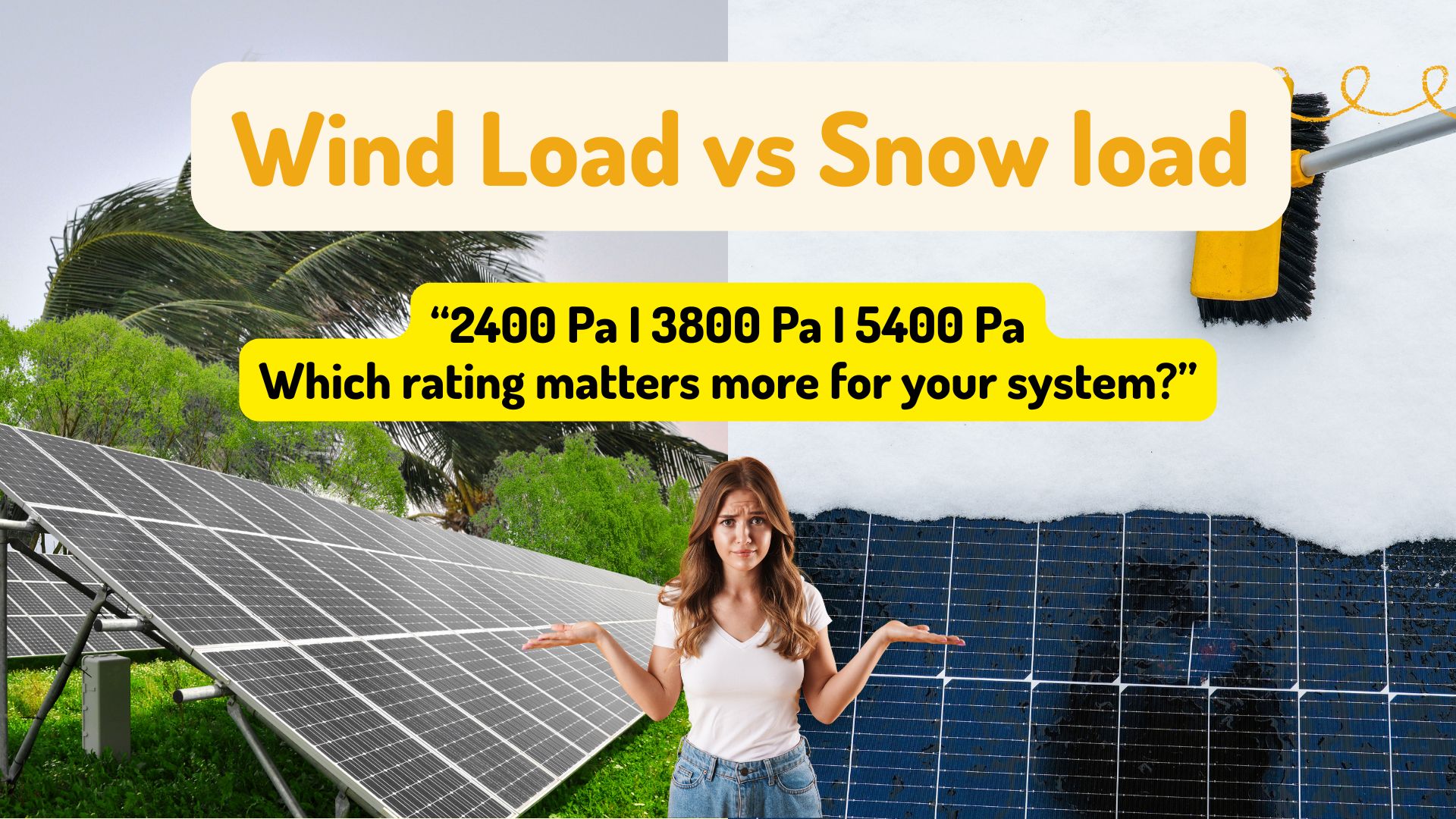
Wind Load vs Snow Load Rating of Solar Panels: Complete Guide for India (2025)
Are you living in a place with high wind speeds or heavy snowfall and still considering installing Solar?
Then this post is for you.
The strength of the solar panels becomes very important in these situations.
It is generally measured in 2 ways:
- Wind load rating
- Snow load rating
Together, they are termed the Mechanical load rating of the solar panels.
Why Do Coastal Areas have High Wind Speeds?
The coastal regions are the regions where land meets a water body, like a sea or ocean. This meeting line is called a coastline, and the region close to it is called a coastal region.
Examples: In India, Gujarat, Maharashtra, Goa, Kerala, Tamil Nadu, Odisha, West Bengal, and the Andaman & Nicobar Islands are coastal regions.

In the world: The U.S. East Coast (Atlantic), Mediterranean coastlines, Australia’s eastern seaboard, etc.
In these areas, high-speed gusts are normal due to their geography (proximity to the water body). Let us know the reasons why coastal regions have high wind speeds?
Land-sea Temperature Difference
The land and the sea both heat up and cool down at different rates.
Sea Breeze
In the daytime, the land heats up faster than the water. This means the air above the land surface is hotter than the air above the sea surface. The hotter air (less dense and lighter) rises upward, creating a void behind it.
Reason: Water has a higher heating capacity and can therefore store more heat than land without a significant rise in its temperature.

The cooler (more dense and heavier) air above the sea goes towards the land surface and fills that void. Hence, an air current develops, called sea breeze (wind from sea to land).
Land Breeze
At night, the land cools faster than water. Now, the air above the land is cooler and heavier than the air over the sea surface.

The warm, lighter air above the sea surface now rises upward, creating a void, and this space is occupied by the denser, heavier air coming from the nearby land surface. The wind current is called a land breeze.
In short, the temperature difference creates a pressure difference between the air above the two surfaces (sea and land), driving strong winds near coasts compared to the inland regions.
Also, over the sea and oceans, there are no obstacles like mountains, buildings, trees, etc to slow the wind speed. Hence, by the time these winds reach the coastal regions, they are still strong and fast.
Coriolis Effect
Due to the Earth’s rotation, the large-scale ocean and atmosphere circulation is deflected.

And this creates strong trade and monsoon winds whose effect is dominant in the coastal regions.
These reasons make coastal regions prone to strong and high-speed winds, creating enormous pressure over the solar panel surface.
What Wind Load Rating in Solar Panels really mean?
It is the ability of the solar panels to withstand wind pressure without breaking down. It is generally measured in Pascals.
The homeowners should look for IEC 61215 and IEC 61730 certifications in the data sheet of the solar panel. These certifications ensure quality and safety.
- IEC61215 = The solar panel will perform good and steadily under heat, cold, wind, snow, and hail for decades.
- IEC 61730 = The panel is safe against fire, electric shock, and mechanical risks.
Solar with 2400 Pa, 3800 Pa, and 5400 Pa have different meanings in terms of their capacities to withstand the wind pressure.
| Wind load Rating (Pa) | Equivalent theoretical Wind Speed (km/h) | Tested Wind Speed (km/h) [1/1.5 factor] |
| 2400 | 225.3 km/h | 150.2 km/h |
| 3800 | 283.6 km/h | 189.0 km/h |
| 5400 | 338.0 km/h | 225.3 km/h |

Therefore, a solar panel with a wind load rating of 2400 Pa is practically tested for about 150 km/h wind speed, considering the 1/1.5 safety factor.
In short, the solar panels with a high wind load rating are considered best for coastal regions in India.
Real Case Study of Coastal Region (Odisha)
Mr. Panda and his family from Odisha (coastal region of Bhubaneshwar) decided to go for a 5-kW solar power system to secure their retirement.
Want to know how much you can save with solar?
Before deciding on the wind load rating of the solar panels, let us look at the history of storms in the region:
- In 1999 Odisha Super Cyclone measured wind speeds up to 175 km/h in Puri and 150 km/h in Bhubaneshwar
- Cyclone Fani (2019): The wind speed reached up to 250 km/h.
- Cyclone Amphan (2020): Gusts up to 133 km/h were experienced in Kolkata and surrounding areas.
Therefore, the wind load rating of at least 5400 Pa was recommended to Mr. Panda to ensure safe operations during storms.
In Odisha, West Bengal, and Tamil Nadu, it is important to check the wind load rating first.
General Recommendations for Coastal Regions
| Region | Wind Speed Observed | Recommended Wind Load Rating (Pa) |
| Coastal Odisha | Up to ~250 km/h (Cyclone Fani) | ≥ 5400 Pa |
| Eastern Coast (Overall) | Frequently 120–200 km/h | ≥ 5400 Pa |
| Coastal Gujarat | Typically 169–180 km/h | 3800–5400 Pa |
Bottom Line

- The Eastern region is most vulnerable to high-speed cyclones and storms. Therefore, a wind load rating of 5400 Pa or higher is advised.
- The western coast also faces the risk of high wind speeds, especially in Saurasthra. Therefore, looking for a wind-load rating of 3800 Pa – 5400 Pa is recommended.
Why is Snowfall Common in Hilly Areas (Shimla, Manali, Gulmarg)?
As we go higher in the atmosphere, the temperature drops (about 6.5 °C per 1,000 meters).

In hilly areas or mountains, the air is much colder than plains. Hence, rainfall freezes into snow.
India example of Hilly Regions
| Hilly Area | Height (m above sea level) | Avg Winter Temp (°C) | Avg Summer Temp (°C) |
| Shimla (HP) | ~2,200 m | -2 to 8 °C | 15 to 25 °C |
| Manali (HP) | ~2,050 m | -5 to 5 °C | 10 to 25 °C |
| Nainital (UK) | ~2,084 m | 0 to 7 °C | 15 to 23 °C |
| Leh (Ladakh) | ~3,500 m | -10 to -2 °C | 5 to 20 °C |
| Gulmarg (J&K) | ~2,650 m | -7 to 3 °C | 12 to 25 °C |
| Darjeeling (WB) | ~2,045 m | 2 to 10 °C | 15 to 22 °C |
World Examples of Hilly Regions
| Hilly Area | Height (m above sea level) | Avg Winter Temp (°C) | Avg Summer Temp (°C) |
| Mount Everest Base Camp (Nepal) | ~5,364 m | -15 to -5 °C | 0 to 10 °C |
| Swiss Alps (Switzerland, Zermatt) | ~1,600–2,000 m | -5 to 5 °C | 10 to 20 °C |
| Rocky Mountains (Colorado, USA) | ~2,500–3,500 m | -10 to 0 °C | 10 to 25 °C |
| Andes (Cusco, Peru) | ~3,400 m | 0 to 8 °C | 15 to 22 °C |
| Mount Fuji (Japan) | ~3,776 m | -15 to -5 °C | 5 to 15 °C |
Also, at higher altitudes, the air pressure is low; therefore, it expands and cools faster. Now the cold air cannot hold much moisture, hence it condenses and falls as snowflakes.
When the monsoon winds or the western disturbances move towards the mountains. They strike and move upwards (orographic lift). In this process, the air expands, cools quickly, and falls as snow instead of rain.
Do Hilly Areas Experience Wind Gusts?
Yes, hills, mountains, and valleys do experience wind gusts. In fact, these topographical features amplify the wind speed. The narrow passage between the valleys acts like a nozzle (venturi effect), accelerating the wind speed.

Over hills and valleys, the wind speed can increase by around 45% compared to the flat land due to the barrier effect.
Therefore, the wind speed along with snow weight should also be considered while designing a system in hilly areas for panel stability.
Snow Load Rating in Solar Panels
The solar panels are mounted on the rooftop of a house in a hilly region.
Snow load is the pressure exerted on the solar panels by the weight of the snow. It is usually measured in Pascals.
Where;
1 Pa = 1 Newton/m²
In the data sheets, you see snow load rating values like 2400 Pa, 3800 Pa, and 5400 Pa.
Let us understand the real meaning of snow load rating:
| Snow Load Rating (Pa) | Equivalent Pressure (N/m²) | Theoretical Snow Capacity (kg/m²) | Practical Snow Capacity (kg/m²) [1/1.5] |
| 2400 | 2400 | 244.6 | 163.1 |
| 3800 | 3800 | 387.4 | 258.2 |
| 5400 | 5400 | 550.5 | 367.0 |

Real Case of Snow Load Rating (Himachal Pradesh)
Mr. Dogra was also planning to go solar when he came to know how his friend saved thousands of rupees in a very short time by going solar.
- Mr. Dogra and family (Shimla)
- Altitude ~2200 m
- House is well-built, low-rise, and flat roof
- Climate: Cold winters, frequent snowfall (light to moderate most years, heavy occasionally).
- Risks Panels can accumulate snow for weeks → extra weight.
“Make your solar investment foolproof”
Wind Speed data for Shimla
| Month | Max Gust (knots) | Max Gust (km/h) |
| Sept 2024 | 19 kt | 35.2 km/h |
| Oct 2024 | 22 kt | 40.7 km/h |
| Nov 2024 | 20 kt | 37.0 km/h |
| Dec 2024 | 26 kt | 48.2 km/h |
| Jan 2025 | 25 kt | 46.3 km/h |
| Feb 2025 | 30 kt | 55.6 km/h |
| March 2025 | 26 kt | 48.2 km/h |
| April 2025 | 27 kt | 50.0 km/h |
| May 2025 | 27 kt | 50.0 km/h |
| June 2025 | 24 kt | 44.4 km/h |
| July 2025 | 21 kt | 38.9 km/h |
| August 2025 | 29 kt | 53.7 km/h |
Recommendation
- Go for 5400 Pa snow load rating panels.
- This equals ~550 kg/m² theoretical snow weight (~367 kg/m² practical tested).
- Go for 2400 Pa wind load rating. This means that solar panels can withstand up to 150 km/h wind speed practically. 2400 Pa is technically sufficient as the house is low-rise, well-built, and flat roof.
- Panels should be installed at a tilt of ≥ 30–35° so snow slides off more easily.
- Use 40 mm+ frame panels with a strong mounting structure.
Verdict:
For Shimla → 5400 Pa minimum snow load rating is the safest choice.
In Himachal Pradesh, the homeowners in Shimla and Manali should check the snow load rating of solar panels before installation.
General Recommendation for Hilly Areas/Snowfall regions:
| Region & Snow Severity | Panel Snow Rating | Panel Wind Rating | Notes |
| Light snow (e.g., Nainital, Mussoorie, Darjeeling – town cores) | ≥ 3800 Pa | ≥ 2400–3800 Pa | 30–35° tilt; HDG/Al structure; standard anchors OK if not highly exposed. |
| Moderate–heavy snow (Shimla urban, Manali, Auli, Gulmarg) | ≥ 5400 Pa | ≥ 3800 Pa (prefer 5400 Pa on exposed roofs/ridges) | 35–40° tilt; stronger clamps; chem anchors; edge setback ≥0.5 m. |
| High-altitude/extreme (Ladakh, upper Himachal/J&K) | ≥ 5400 Pa (industrial-grade modules) | ≥ 5400 Pa | 40–45° tilt; heavier rails, more support points; design for drift load. |
I have taken the wind rating on the higher side because if the roof is exposed and high-rise, then the wind speed is further accelerated. Therefore, a higher wind load rating is considered a safer bet for the smooth operation of the system.
Wind Load vs Snow Load: Comparison
| Feature | Wind Load Rating | Snow Load Rating |
| Definition | The pressure panel can withstand strong winds (uplift or push force). | The pressure panel can withstand the weight of snow sitting on it. |
| Unit | Pascal (Pa) = N/m² | Pascal (Pa) = N/m² |
| Typical Values | 2400 Pa (standard), 3800 Pa, up to 5400 Pa for high-wind zones | 2400 Pa, 3800 Pa, 5400 Pa (heavy snow areas) |
| Force Direction | Dynamic: Wind blows horizontally, creating uplift/suction on panels. | Static: Snow sits vertically on the panel, creating downward weight. |
| Test Standard | IEC 61215 / IEC 61730 (tested with suction/blowing force) | IEC 61215 / IEC 61730 (tested with uniform load on panel surface) |
| Equivalent Meaning | 2400 Pa ≈ 225 km/h wind speed | 5400 Pa ≈ 550 kg of snow per m² |
| Risk if Under-rated | Panels may lift, break, or fly off in storms/cyclones. | Panels may bend, crack, or collapse under heavy snow weight. |
| Critical Regions | Coastal areas (Odisha, Gujarat, Tamil Nadu), cyclone-prone zones, and high-rise rooftops | Hilly & cold regions (Himachal, Kashmir, Uttarakhand) |
| Solution | Strong mounting structure, proper anchoring, tilt adjustment | Higher tilt angle (snow slides off), stronger frames, 5400 Pa-rated panels |

Decision Chart for Solar Panel Ratings

Conclusion
When ensuring safety and strength of the solar panels, wind load and snow load ratings are more than just numbers on a datasheet—they indicate how well your system can withstand extreme weather.
- In coastal and cyclone-prone areas like Odisha, Gujarat, and Tamil Nadu, a high wind load rating (≥ 3800–5400 Pa) is crucial to resist storms and strong gusts.
- In hilly and snow-prone areas (Shimla, Manali, Gulmarg, Ladakh), a high snow load rating (≥ 5400 Pa) ensures panels won’t bend or crack under heavy snow.
- For most of India’s plains, a standard 2400–3800 Pa rating is sufficient, but investing in stronger ratings provides peace of mind and longer system life.
👉 Bottom line: Always match your solar panel’s wind and snow load rating with your region’s climate risks. A slightly higher upfront investment in stronger panels and mounting structures can save you from costly damage, downtime, and safety hazards in the long run.
🔎 Before buying, always check your panel’s datasheet—or consult a solar expert to choose the right rating for your region.
Want to know exactly which solar panels are right for your home?