Green Hydrogen Technology: From Sunlight to Clean Energy
From School Science to the Future of Clean Energy
Do you remember those school days when we learned about hydrogen — the lightest gas in the universe?
We read how it’s colorless, odorless, and lighter than air — and how hydrogen balloons could fly high into the sky.
Back then, it felt like magic.
But as we grew up, we discovered that hydrogen isn’t just one thing — it comes in different forms: grey, blue, and green — each telling a different story about how clean (or dirty) it is.
Today, the world is turning its eyes toward Green Hydrogen, a clean version made from sunlight and water — one that could power homes, cars, and industries without polluting our planet.
What is Hydrogen?
Hydrogen is the first element in the periodic table. It is odorless, colorless, non-toxic, and the lightest gas. It generally occurs in the combined state in vast quantities as in oceans, sea, ice, lakes, rivers, and the atmosphere.
Also, Hydrogen is present in all animals, vegetables, and petroleum products (coal, natural gas).

If you want hydrogen, you need to separate it from its compounds, and doing so requires energy.
The process you adopt to separate hydrogen from its compounds determines its impact on the environment.
Hydrogen as a energy source
Once extracted, hydrogen can be stored as compressed gas or cryogenic liquid (stored in its condensed form). It has one of the highest energy densities per unit mass.
With one of the highest energy densities per unit mass, hydrogen releases 120 kJ to 140 kJ of energy when 1 kg of it is burned.
It has applications in many sectors that can be divided into 3 broad categories:
- It is used in power plants and can be used as a backup energy source.
- Industries for oil refining, ammonia production, methanol production, and steel production, and all this hydrogen is made through fossil fuels. Therefore, there is a significant potential for emissions reduction from clean hydrogen.
- Used as a fuel in land, water, air, and space transportation
The primary use of hydrogen is in fertilizer production, steel production, and hydro-cracking (the process of converting heavy fuel into kerosene, diesel, naphtha, and other high lubricating oils under high-pressure hydrogen).
Hydrogen “Forms” : Grey, Blue, and Green
Hydrogen gets its “color” not from appearance but from the process used to make it.
| Type | Source | Carbon Emissions | Process |
|---|---|---|---|
| Grey Hydrogen | Natural Gas | High | Steam Methane Reforming (SMR) |
| Blue Hydrogen | Natural Gas + Carbon Capture | Medium | SMR + CCS |
| Green Hydrogen | Water + Renewable Energy | Zero | Electrolysis of Water |
When you produce hydrogen using renewable energy — like solar or wind power — the result is Green Hydrogen, a truly sustainable fuel.
What is Grey Hydrogen and Why is it a Problem?
Natural gas is currently the primary source of hydrogen production. Most of the hydrogen is produced through Steam Methane Reforming (SMR).
Natural gas contains methane that is made to react with steam under high pressure to produce hydrogen.
But in this process, greenhouse gases such as carbon monoxide and carbon dioxide are also produced.
1) CH₄ (Methane) + H₂O (steam) –> CO + H₂ (Hydrogen)
2) CO (Carbon monoxide) + H₂O (steam) –> H₂ + CO₂
In addition, some methane leaks out in this process and gets dispersed into the atmosphere.
This leakage further adds to global warming. The hydrogen produced in the SMR process is called Grey Hydrogen, which leads to the emission of greenhouse gases that have a disastrous climatic impact.
When you manage, control, and prevent the dispersal of carbon monoxide and carbon dioxide into the atmosphere through the carbon capture and control process, the same hydrogen produced is called Blue hydrogen.
But some of these gases always leak out into the atmosphere.
Why do we produce Grey Hydrogen?
The wide range of applications of hydrogen as a fuel and the fuel cost is the main components that drive hydrogen production using natural gas. And Russia, the Middle East, North America, Turkmenistan, and Venezuela are the countries rich in natural gas reserves.
That is why you see the lowest gas prices in these countries and this is the reason for the low cost of hydrogen production through the SMR process.
Green Hydrogen: Why has its demand increased suddenly?
The wide applications of hydrogen as a fuel have resulted in a 300% increase in its demand in the last 4 decades. And this process has resulted in 830 million metric tonnes of CO₂ emissions each year (equivalent to the CO₂ emissions of Brazil and Italy combined), leading to global warming.
Before, we hit a climate disaster, the search for an alternate method has started that can produce hydrogen without greenhouse gas emissions.
And here comes GREEN HYDROGEN.
Water covers over 70% of the Earth’s surface, and if we can extract hydrogen from it economically, it can meet the energy demands of the world and drive the future economy. And Green hydrogen has the potential to reduce global warming by 2°C by 2050.
How Does Solar Energy Help Produce Green Hydrogen?
Hydrogen can be produced through the electrolysis of water. It is a process of breaking water molecules into hydrogen and oxygen using an electric current. And when we use renewable sources of energy like solar or wind to produce electric current, the hydrogen produced is called Green Hydrogen.
For that, we need a big electrolyzer and plenty of electricity for breaking water molecules.
- Solar PV or Wind
- Inverter
- Electrolyzers
- Hydrogen produced and stored
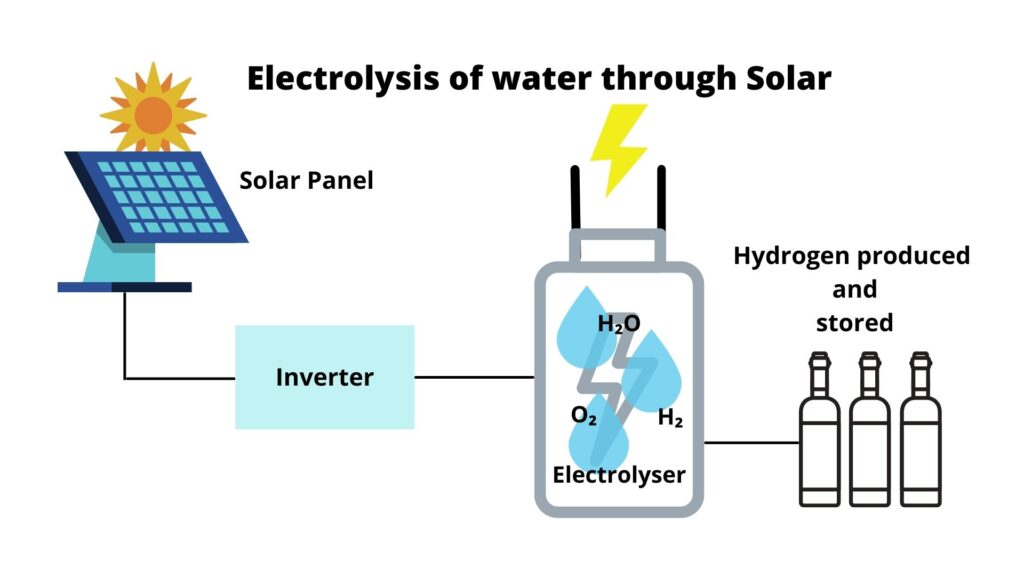
Solar electricity cannot be produced at night. Therefore, in the daytime when sunlight is at its peak, the hydrogen generated through solar is in excess and it can be stored for later use.
Hydrogen produced by countries abundant in solar resources can produce excess hydrogen, store it, and transport it long distances to other energy-deficient regions.
Green Hydrogen vs. Grey Hydrogen
| Feature | Grey Hydrogen | Green Hydrogen |
|---|---|---|
| Source | Natural Gas | Water + Renewable Power |
| Carbon Emissions | High | Zero |
| Cost (2023) | $1–3/kg | $2.5–6/kg |
| Scalability | Mature | Rapidly Growing |
| Impact | Fossil-based | Climate-friendly |
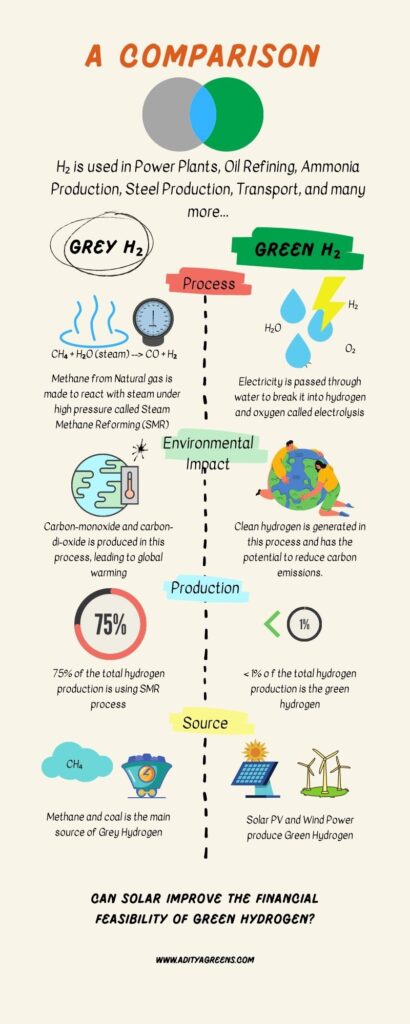
Although green hydrogen currently costs more, its price is falling fast as solar and wind energy become cheaper.
The different shades of Hydrogen
a) Green hydrogen is generated by the electrolysis of water (as explained above). The current needed to break water molecules is produced by renewable energy sources such as solar or wind power.
b) Turquoise Hydrogen: The methane obtained from natural gas is split into hydrogen and separable solid carbon. The splitting requires electricity, and if the electricity is produced from renewable energy sources such as solar or wind, it makes this whole process carbon-neutral.
c) Blue Hydrogen is produced through the SMR process, and the greenhouse gases produced are stored through the CCS (carbon capture and storage) process.
d) Grey Hydrogen is produced through the SMR process, and the carbon emissions are released into the air.
e) Brown/Black hydrogen is produced from brown coal and black coal.
The gasification of coal produces hydrogen, and carbon dioxide is released.
Cost of making Green Hydrogen
Although, green hydrogen production is technically viable. But to make it come into mainstream production, the economic feasibility is very important.
At present, green hydrogen costs $2.5 to $6 per kg, almost 2 to three times more costly than its production using the SMR process ($1 to $3 per kg). Energy giants are making efforts to reduce their production cost to $ 2/kg by 2030.
Top energy developers took Green Hydrogen initiative
The top 7 energy developers have come together to decarbonize industries’ processes by accelerating the green hydrogen production 50 folds in the next 6 years to bring down its production cost to $2/kg
- ACWA Power (Saudi Arabia)
- CWP renewables (Australia)
- Envision (China)
- Iberdrola (Spain)
- Ørsted (Denmark)
- Snam (Italy)
- Yara (Norway)
Green Hydrogen in India
India launched the National Green Hydrogen Mission (2023) with a bold goal:
- Produce 5 million tonnes of green hydrogen per year by 2030.
- Attract ₹8 lakh crore in investment.
- Replace grey hydrogen in fertilizer, steel, and refineries.
With our abundant solar potential, India could become a global leader in green hydrogen exports — turning sunlight into a new kind of economic power.
Related Resource:
Want to see how much solar can save for your home or business?
it helps you size, design, and calculate ROI in minutes.
How Solar can Help in Green Hydrogen Production?
Solar PV offers a clean and low-cost option for producing electricity for the electrolysis process.
With the advancement in solar technology and the increase in demand, the solar electricity production cost is falling constantly. Scientists are working to improve the efficiency of solar panels. (We see solar panels having efficiency as high as 22%).
The improved technologies like Half-cut solar cell technology, Bifacial, and Mono-PERC produce more power than before, and people are more interested in solar installations.
More solar installations mean the solar cost will fall further, and this process keeps repeating, resulting in us seeing some of the lowest prices of solar electricity in the future. This cheap solar electricity is used for the electrolysis of water, which will improve the financial feasibility of green hydrogen.
The Challenges in Green Hydrogen Adoption
1) Although hydrogen itself is a clean energy source but it occurs in combined forms, so we need other energy sources to separate it from its compounds, adding extra infrastructure cost to its production.
2) Hydrogen is a highly inflammable gas , and even a small negligence can be disastrous to human life and material. Therefore, hydrogen production plants must be certified for the utmost safety standards.
3) It is difficult to store hydrogen, whether we keep it in compressed form or condense it at a lower temperature. This adds to the overall cost.
In addition, we need special tankers that can take condensed or compressed hydrogen from one point to another
4) There is a financial risk for the investors who are taking the first step in green hydrogen. The government should structure the right financial tools, such as loan amount, duration, payback period, etc, specific to the investment in green hydrogen, so that more private players come in and invest in this technology.
5) There is a need to allocate funds for technology development. More research can improve the electrolysis process.
The Future: Solar + Hydrogen = Clean Energy Independence
Just as solar PV transformed electricity costs over the last decade, green hydrogen is set to do the same for industrial fuel and mobility.
As solar technology advances — with Mono-PERC, Bifacial, and Half-cut solar cells improving efficiency — the cost of renewable electricity keeps falling.
And when cheap solar meets clean hydrogen, we get a self-sustaining, pollution-free energy cycle.
Imagine: Your rooftop solar panels not only power your home but also contribute to creating fuel for cars, factories, and even airplanes — all from sunlight and water. That’s the clean, exciting future we’re building toward.
Green hydrogen is more than a technology — it’s a pathway to clean, independent energy.
Let’s make that future real — one rooftop, one solar panel, and one molecule of hydrogen at a time.
Want to Master Solar System Size, Design, and Financial Feasibility Yourself
If you want to learn how to size, design, and calculate the financial feasibility of solar systems —
join my Solar Energy Masterclass: Basics to Profit.

Frequently Asked Questions: Green Hydrogen
1. What makes hydrogen “green”?
Hydrogen is called green when it’s produced using renewable electricity (like solar or wind) to split water — without any carbon emissions.
2. Is green hydrogen safe?
Yes, when handled with proper equipment and safety protocols. Hydrogen is flammable but manageable with the right storage and certification standards.
3. Why is green hydrogen so expensive now?
Mainly because electrolyzers and renewable setups are still costly. But prices are expected to fall to $2/kg by 2030.
4. Can green hydrogen power homes?
Not directly yet. It’s mainly used in industries and transport, but in the future, hydrogen fuel cells may power homes and communities.
5. How does solar energy help green hydrogen?
Solar PV provides the electricity needed for electrolysis, making hydrogen production 100% clean and sustainable.