How Much Money Will Rooftop Solar Save? A Complete Homeowner’s Decision Guide
If you are planning to install a rooftop solar system, one of the first questions that probably comes to your mind is:
“How much money will rooftop solar save me?”
It is one of the most important questions because the expected savings largely determine whether rooftop solar is a worthwhile investment for your home.
At first glance, the answer may seem straightforward. However, there is no single savings figure that applies to every homeowner. Even two families installing the same size solar system may experience significantly different savings over its lifetime.
This is because rooftop solar savings depend on several factors, including your electricity consumption, daytime energy usage, local electricity tariff, solar resource, system size, net-metering policy, equipment quality, maintenance practices, panel degradation, and future electricity price escalation.
In other words, the objective is not to estimate an average saving, but to determine the right savings for your home.
In this guide, we will explain each factor that influences rooftop solar savings, show how they affect your annual and lifetime savings, and help you estimate realistic financial benefits before making your investment decision.
By the end of this guide, you will understand not only how much money rooftop solar can save, but also why those savings differ from one homeowner to another and how you can maximize the financial return from your solar investment.
Quick Decision Summary
A short checklist to maximise the savings:
✅ Moderate to high electricity bill
✅ Good daytime electricity consumption
✅ Shade-free roof
✅ Net-metering available
✅ Higher local electricity tariff
1. How Does Rooftop Solar Save Money?
The basic principle behind rooftop solar savings is simple. Once a rooftop solar system is installed, the solar panels absorb sunlight and convert it into electricity. This electricity is then used to power your home’s electrical appliances during the daytime.
Every unit of solar electricity that you consume is one less unit of electricity that you need to purchase from the utility grid. As a result, your dependence on grid electricity decreases, leading to a lower monthly electricity bill.
In simple terms:
Sunlight → Solar Panels → Electricity Generation → Reduced Grid Electricity Consumption → Lower Electricity Bill → Financial Savings
Example
Suppose your rooftop solar system generates 8 units (8 kWh) of electricity during the daytime, and all of these units are consumed by your home. Since these 8 units are supplied by your solar system, you avoid purchasing 8 units of electricity from the utility grid.
If your electricity tariff is:
- India: ₹8 per unit
- USA: $0.18 per unit
Then your savings for that day would be:
India: 8 units × ₹8 per unit = ₹64 saved
USA: 8 units × $0.18 per unit = $1.44 saved
Key Takeaway
Rooftop solar does not generate income directly—it saves money by reducing the amount of electricity you need to purchase from the utility grid.
The more grid electricity your solar system replaces, and the higher your electricity tariff, the greater your financial savings.
These savings accumulate day after day, month after month, and year after year. Over the lifetime of the solar system, they can recover your initial investment and, in many cases, provide substantial additional savings beyond the payback period.
However, not every homeowner saves the same amount. Even two families installing the same size rooftop solar system may experience different savings because several factors influence the final outcome. These include your electricity consumption, daytime energy usage, local electricity tariff, solar resource, system size, net-metering policy, equipment performance, maintenance practices, panel degradation, and future electricity price escalation.
The following sections explain each of these factors in detail so that you can estimate the right savings for your home rather than relying on average figures.
2. Factors Affecting Solar Savings
Let us know about these factors:
(i) Electricity Consumption
One of the most important factors affecting rooftop solar savings is your electricity consumption. In general, the more electricity your household consumes, the larger the rooftop solar system required to offset that consumption.
A larger solar system generates more electricity, replacing a greater number of grid units. Since every unit of solar electricity used by your home replaces a unit that would otherwise be purchased from the utility grid, higher electricity consumption generally results in greater potential savings.
The relationship can be summarized as:
Higher Electricity Consumption → Larger Solar System → More Grid Units Replaced → Greater Financial Savings
Example – India
Suppose two homeowners in Delhi have different electricity consumption.
| System Size | Average Daily Solar Generation | Electricity Tariff | Approximate Daily Savings |
|---|---|---|---|
| 5 kW | 20 kWh | ₹8 per unit | ₹160/day |
| 8 kW | 32 kWh | ₹8 per unit | ₹256/day |
The 8kW system replaces more grid electricity than the 5 kW system and therefore produces higher daily savings.
Example – Texas (USA)
Assume two homeowners in Houston have similar solar conditions.
| System Size | Average Daily Solar Generation | Electricity Tariff | Approximate Daily Savings |
|---|---|---|---|
| 5 kW | 20 kWh | $0.17 per kWh | $3.40/day |
| 8 kW | 32 kWh | $0.17 per kWh | $5.44/day |
Again, the larger system replaces more grid electricity and therefore provides greater daily savings.
However, installing a larger solar system simply to increase savings is not always the right decision. The system should be designed to match your present and expected future electricity requirements. Oversizing a system without a corresponding increase in electricity consumption may reduce its financial efficiency and extend the payback period.
(ii) Daytime Consumption Pattern
Another important factor affecting rooftop solar savings is when you consume electricity, not just how much you consume.
Rooftop solar panels generate electricity only during daylight hours. Therefore, homeowners who consume a larger share of their electricity during the daytime are generally able to use more of the electricity produced by their solar system directly.
Since every unit of solar electricity used in the home replaces a unit that would otherwise be purchased from the utility grid, higher daytime consumption often leads to greater financial savings.
Consider two families with the same total daily electricity consumption of 30 kWh.
- Family A works from home, has senior family members at home during the day, and runs appliances such as air conditioners, washing machines, and computers while the solar system is generating electricity.
- Family B spends most of the day outside the home and uses most of its electricity during the evening and night.
Although both families consume the same amount of electricity over 24 hours, Family A is likely to achieve higher savings because it directly uses a larger portion of the electricity generated by its rooftop solar system.
Family B, on the other hand, may export more electricity to the grid during the day and purchase more electricity from the grid at night. Depending on the applicable net-metering or export compensation policy, this can reduce the overall financial savings.
Decision Insight
The more electricity you consume while your solar system is generating power, the greater your potential savings from rooftop solar.
(iii) Electricity Tariff
The amount of electricity generated by your rooftop solar system is only one part of the savings equation. The value of each unit of electricity is equally important.
Every unit of electricity generated by your solar system replaces a unit that you would otherwise purchase from the utility grid. Therefore, the higher your residential electricity tariff, the greater the monetary value of every unit of solar electricity generated.
This means that two homeowners with identical rooftop solar systems may generate the same amount of electricity but achieve very different financial savings simply because they pay different electricity tariffs.
The relationship can be summarized as:
Higher Electricity Tariff → Higher Value of Each Solar Unit → Greater Financial Savings
Example 1: India
Assume two homeowners install identical 5 kW rooftop solar systems, and each system generates 20 units (20 kWh) on a sunny day.
| City | Solar Generation | Residential Electricity Tariff | Daily Savings |
|---|---|---|---|
| Jaipur | 20 kWh | ₹7.2 per unit | ₹144/day |
| Ahmedabad | 20 kWh | ₹8.8 per unit | ₹176/day |
Although both systems generate the same amount of electricity, the homeowner in Ahmedabad saves more money because each solar unit replaces a more expensive grid unit.
Example 2: USA
Now consider two identical 5kW rooftop solar systems installed in Houston and San Diego, each generating 20 kWh on the same day.
| City | Solar Generation | Residential Electricity Tariff | Daily Savings |
|---|---|---|---|
| Houston, Texas | 20 kWh | $0.17 per kWh | $3.40/day |
| San Diego, California | 20 kWh | $0.40 per kWh | $8.00/day |
Again, both systems generate the same amount of electricity, yet the homeowner in San Diego saves considerably more because the local electricity tariff is much higher.
These examples show that the financial value of solar electricity depends not only on how many units your system generates but also on the price of the grid electricity those units replace.
Decision Insight
Two rooftop solar systems producing the same amount of electricity can generate very different financial savings because electricity tariffs vary from one location to another. The higher the electricity tariff, the greater the value of every solar unit generated.
(iv) Electricity Tariff Escalation
In the previous section, we saw how the current electricity tariff affects rooftop solar savings. However, the current tariff is only part of the story. Electricity prices generally increase over time because of inflation, rising fuel costs, increasing infrastructure investments, and changes in utility pricing.
As electricity tariffs increase, every unit of electricity generated by your rooftop solar system replaces a more expensive grid unit. As a result, the monetary value of your solar generation also increases over time.
This means that even if two homeowners install identical rooftop solar systems and currently pay the same electricity tariff, their future savings may differ if electricity prices increase at different rates in their respective locations.
The relationship can be summarized as:
Higher Electricity Tariff Escalation → Higher Future Value of Solar Electricity → Greater Lifetime Savings
Example
Consider two homeowners installing identical 5 kW rooftop solar systems, each generating 20 units (20 kWh) per day.
Both currently pay:
- Electricity tariff = ₹8 per unit
- Daily savings = ₹160
However, assume the annual electricity tariff escalation differs.
| Location | Current Tariff | Annual Tariff Escalation | Present Daily Savings | Daily Savings After 10 Years* |
|---|---|---|---|---|
| Place X | ₹8.00/unit | 3% | ₹160 | ≈ ₹215/day |
| Place Y | ₹8.00/unit | 2% | ₹160 | ≈ ₹195/day |
*Assuming the solar system continues to generate approximately the same amount of electricity and only the electricity tariff changes for illustration. In practice, solar panel output gradually declines over time because of panel degradation, which is discussed in a later section.
Explanation
Today, both homeowners save exactly ₹160 per day because they generate the same amount of solar electricity and pay the same electricity tariff.
(Add graph here)
However, after 10 years, the homeowner in Place X saves approximately ₹215 per day, while the homeowner in Place Y saves about ₹195 per day.
Although both solar systems generate the same amount of electricity, the homeowner in Place X saves more because the value of every solar unit has increased faster due to the higher annual electricity tariff escalation.
Decision Insight
A rooftop solar system generates electricity, but its financial value depends on the future price of grid electricity. The faster electricity tariffs increase, the greater your future solar savings are likely to be.
(v) Solar Panel Degradation
Solar panels do not continue producing the same amount of electricity throughout their entire lifetime. Like most engineering systems, their performance gradually declines with age. This gradual reduction in electricity generation is known as solar panel degradation.
Although the reduction in annual electricity generation is relatively small, it accumulates over the solar system’s lifetime and therefore affects the total electricity generated and the overall financial savings.
Typically, solar panels experience slightly higher degradation in the first year of operation, followed by much lower, relatively stable annual degradation thereafter. The exact degradation rate depends on the panel technology, manufacturing quality, and operating conditions.
Modern technologies such as TOPCon and HJT generally exhibit lower long-term degradation than many conventional panel technologies. However, all solar panels degrade over time—the difference lies only in the rate of degradation.
The relationship can be summarized as:
Higher Panel Degradation → Lower Electricity Generation → Lower Lifetime Savings
Example
Consider two neighbouring families.
Both have:
- 5 kW rooftop solar system
- Same location
- Same sunlight (PSH)
- Same electricity tariff (₹10/unit)
- Same electricity consumption
The only difference is the long-term degradation rate of their solar panels.
Add whole 25 years of degradation and chart amd assume ₹ 8 per unt letit be constant
| Parameter | Family A | Family B |
| Initial Annual Generation | 7,200 kWh | 7,200 kWh |
| Annual Degradation | 0.20% | 0.30% |
| Electricity Tariff | ₹10/unit | ₹10/unit |
Now show the comparison after 10 years.
| Parameter | Family A | Family B |
| Annual Generation (Year 10) | ≈ 7,071 kWh | ≈ 7,008 kWh |
| Annual Savings (Year 10) | ≈ ₹70,710 | ≈ ₹70,080 |
Although the annual difference appears relatively small, it continues to accumulate throughout the entire lifetime of the solar system. Over 25–30 years, lower degradation results in greater electricity generation and higher lifetime savings.
Decision Insight
A small difference in annual degradation may seem insignificant today. Still, over 25–30 years, it can lead to meaningful differences in the total electricity generated and the financial savings from your rooftop solar system.
(vi) Net-Metering Policy and Export Compensation Policy
The amount of money you save from a rooftop solar system depends not only on how much electricity you generate, but also on how your electricity distribution company (DISCOM or utility) values the electricity exported to the grid.
During the daytime, your solar system may generate more electricity than your home consumes. The surplus electricity is exported to the utility grid. The way this exported electricity is credited or compensated depends on the metering policy applicable in your area.
Different policies can produce significantly different electricity bills and, consequently, different financial savings—even when two homeowners generate exactly the same amount of solar electricity.
The relationship can be summarized as:
More Favorable Export Compensation → Higher Financial Savings
Example
Assume the following:
- Solar generation = 200 units
- Household electricity consumption = 210 units
- Direct self-consumption = 110 units
- Electricity imported from the grid = 100 units
- Electricity exported to the grid = 90 units
- Retail electricity tariff = ₹8 per unit
- Export tariff (where applicable) = ₹3 per unit
1. Net-Metering
Under net metering, exported electricity is adjusted against imported electricity on a unit-to-unit basis.
| Item | Units |
|---|---|
| Grid Import | 100 |
| Grid Export | 90 |
| Net Grid Consumption | 10 units |
Electricity Bill: 10 × ₹8 = ₹80
2. Gross Metering
Under gross metering, all electricity generated by the solar system is sold to the utility, while all household consumption is purchased separately from the grid.
| Item | Calculation |
|---|---|
| Electricity Purchased | 210 × ₹8 = ₹1,680 |
| Solar Export Credit | 200 × ₹3 = ₹600 |
Net Electricity Bill = ₹1,080
3. Feed-in-Tariff
Under a feed-in tariff arrangement, exported electricity is compensated at a predetermined rate that is generally lower than the retail electricity tariff.
| Item | Calculation |
|---|---|
| Electricity Purchased | 100 × ₹8 = ₹800 |
| Export Credit | 90 × ₹3 = ₹270 |
Net Electricity Bill = ₹530
4. Zero Export Mode
In zero-export systems, the inverter limits solar generation so that no electricity is exported to the utility grid.
Any electricity that cannot be consumed immediately is simply not generated.
In this example:
- Direct Solar Consumption = 110 units
- Electricity Imported = 100 units
Electricity Bill
100 × ₹8 = ₹800
Although the electricity bill is higher than under net metering, zero-export systems may still be a practical solution in locations where exporting electricity to the grid is not permitted.
Why System Sizing Becomes More Important in Zero-Export Mode
In a zero-export system, excess solar generation is curtailed rather than exported to the grid. Therefore, an oversized system may not provide proportional financial benefits. Homeowners should carefully size their rooftop solar system based on their daytime electricity consumption and future energy requirements.
| Policy | Electricity Bill | Relative Savings |
|---|---|---|
| Net Metering | ₹80 | ⭐⭐⭐⭐⭐ Highest |
| Feed-in Tariff | ₹530 | ⭐⭐⭐ |
| Zero Export | ₹800 | ⭐⭐ |
| Gross Metering | ₹1,080 | ⭐ Lowest |
(vii) Solar Resource(location)
Another important factor affecting rooftop solar savings is the solar resource available at your location, often expressed as Peak Sun Hours (PSH).
The amount of electricity generated by a rooftop solar system depends largely on the amount of sunlight it receives. Locations with higher PSH enable the same solar system to generate more electricity than locations with lower PSH.
However, there is another important aspect that many homeowners overlook.
The required system size is inversely related to the available solar resource. In other words, for the same annual electricity consumption, a location with higher PSH generally requires a smaller rooftop solar system, whereas a location with lower PSH requires a larger system to generate the same amount of electricity.
This can be summarized as:
Higher PSH → Smaller System Size → Lower Initial Investment → Faster Payback
Conversely,
Lower PSH → Larger System Size → Higher Initial Investment → Slower Payback
Example – India
Consider two families with identical annual electricity consumption.
| Parameter | Jaipur | Shimla |
| Average PSH | Higher | Lower |
| Electricity Consumption | Same | Same |
| Required System Size | Smaller | Larger |
| Initial Investment | Lower | Higher |
| Potential Payback | Faster | Slower |
Although both families consume the same amount of electricity, the family in Jaipur generally requires a smaller rooftop solar system because of the higher solar resource available throughout the year.
Example – USA
Now consider two homeowners with similar electricity consumption.
| Parameter | Phoenix, Arizona | Seattle, Washington |
| Average PSH | Higher | Lower |
| Electricity Consumption | Same | Same |
| Required System Size | Smaller | Larger |
| Initial Investment | Lower | Higher |
| Potential Payback | Faster | Slower |
Again, the homeowner in Phoenix can typically meet the same electricity demand with a smaller solar system than the homeowner in Seattle because of the higher solar resource.
Latitude and Solar Resource
In general, locations closer to the equator receive more solar radiation throughout the year and therefore tend to have higher Peak Sun Hours (PSH). As a result, homeowners in these regions often require smaller rooftop solar systems to meet the same electricity demand.
Conversely, locations at higher latitudes generally receive lower annual solar radiation and therefore may require larger systems to generate the same amount of electricity.
However, latitude is not the only factor affecting solar resource. Local climate, cloud cover, altitude, and seasonal weather patterns also influence the amount of sunlight available at a particular location.
Decision Insight
For the same electricity requirement, homeowners living in locations with higher solar resource generally require smaller rooftop solar systems, resulting in lower initial investment, faster payback, and often higher financial returns.
(viii) Maintenance Practices
Maintenance is one of the most overlooked factors affecting rooftop solar savings. Although rooftop solar systems require relatively little maintenance, how well you maintain your system can significantly influence the amount of electricity it generates over its lifetime.
Dust, bird droppings, leaves, pollen, and other debris gradually accumulate on the surface of solar panels, reducing the amount of sunlight reaching the solar cells. As a result, the system generates fewer units of electricity, leading to lower financial savings.
Regular cleaning, periodic inspections, and timely servicing help ensure that the system continues to operate close to its designed performance.
The relationship can be summarized as:
Better Maintenance → Higher Electricity Generation → Greater Financial Savings
Example
Consider two neighbouring families.
Both have:
- 5 kW rooftop solar system
- Same solar panel technology
- Same inverter
- Same electricity tariff
- Same Peak Sun Hours (PSH)
- Same electricity consumption
- Same net-metering policy
The only difference is their maintenance practices.
| Parameter | Family A | Family B |
|---|---|---|
| Panel Cleaning | Every 2–4 weeks | Occasional |
| Preventive Inspection | Regular | Rare |
| Annual Generation | Higher | Lower |
| Annual Savings | Higher | Lower |
Although both families installed identical rooftop solar systems, Family A consistently generates more electricity because the solar panels remain cleaner and the system is maintained properly. Over the lifetime of the project, this difference in generation can translate into higher cumulative savings.
Practical Tips
To maximize rooftop solar savings:
- Clean solar panels at appropriate intervals based on local dust and weather conditions.
- Inspect wiring and mounting structures periodically.
- Monitor system performance through the inverter or monitoring app.
- Address faults promptly to avoid prolonged generation losses.
Decision Insight
Rooftop solar is not a “fit-and-forget” investment. Simple maintenance practices can help maximize electricity generation and improve lifetime financial savings.
3. Annual vs Lifetime Savings
Many homeowners estimate the financial benefits of rooftop solar using only the first year’s expected savings.
For example, the payback period is often calculated as:
Payback Period = (Initial Investment − Government Subsidy) ÷ First-Year Annual Savings
While this provides a quick estimate, it assumes that your annual savings remain constant throughout the lifetime of the solar system. In reality, this is rarely the case.
Over a project life of 25–30 years, annual savings are continuously influenced by several factors, including:
- Electricity tariff escalation
- Solar panel degradation
- Maintenance costs
- Equipment replacement (such as inverter replacement)
- Repairs and servicing
- Other miscellaneous operating expenses
Some of these factors increase your savings, while others reduce them. As a result, your annual savings are dynamic rather than constant.
For example, increasing electricity tariffs generally increase the financial value of every unit generated by your rooftop solar system. On the other hand, gradual solar panel degradation reduces electricity generation over time, while maintenance and equipment replacement introduce additional costs during certain years of the project’s lifetime.
Consequently, the financial performance of a rooftop solar system is not represented by a straight line. Instead, it is the combined effect of all these factors over time.
Example
The figure below illustrates the expected savings (year on year) for 25 years of a typical 5 kW rooftop solar system installed in Delhi/NCR.
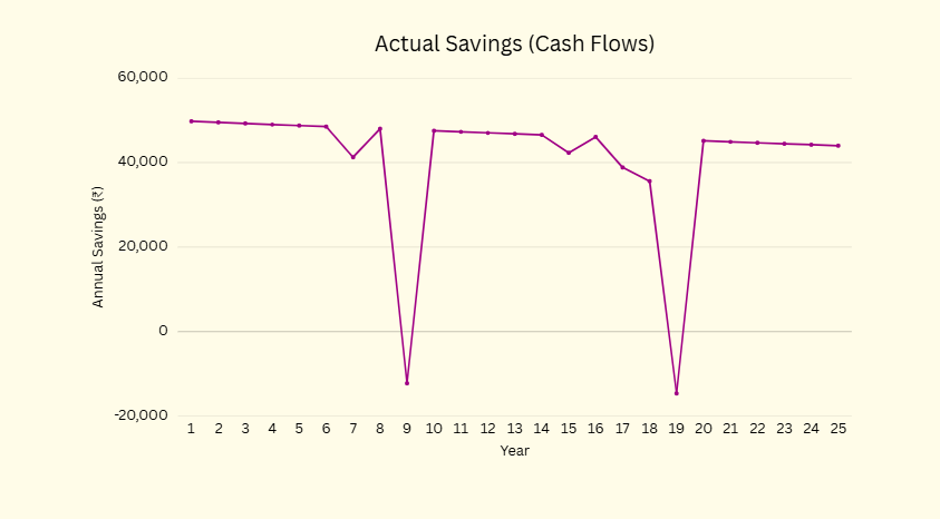
The graph demonstrates how annual savings evolve as electricity tariff escalation, solar panel degradation, maintenance costs, and equipment replacement collectively influence the overall financial performance of the system.
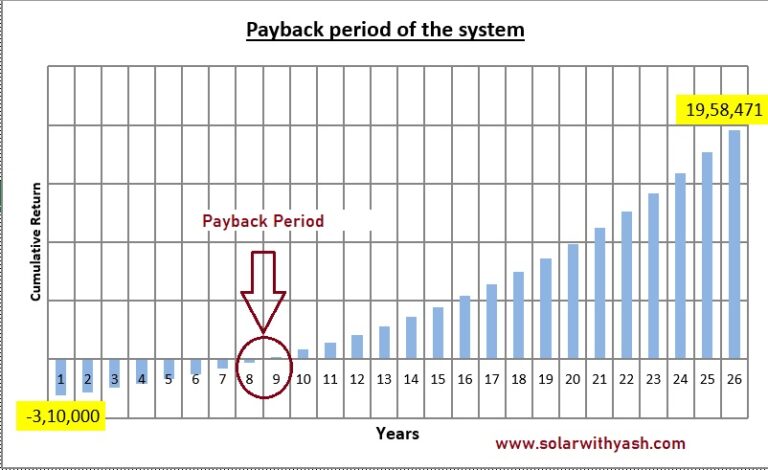
The figure below illustrates the cumulative lifetime savings and payback period of a typical 5 kW rooftop solar system installed in Delhi/NCR.
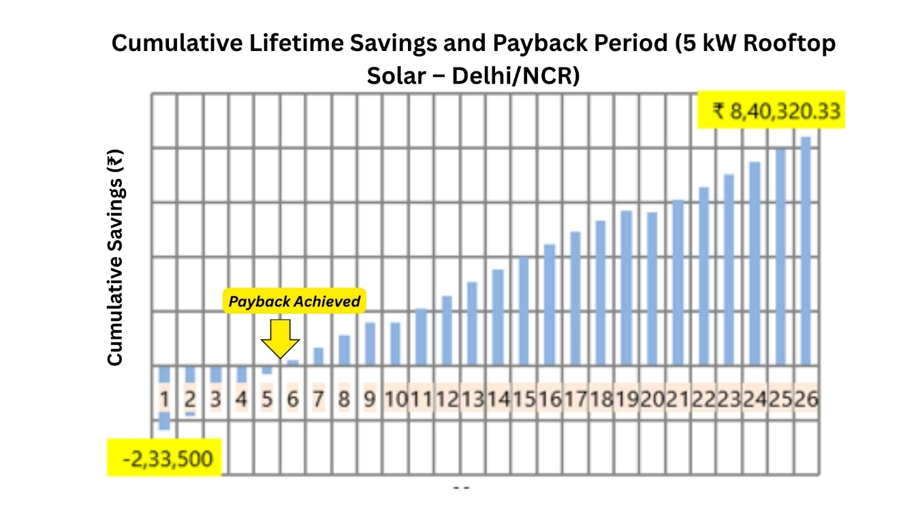
Notice that the investment is initially negative because of the upfront installation cost. As annual electricity bill savings accumulate, the investment is gradually recovered. After the payback period, the system continues to generate net financial savings for the remainder of its useful life.
Although the exact pattern differs for every homeowner, the underlying principle remains the same—lifetime savings are dynamic and should not be estimated using only the first year’s savings.
Decision Insight
A rooftop solar system should not be evaluated only on its first year’s savings. The real financial benefit comes from the cumulative savings generated over its 25–30-year lifetime, after recovering the initial investment.
Want to Estimate Your Own Lifetime Savings?
If you would like to estimate the lifetime savings, payback period, return on investment (ROI), and life-cycle economics of your rooftop solar system before investing, you can use:
Both tools consider multiple engineering and financial parameters—including electricity tariff escalation, solar panel degradation, maintenance costs, equipment replacement, and other project variables—to provide a more realistic estimate of your rooftop solar investment.
4. How to Maximize Your Savings?
Although several factors affecting rooftop solar savings—such as your location, electricity tariff, and net-metering policy—are beyond your control, there are many practical steps you can take to maximize the financial benefits of your rooftop solar system.
4.1. Shift Electricity Consumption to Daytime
One of the simplest ways to increase rooftop solar savings is to use more electricity while your solar panels are generating power.
Whenever possible, schedule high-energy appliances during daylight hours, such as:
- Running the water pump to fill the overhead tank
- Using the washing machine
- Operating the dishwasher (if available)
- Charging your electric vehicle, especially on weekends or holidays
- Running pool pumps or similar equipment
The more solar electricity you consume directly, the less electricity you need to purchase from the utility grid. This also reduces the amount of electricity exported to the grid, which may receive lower compensation depending on your local policy.
4.2. Clean Solar Panels Regularly
Dust, bird droppings, leaves, pollen, and other debris can reduce the amount of sunlight reaching the solar cells.
Cleaning your panels at appropriate intervals based on your local climate and dust conditions helps maintain optimum electricity generation and improves long-term savings.
4.3. Monitor System Performance
Most modern solar inverters include a mobile application or web portal that allows homeowners to monitor electricity generation in real time.
Regular monitoring helps you:
- Detect faults quickly
- Identify unusual drops in generation
- Reduce downtime
- Improve maintenance response
Early fault detection helps prevent unnecessary loss of electricity generation and financial savings.
4.4. Choose the Right System Size
Bigger is not always better.
Some homeowners intentionally install oversized systems expecting to export surplus electricity and recover additional money from the utility.
However, export compensation policies vary significantly between utilities and may change over time.
Therefore, your rooftop solar system should be sized primarily according to your current electricity consumption, future energy requirements, and local electricity policy, rather than the expectation of earning income from surplus exports.
4.5. Minimize Future Shading
When planning a rooftop solar installation, think beyond today’s roof conditions.
Consider whether:
- A neighbouring building may be constructed in the future.
- Trees may grow taller and cast shadows.
- Water tanks or rooftop structures could block sunlight.
Selecting a location with good long-term sunlight exposure helps maintain electricity generation throughout the system’s lifetime.
A proactive assessment today can prevent years of reduced generation and lower financial savings.
4.6. Improve Your Home’s Energy Efficiency Before Installing Solar
One of the smartest ways to maximize rooftop solar savings begins before installing the solar system.
First, reduce unnecessary electricity consumption by improving your home’s energy efficiency.
For example:
- Replace old, inefficient appliances with energy-efficient models.
- Upgrade to LED lighting.
- Seal air leaks around doors and windows.
- Improve roof or wall insulation where appropriate.
- Reduce unnecessary standby power consumption.
By lowering your electricity demand first, you may require a smaller rooftop solar system, reducing the initial investment while maintaining the same level of comfort.
In many cases, the cheapest unit of electricity is the one you never need to consume.
4.7. Size for Future Energy Needs—But Avoid Unnecessary Oversizing
Homeowners should consider expected future electricity demand, such as:
- Purchasing an electric vehicle
- Installing additional air conditioners
- Working from home
- Expanding the house
- Adding a heat pump or other major electrical loads
Planning for realistic future demand can avoid expensive upgrades later.
However, oversizing the system without a clear future requirement may increase the initial investment and reduce the project’s financial efficiency.
Decision Insight
Maximizing rooftop solar savings is not only about installing more solar panels—it is about using electricity more efficiently, properly maintaining the system, and making informed energy decisions throughout the project’s life.
5. Homeowner’s Solar Savings Checklist
A practical worksheet to help homeowners evaluate the key factors that influence annual and lifetime rooftop solar savings. Use it before investing to assess your system size, electricity tariff, consumption patterns, maintenance needs, export policy, and overall financial expectations.
Download FREE!
5. Conclusion
The objective of a rooftop solar system is not simply to generate more electricity—it is to maximize the financial value of every unit of electricity your system produces.
One of the biggest misconceptions among homeowners is that a single fixed number can represent rooftop solar savings. In reality, there is no universal savings figure that applies to every home. Even two families installing identical rooftop solar systems may experience different financial outcomes because their electricity consumption, daytime usage, electricity tariff, solar resource, maintenance practices, equipment performance, and local policies are different.
The good news is that many of these factors can be understood and, in several cases, improved. By selecting the right system size, shifting more electricity consumption to the daytime, maintaining the system properly, minimizing shading, and understanding your local electricity policy, you can maximize the financial benefits of your rooftop solar investment.
This guide is not intended to provide an optimistic or pessimistic estimate of your savings. Instead, its objective is to provide a realistic framework for understanding the factors that influence rooftop solar savings. A realistic estimate helps align expectations with actual performance, allowing you to make informed decisions with confidence and avoid disappointment later.
Ultimately, rooftop solar is not just about reducing your electricity bill. It is about making smarter long-term energy and financial decisions for your home.
If you want to estimate your annual savings, lifetime savings, payback period, and return on investment before investing, consider using:
These tools combine engineering and financial analysis to help homeowners make more informed rooftop solar decisions.
The goal is not to chase the highest savings—it is to achieve the right savings for your home through informed, realistic, and well-planned decisions.
6. FAQs
1. How much money can a rooftop solar system save?
There is no fixed savings amount. Solar savings depend on system size, electricity consumption, daytime usage, electricity tariff, solar resource, net-metering policy, panel degradation, and maintenance.
2. Does a larger solar system always mean higher savings?
No. A larger system can generate more electricity, but oversizing may reduce financial efficiency if the additional electricity cannot be effectively consumed or compensated through the grid.
3. Does daytime electricity consumption affect solar savings?
Yes. Using more electricity during daylight hours allows you to directly consume more solar electricity and reduce purchases from the grid, which can increase savings.
4. Does a higher electricity tariff increase solar savings?
Yes. When each grid unit costs more, every solar unit that replaces that grid unit has greater monetary value.
5. How does electricity tariff escalation affect lifetime solar savings?
As electricity prices increase, the monetary value of the electricity generated by your solar system can also increase, potentially increasing future savings.
6. Does solar panel degradation reduce savings?
Yes. Solar panels gradually produce less electricity as they age. The lower generation can reduce annual and lifetime savings.
7. How does net metering affect solar savings?
Net metering allows eligible exported solar electricity to be credited against electricity imported from the grid. More favorable export compensation generally results in higher financial savings.
8. Can maintenance increase my solar savings?
Yes. Regular cleaning, monitoring, inspection, and timely repairs can help maintain system performance and prevent prolonged generation losses.
9. Is solar generation the same every year?
No. Solar generation can vary because of weather conditions, shading, panel degradation, equipment performance, and other operating conditions.
10. Should I consider future electricity consumption when estimating solar savings?
Yes. Future loads such as an electric vehicle, additional air conditioners, working from home, or home expansion can change your electricity consumption and should be considered when sizing the system.
11. How can I maximize my rooftop solar savings?
Use more electricity during daylight hours, maintain and monitor the system, minimize shading, choose the right system size, improve home energy efficiency, and understand your local electricity and export-compensation policy.
12. How can I calculate my lifetime solar savings before installing solar?
You need to consider system cost, solar generation, electricity tariff, tariff escalation, panel degradation, maintenance, equipment replacement, and other relevant factors. A life-cycle analysis such as SFS India Edition or SFS USA Edition can help estimate these outcomes for your specific situation.