Solar Payback in Chhattisgarh: Cost, Savings, and ROI of a 5 kW Solar System (2026)
Chhattisgarh is located in central India between roughly 17°N and 24°N latitude, a region that receives strong sunlight for most of the year. Because of its geographic position and long, sunny seasons, the state has strong potential to generate electricity from rooftop solar systems.
Most regions of India receive about 4 – 7 kWh/m²/day of solar radiation, with central Indian states such as Chhattisgarh typically falling within 4.8 – 5.5 kWh/m²/day. This level of sunlight is sufficient for rooftop solar panels to produce significant electricity throughout the year.
At the same time, residential electricity tariffs in the state are gradually increasing as consumption moves into higher tariff slabs. Electricity supply in the state is managed by Chhattisgarh State Power Distribution Company Limited, and households with higher monthly consumption often face rising electricity bills.
Another important factor improving the economics of rooftop solar in India is the government subsidy program under PM Surya Ghar: Muft Bijli Yojana. This scheme provides financial assistance for residential rooftop solar installations, reducing the upfront cost for homeowners.
Because of these factors — good solar resource, rising electricity prices, and government incentives — rooftop solar systems can be an attractive investment for many households in Chhattisgarh.
In this article, we will estimate the cost, annual savings, and payback period of a typical 5 kW rooftop solar system in Chhattisgarh, helping homeowners understand whether installing solar panels is financially worthwhile.
Curious to know your annual savings from Solar? Get Solar Snap for FREE
Solar Potential in Chhattisgarh
Before estimating solar savings or payback, it is important to understand the solar resource available in the state, because the amount of electricity generated by a rooftop solar system depends mainly on the sunlight it receives.
Chhattisgarh receives good solar radiation throughout the year (4.8 – 5.5 kWh/m²/day), making it suitable for rooftop solar installations.
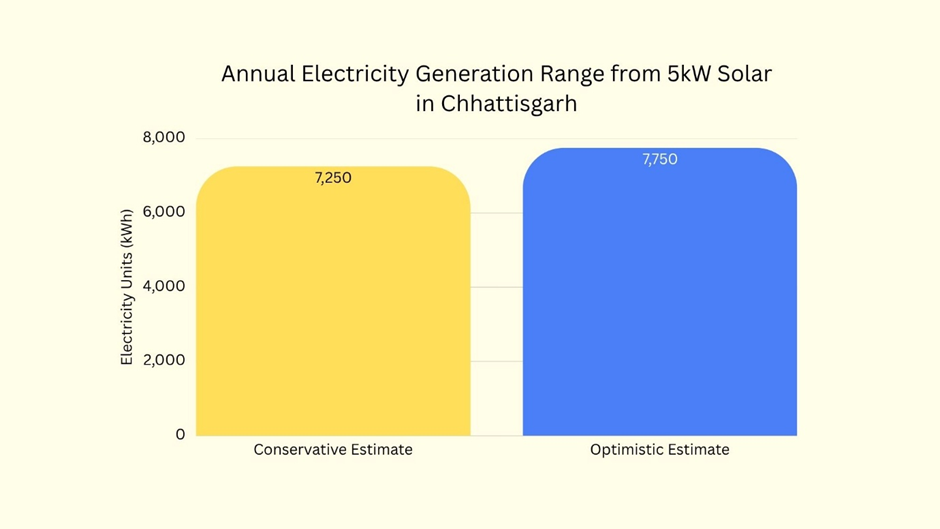
This level of sunlight is comparable to that in several other states in central and eastern India and is sufficient to generate significant solar electricity. In practical terms, a 1 kW rooftop solar system installed under real conditions can typically generate 1,450–1,550 kWh of electricity per year in the state. Based on this estimate, a 5kW residential rooftop solar system can produce roughly 7,250–7,750 units annually, depending on factors such as rooftop orientation, shading, and system efficiency.
Although solar generation may slightly reduce during the monsoon months due to cloud cover, the overall annual solar resource in Chhattisgarh remains strong enough to support efficient rooftop solar systems. Because of this reliable solar potential, homeowners in the state can generate a significant portion of their annual electricity consumption using rooftop solar panels.
You may be interested in knowing why sunlight intensity varies across different regions. Read my full post on “Top Reasons for the variations in the Peak Sun Hours.”
Electricity Tariffs in Chhattisgarh
Electricity prices are one of the most important factors affecting the financial attractiveness of rooftop solar systems. The higher the electricity tariff, the more money a household can potentially save by generating its own electricity using solar panels.
In Chhattisgarh, residential electricity is supplied by Chhattisgarh State Power Distribution Company Limited. Like most Indian states, the electricity tariff structure follows a slab-based system, where the price per unit increases as electricity consumption rises.
For example, domestic electricity tariffs typically start at around ₹3.4 per unit for the first 100 units of monthly consumption, and the rate increases for higher consumption slabs. As households consume more electricity, the effective cost per unit rises accordingly.
This slab-based tariff structure means that households with higher electricity usage often pay significantly more per unit of electricity, which can make rooftop solar systems financially attractive.
In recent years, electricity tariffs in the state have also seen periodic revisions, with a modest increase of around 1.89% announced for FY 2025-26 across consumer categories.
For homeowners with moderate to high electricity consumption, rooftop solar systems can help reduce dependence on grid electricity and stabilize long-term energy costs.
In the next section, we will estimate the typical cost of installing a 5kW rooftop solar system in Chhattisgarh, which is the first step in calculating solar payback.
Cost of 5kW Solar Rooftop in Chhattisgarh
To estimate the solar payback period, the next step is to understand the typical cost of installing a rooftop solar system. In most Indian homes, a 5kW rooftop solar system is considered a practical size because it can generate a large share of the electricity required by an average household.
In Chhattisgarh, the cost of installing a grid-connected rooftop solar system is broadly similar to the national market price. The final installation cost depends on several factors such as solar panel quality, inverter type, mounting structure, rooftop height, and installation complexity. Based on current rooftop solar market prices in India, a 5kW residential solar system typically costs around ₹2.8 lakh to ₹3.5 lakh before subsidy. This cost usually includes solar panels, an inverter, mounting structures, electrical wiring, safety equipment, and installation charges.
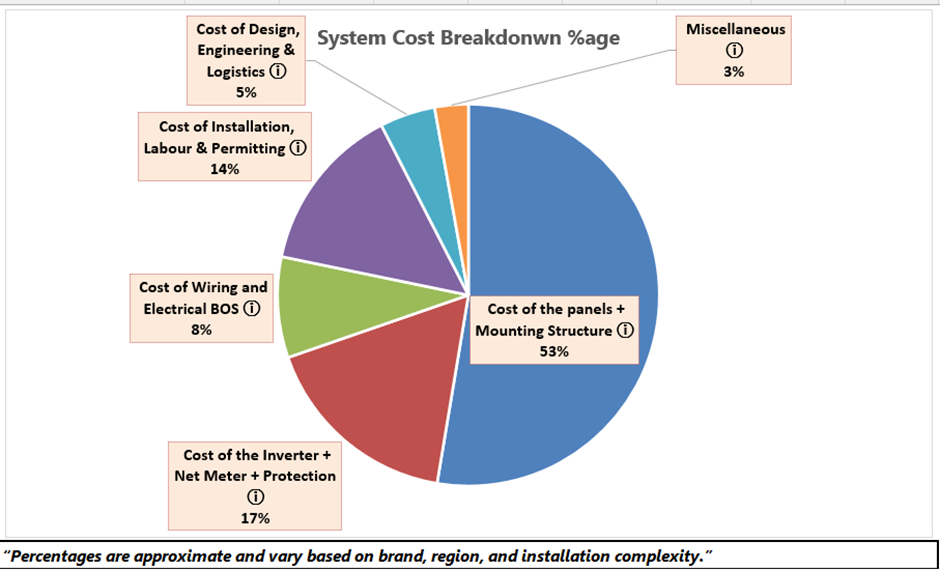
Solar system pricing is often expressed in cost per kilowatt (kW). For residential rooftop systems in India, the typical installation cost ranges between ₹55,000 and ₹65,000 per kW, depending on equipment quality and installer pricing.
Because a 5kW system falls within the common size range for residential installations, many solar installers offer standardized system packages, which helps keep installation costs relatively predictable.
However, homeowners do not usually have to pay the full system cost themselves. The Indian government provides financial support for residential rooftop solar installations through the PM Surya Ghar: Muft Bijli Yojana, which significantly reduces the upfront investment.
Government Subsidy for Rooftop Solar in Chhattisgarh
One of the major reasons rooftop solar systems have become more affordable in recent years is the financial support provided by the government for residential installations. This subsidy significantly reduces the upfront investment required from homeowners.
In Chhattisgarh, residential rooftop solar systems are eligible for central financial assistance under the national rooftop solar program called PM Surya Ghar: Muft Bijli Yojana. This scheme was introduced to encourage households across India to adopt clean energy and reduce their electricity bills.
Under this program, the subsidy amount depends on the capacity of the rooftop solar system installed. For residential systems, the current subsidy structure provides financial assistance for systems up to 10 kW capacity.
At present, homeowners installing rooftop solar systems can receive approximately:
- ₹30,000 per kW for the first 2 kW
- ₹18,000 per kW for the next 1 kW
This means the maximum subsidy available for residential systems up to 3 kW is about ₹78,000. For systems larger than 3 kW (such as a 5kW system), the subsidy is still limited to this amount, because the government support currently applies to the first 3 kW capacity only.
As a result, homeowners installing a 5kW rooftop solar system in Chhattisgarh can still benefit from the maximum subsidy of around ₹78,000, which reduces the overall investment required for the system.
Cost of 5kW Solar Rooftop in Chhattisgarh
After understanding the system cost and the available government support, the next step is to estimate the actual investment required after applying the subsidy.
As discussed earlier, the typical cost of installing a 5kW rooftop solar system in Chhattisgarh generally falls between ₹2.8 lakh and ₹3.5 lakh before subsidy, depending on equipment quality, installer pricing, and installation conditions.
Homeowners installing residential rooftop solar systems can receive financial support under PM Surya Ghar: Muft Bijli Yojana. For systems larger than 3 kW, such as a 5kW system, the maximum subsidy available is currently about ₹78,000, because the subsidy applies to the first 3 kW capacity.
If we subtract this subsidy from the typical installation cost, the effective cost of a 5kW solar system may be reduced to approximately ₹2.0 lakh to ₹2.7 lakh, depending on the installer price and system specifications.
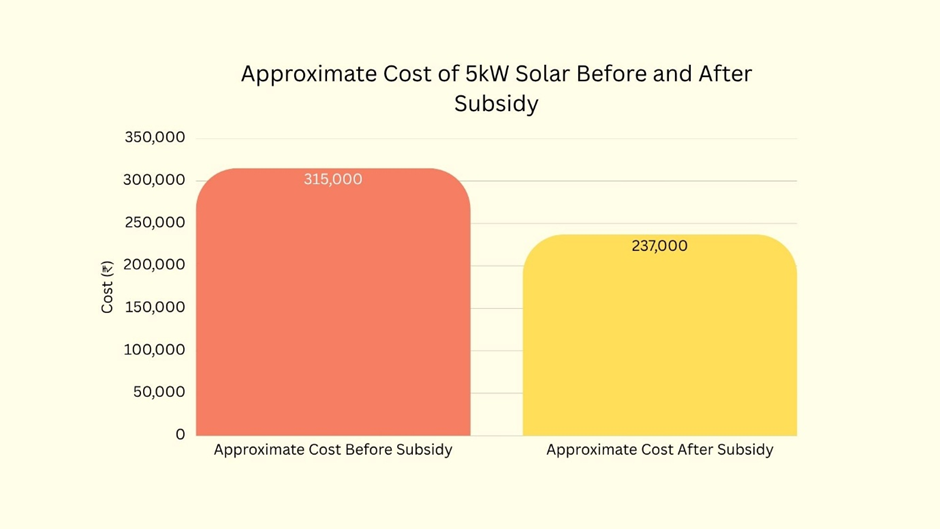
This reduction in upfront investment plays an important role in improving the financial feasibility of rooftop solar systems for homeowners. A lower initial cost means the solar system can recover its investment faster through electricity savings.
It is also important to remember that once installed, rooftop solar systems generally require very low operating and maintenance costs, while continuing to generate electricity for many years. In the next section, we will estimate the annual electricity generation of a 5kW rooftop solar system in Chhattisgarh, which will help us calculate the potential electricity savings and the overall solar payback period.
Annual Solar Generation from a 5kW Rooftop System in Chhattisgarh
After estimating the installation cost of a solar system, the next important step is to understand how much electricity the system can generate every year. The annual solar generation largely depends on the solar resource available in the region, system size, and installation conditions.
In Chhattisgarh, most districts receive average solar irradiance of around 4.8–5.3 kWh per square meter per day. This level of sunlight is sufficient for rooftop solar systems to generate a substantial amount of electricity annually.
A useful way to estimate solar generation is by using the specific yield of a solar system, which represents the amount of electricity generated per kilowatt (kW) of installed capacity in a year.
In many parts of central and eastern India, a well-installed rooftop solar system typically produces around 1,450–1,550 units of electricity per kW per year, depending on factors such as rooftop orientation, shading, and system efficiency.
Using this estimate, a 5kW rooftop solar system in Chhattisgarh can typically generate approximately 7,250 to 7,750 units of electricity annually under normal operating conditions.
Solar generation may vary slightly throughout the year. During the summer months, solar output is usually higher due to longer sunny days, while generation may decrease somewhat during the monsoon season because of cloud cover. However, over the entire year, the overall solar resource remains strong enough to support consistent solar electricity production. In the next section, we will estimate the annual electricity savings from a 5kW solar system in Chhattisgarh, which will help us calculate the solar payback period.
Annual Electricity Savings from a 5kW Solar System in Chhattisgarh
Once we estimate the annual solar generation, the next step is to calculate how much money a household can save every year by installing rooftop solar.
As discussed earlier, a 5kW rooftop solar system in Chhattisgarh can typically generate around 7,250–7,750 units of electricity per year, depending on system performance and rooftop conditions.
To estimate the financial savings, we need to consider the average electricity price paid by households. In many homes with moderate electricity consumption, the effective electricity tariff often falls in the range of ₹5 to ₹6 per unit, depending on the consumption slab under Chhattisgarh State Power Distribution Company Limited.
If a solar system generates around 7,500 (average) units of electricity annually, and each unit offsets electricity that would otherwise be purchased from the grid, the potential annual savings can be estimated as:
Annual Savings ≈ Electricity Generation × Electricity Tariff
Using an average tariff of ₹5.5 per unit, the annual savings can be roughly estimated as:
7,500 units × ₹5.5 ≈ ₹41,250 per year
This means a typical 5 kW rooftop solar system in Chhattisgarh may help homeowners save around ₹40,000 annually on electricity bills, depending on electricity usage and tariff levels.
It is also important to remember that electricity prices generally increase over time. As tariffs rise in the future, the financial savings from rooftop solar may increase further, improving the overall return on investment.
Want to know the annual savings from Solar in your district? Use SFS (Solar Financial Tool) for a proper financial analysis
Solar Payback Period for a 5 kW System in Chhattisgarh
After estimating the system cost and annual savings, we can now calculate the solar payback period, which tells us how long it takes for the savings from the solar system to recover the initial investment.
In simple terms, the payback period is calculated as:
Solar Payback = Total System Cost ÷ Annual Electricity Savings
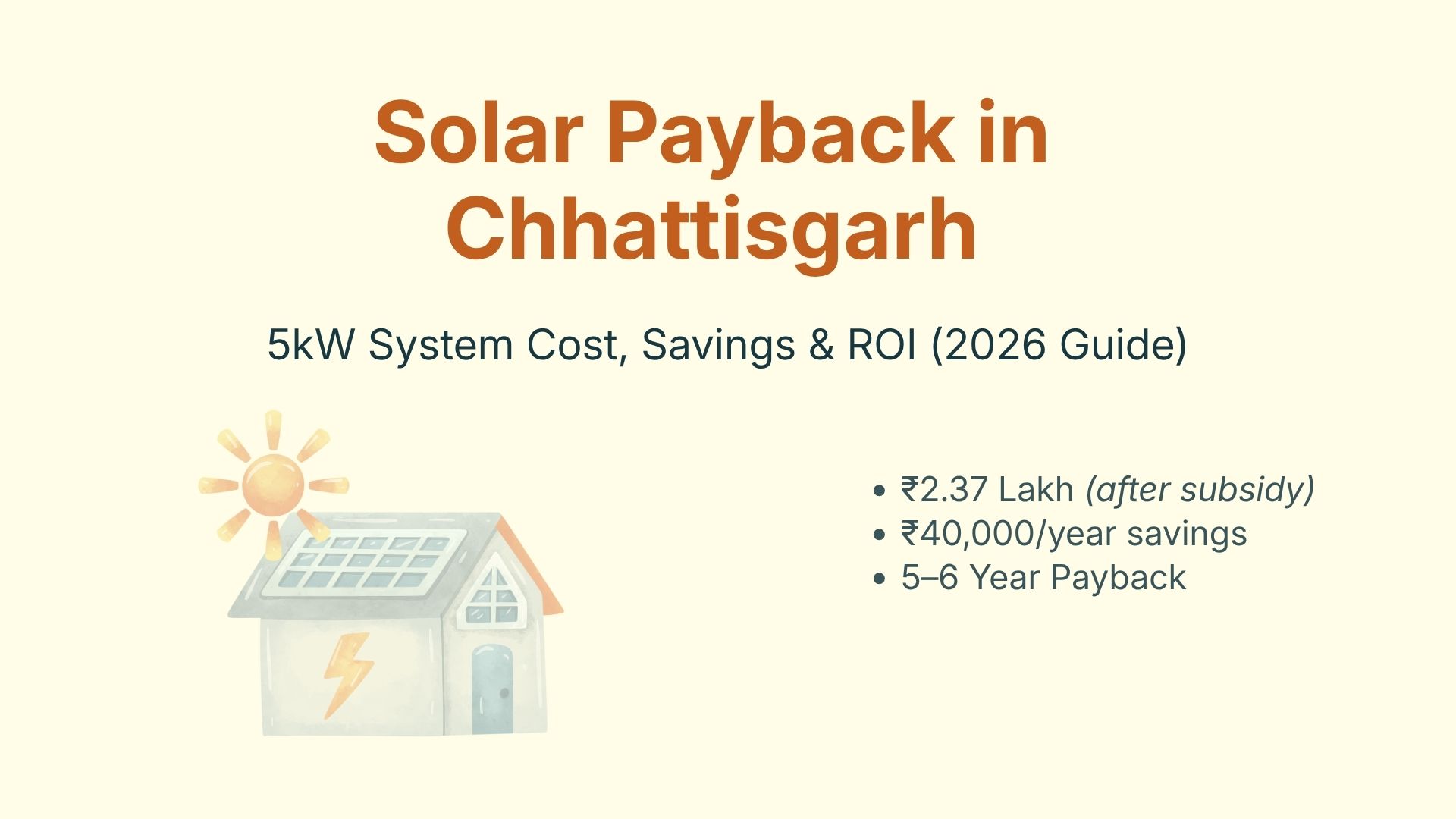
As discussed in the previous sections, the effective cost of installing a 5kW rooftop solar system in Chhattisgarh after applying the government subsidy may fall in the range of ₹2.0 lakh to ₹2.7 lakh. The average is ₹2.37 lakhs
We also estimated that a 5kW system can generate roughly 7,500 units of electricity per year, which can lead to annual savings of about ₹40,000, depending on electricity tariffs and system performance.
Using these values, the solar payback period can be estimated approximately as:
- Payback = ₹2,37,000 ÷ ₹40,000 ≈ 6 years
This means that, under typical conditions, the payback period for a 5kW rooftop solar system in Chhattisgarh is about 6 years.
Once the system recovers its initial cost, the electricity generated afterward essentially becomes free energy, apart from minor maintenance costs.
Since most rooftop solar systems have a lifespan of 20–25 years, homeowners can continue to benefit from electricity savings for many years after the payback period.
25-Year Lifetime Savings from a 5kW Solar System in Chhattisgarh
To fully understand the financial benefit of rooftop solar, it is helpful to look beyond the payback period and estimate the total savings over the lifetime of the system.
Most modern solar panels are designed to operate for 25 years or more, although their electricity generation may slowly decline over time due to natural panel degradation.
As discussed earlier, a 5kW rooftop solar system in Chhattisgarh can generate roughly 7,500 units of electricity per year under typical conditions.
If we assume an average electricity tariff of around ₹5.5 per unit, the annual electricity savings may be approximately ₹40,000.
To estimate the long-term financial benefit, we can multiply the annual savings by the expected system lifetime.
Estimated Lifetime Savings
- Annual savings ≈ ₹40,000
- System lifetime ≈ 25 years
This gives an approximate total electricity savings of ₹10 lakh over 25 years
It is important to note that this estimate is based on current electricity prices. In reality, electricity tariffs tend to increase gradually over time. As a result, the actual lifetime savings from rooftop solar may be even higher than this estimate.
Another factor to consider is that rooftop solar systems typically have very low operating and maintenance costs, which means most of the electricity generated during the system’s lifetime directly translates into savings.
In the next section, we will summarize these results and examine whether installing solar panels is financially worthwhile for homeowners in Chhattisgarh.
A Real-Life Example: Rooftop Solar in Raigarh
To better understand how these numbers work in practice, let us consider a simple example of a homeowner in Raigarh.
Suppose Mr. Sahu, a homeowner living in Raigarh, installs a 5kW rooftop solar system on his house. Raigarh receives a good solar resource, with an average solar irradiance of around 5.39 kWh per square meter per day, which is favorable for rooftop solar electricity generation.
The total installation cost of the solar system is approximately ₹3.0 lakh before subsidy. After receiving the central financial assistance under PM Surya Ghar: Muft Bijli Yojana, the effective cost of the system reduces to about ₹2.2 lakh.
Because of the strong solar resource in the region, Mr. Sahu’s 5 kW rooftop solar system generates roughly 7,200 units of electricity per year. Before installing solar, his household’s electricity consumption was around 600 units per month, with an average electricity tariff of about ₹5.5 per unit.
After installing the solar system, a large portion of his electricity consumption is now supplied by solar power. As a result, his electricity bills have reduced significantly, leading to annual savings of around ₹38,000–₹40,000.
Based on these savings, the expected payback period of the system is approximately 5–6 years.
If the solar system continues operating for about 25 years, the total electricity savings could reach roughly ₹9 lakh to ₹10 lakh over the system’s lifetime, assuming current electricity prices. Mr. Sahu believes that one of the biggest advantages of rooftop solar is the long-term reduction in electricity bills, making it a financially attractive investment for homeowners in Chhattisgarh.
Factors Affecting Solar Payback in Chhattisgarh
Although we estimated a typical payback period for a 5kW rooftop solar system, it is important to understand that solar payback is not the same for every household. Several factors can influence the actual payback period, including solar resource, electricity consumption, and system installation conditions.
One important factor is the solar resource available in different districts of Chhattisgarh. Solar irradiance is often discussed at the state level, but in reality, it can vary slightly from district to district depending on local climate conditions, cloud cover, and geographic location.
For example, some districts receive slightly higher solar radiation than others.
| District | Average Solar Irradiance (kWh/m²/day) |
|---|---|
| Durg | 5.44 |
| Bijapur | 5.39 |
| Bastar | 5.27 |
| Bilaspur | 4.92 |
Although these differences may appear small, they can still influence the total electricity generated by a rooftop solar system over many years. Districts with slightly higher solar irradiance may produce more solar electricity annually, which can help reduce electricity bills faster and improve the overall payback period.
Another important factor affecting solar payback is the household electricity consumption and tariff slab. Homes with higher electricity usage usually pay a higher price per unit of electricity, which increases the financial savings from solar generation.
Finally, system design and installation quality also matter. Proper panel orientation, minimal shading, and good system maintenance can help maximize solar electricity generation and improve long-term financial returns from rooftop solar systems.
Is Solar Worth It in Chhattisgarh?
Based on the analysis presented in the previous sections, rooftop solar can be a financially attractive investment for many households in Chhattisgarh.
The state lies in the tropical belt and receives strong solar radiation throughout the year, with average solar resource levels often around 5 kWh/m²/day. This level of sunlight allows rooftop solar systems to generate a substantial amount of electricity annually.
For a typical homeowner installing a 5kW rooftop solar system, the effective investment after subsidy may fall in the range of roughly ₹2.0 lakh to ₹2.7 lakh, depending on system specifications and installer pricing. At the same time, such a system can generate around 7,250–7,750 units of electricity per year, helping offset a large portion of household electricity consumption.
With average electricity tariffs of around ₹5–₹6 per unit, the annual savings from a 5kW solar system can reach roughly ₹38,000–₹40,000 per year. Under these conditions, the solar payback period typically falls between about 5 and 6 years.
Since rooftop solar panels generally have an operating life of 25 years or more, homeowners can continue benefiting from electricity savings long after the system has recovered its initial cost. Over the lifetime of the system, the total savings may reach around ₹9 lakh to ₹10 lakh, assuming current electricity prices.
Of course, the exact payback period may vary depending on factors such as district-level solar resource, electricity consumption, tariff slab, and installation quality.
Overall, for households with moderate to high electricity usage and suitable rooftop space, installing solar panels can be a practical long-term investment that reduces electricity bills and provides predictable energy costs for decades.
Frequently Asked Questions
1. How much does a 5kW solar system cost in Chhattisgarh?
A typical 5 kW rooftop solar system may cost around ₹2.8 lakh to ₹3.5 lakh before subsidy. After applying the government subsidy, the effective cost may reduce to roughly ₹2.0 lakh to ₹2.7 lakh, depending on installer pricing and system quality.
2. How much electricity can a 5kW solar system generate in Chhattisgarh?
A properly installed 5 kW rooftop solar system in Chhattisgarh can typically generate around 7,250–7,750 units of electricity per year, depending on sunlight availability and system performance.
3. What is the solar payback period in Chhattisgarh?
Based on typical system costs and electricity tariffs, the solar payback period for a 5kW system in the state usually ranges between 5 and 6 years.
4. Is there a government subsidy for rooftop solar in Chhattisgarh?
Yes. Homeowners installing rooftop solar systems can receive financial assistance under PM Surya Ghar: Muft Bijli Yojana. The maximum subsidy for residential systems up to 3 kW is currently about ₹78,000.
5. How long do rooftop solar panels last?
Most solar panels are designed to operate for 25 years or more, although their electricity generation gradually declines over time due to natural panel degradation.
6. Can rooftop solar eliminate electricity bills?
In many cases, rooftop solar can significantly reduce electricity bills, but the exact reduction depends on system size, electricity consumption, and local net-metering policies.