What Is the Solar Constant and Why Does It Matter in Solar Energy?
Introduction
Every second, the Sun sends an unimaginable amount of energy toward Earth — enough to power human civilization thousands of times over.

But how much of that solar energy actually reaches us?
Scientists quantify it using something called the solar constant — a foundational value that defines how much sunlight our planet receives at the boundary of space and the Earth’s atmosphere.
In this article, you’ll learn what the solar constant is, how it’s measured, how to calculate real solar intensity on a given day, and how it’s used in solar PV design, ROI estimation, and climate science.
What is Solar Constant?
The solar constant is the average amount of solar radiation received per square meter on a surface perpendicular to the Sun’s rays outside Earth’s atmosphere at the mean Earth–Sun distance (1 astronomical unit).
- 1 au = 149.6 million km
- 1 au = 1.496 x 10¹¹ m
Which is shown in the picture below:

But the Earth’s orbit around the Sun is not a perfect circle; it is in an ellipse, with the Sun located at one of the two foci (focus points) of the ellipse. It looks something like this:
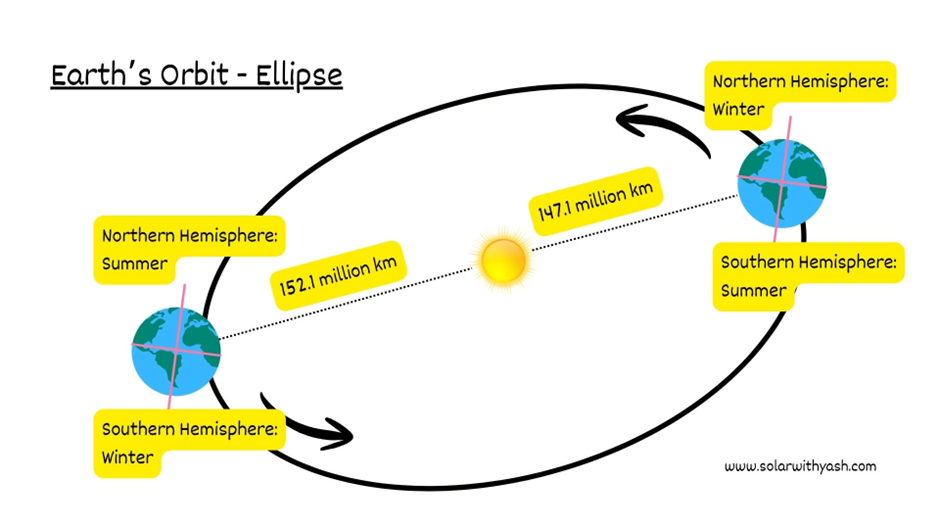
This means the distance between the Earth and the Sun is not constant. Therefore, we take the average distance between the Sun and the Earth, which is:
1 AU = (152.1 million km + 147.1 million km)/2 = 149.1million km.
And this average value is called 1 Astronomical Unit (1 AU).
Now, coming back to the Solar Constant; It represents the intensity of solar energy reaching the top of the atmosphere before any losses occur.
Solar Constant (S) = 1367 W/m2 (average value)
Notes:
- The value fluctuates slightly (±1 W/m²) during the 11-year solar cycle.
- It forms the basis for all calculations of solar energy on Earth.
- Older textbooks often quote the solar constant as 1367 W/m², while modern satellite measurements refine this value to about 1361 W/m²; the difference is small and does not affect practical solar energy calculations.
How is the Solar Constant Measured?
The solar constant is not measured on the ground — it’s measured by space-based instruments such as NASA’s SOHO and SORCE satellites that monitor Total Solar Irradiance (TSI).
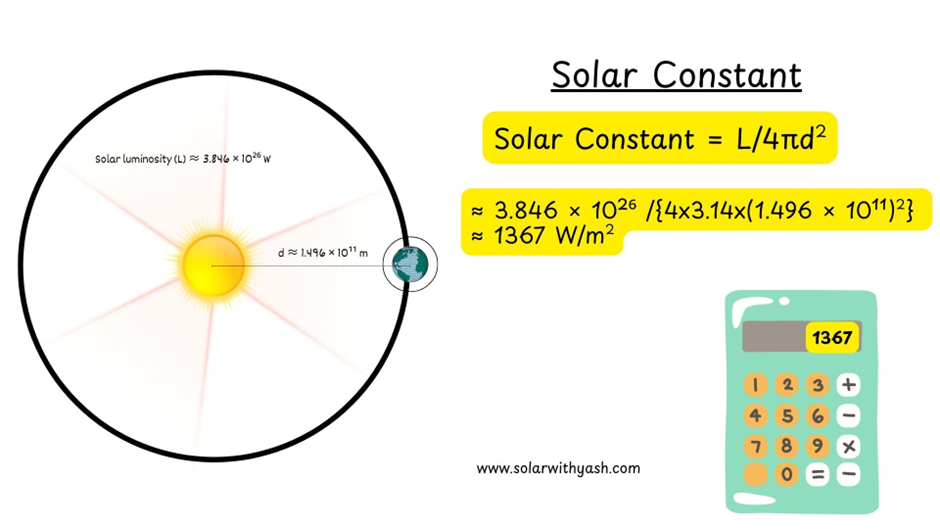
A simplified equation:
Solar Constant (S) = L/4πd2
Where:
- L = Solar luminosity ≈ 3.846 × 10²⁶ W
- d = Mean Earth–Sun distance ≈ 1.496 × 10¹¹ m
The result is about 1367 W/m².
Why does the Solar Constant Matter?
The solar constant is much more than a number — it’s the foundation for understanding how solar energy drives climate, space systems, and solar power technologies.
Climate Change and Earth Science
Earth’s entire climate system — winds, rainfall, ocean currents, and temperature patterns — is powered by incoming solar radiation.
The solar constant defines the total energy input for this system.
- Global Energy Balance:

- Climate Change Research:
Tracking solar irradiance distinguishes natural solar variations from human-caused warming. - Atmospheric Studies:

💡 Without this constant as a reference, we couldn’t quantify how solar power drives Earth’s climate.
For Solar Energy Design and Engineering
All PV design models begin with the solar constant and then adjust for atmospheric conditions, tilt, and location.
- Baseline for Irradiance Calculations:
Engineers use it (1367 W/m²) to compute extraterrestrial irradiance (I₀) for any day of the year. - Solar Maps and PSH Data:
Databases like NREL NSRDB, PVGIS, and NIWE derive solar maps from this constant to keep measurements consistent worldwide. - System Sizing and ROI:
Every Solar Feasibility Spreadsheet (SFS) or payback tool ultimately converts the solar constant’s energy (W/m²) into usable electricity (kWh).
The solar constant tells us how much energy the Sun provides; PV design tells us how much of that we can capture.
For Space Missions and Satellite Systems
Outside Earth’s atmosphere, spacecraft experience the full strength of the solar constant.
- Sizing Solar Panels:
Spacecraft solar arrays use the constant directly — about 1367 W/m² of continuous sunlight. - Deep-Space Missions:
Solar power decreases with the inverse-square law:
I = S x (1 AU/r)2
At Mars (~1.52 AU), sunlight is only ~43 % as strong as near Earth.
- Thermal Design:
It guides engineers in designing radiators and shields to manage heat in orbit.
Summary: Uses and Applications
| Field | Why It Matters | Example |
|---|---|---|
| Climate Studies | Determines global energy balance | Modeling Earth’s temperature |
| Solar Design | Basis for irradiance & ROI | Rooftop PV sizing |
| Space Missions | Power & thermal control | Designing satellite arrays |
✅ Takeaway:
The solar constant links the Sun’s energy, your rooftop output, and the balance of life on Earth.
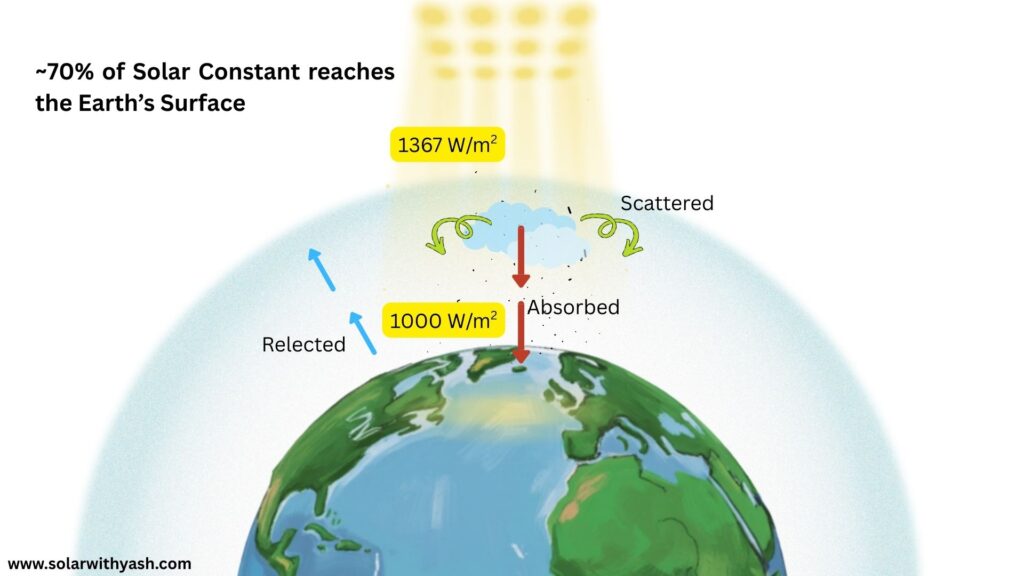
How Much Solar Constant Reaches the Earth’s Surface?
Only about 70% of the solar energy entering the atmosphere reaches the surface; the rest is reflected or absorbed by clouds, dust, and gases.
Typical clear-sky ground irradiance: 900 – 1000W/m2 at Noon near the Equator
🔢 How to Calculate Solar Intensity on a Given Day
Step 1 — Adjust for Earth–Sun Distance
Io = 1367 x (1+ 0.033cos{(360 x n)/365}
For April 1 (n = 91):
Io = 1367 x (1+ 0.033cos{(360 x 91)/365}
Io = 1367 x (1+ 0.033cos{89.7°} = 1367 W/m2
Step 2 — Adjust for Solar Angle:
At Latitude ϕ = 20° N on April 1 (δ ≈ 4.3°):
Solar Noon Zenith Angle (θz) =∣ϕ−δ∣=∣20°−4.3°∣=15.7°
Now Adjust for angle:
I = 1367×cos(15.7°)
= 1367 x (0.963) = 1316
Step 3 — Atmospheric Losses: Why Only 70% of Sunlight Reaches the Ground
Even though the solar constant (S = 1367 W/m²) represents sunlight at the top of Earth’s atmosphere, not all that energy reaches your solar panels.
Roughly 30% is lost as sunlight travels through 100 km of atmosphere before hitting the ground.
That’s why we apply a multiplying factor of 0.7, known as the atmospheric transmittance (τ).
This factor accounts for scattering, absorption, and reflection processes that reduce solar intensity.
Ig = ITOA x τ = ITOA x 0.7
where:
- Ig = Global (ground-level) solar irradiance
- ITOA = Top-of-Atmosphere irradiance
- τ = Atmospheric Transmittance
Why 30% Energy is Lost?
| Mechanism | Description | Typical % Loss |
|---|---|---|
| Rayleigh Scattering | Shorter wavelengths (blue light) are scattered by nitrogen and oxygen molecules — this is why the sky appears blue. | ~6–8% |
| Absorption by Ozone and Water Vapor | Ozone absorbs UV, while water vapor absorbs infrared heat. | ~10–12% |
| Aerosols and Dust (Mie Scattering) | Tiny particles, smoke, and pollution scatter sunlight and reduce direct beam intensity. | ~5–8% |
| Cloud Reflection & Absorption | Thin clouds reflect or absorb some light even on clear days. | ~5–10% |
| Surface Reflection (Albedo) | Some sunlight reflects off clouds, oceans, or land back into space. | ~2–3% |
Total typical losses: ~30% → Transmittance ≈ 0.7
🌞 Clear vs Polluted Atmosphere
- In clean, dry, high-altitude regions (e.g., Ladakh, Pune hills), τ ≈ 0.8–0.85.
- In humid, dusty, or smoggy cities (e.g., Delhi NCR, coastal areas in monsoon), τ ≈ 0.6–0.65.
So, τ = 0.7 represents a balanced average for clear-sky conditions in most Indian cities.
✅ Example Calculation
From Step 2:
ITOA = 1316 W/m2
Ig = ITOA x τ = 1316 x 0.7 = 921 W/m2
✅ Result: About 921 W/m² of sunlight actually reaches your panels — the intensity that drives solar generation under clear skies at noon.
Real World Application Example: Solar Intensity and Optimal Tilt
Let’s see how the solar constant connects to an actual rooftop design.
📅 Example
- Date: May 14
- Location: Pune, India (Latitude ϕ =18.5° N)
- System: 5 kW grid-tied
- Goal: Estimate solar intensity & optimal tilt.
- Assumption: Solar Noon, Clear Sky
Step-By-Step Calculation:
☀️ Step 1 — Extraterrestrial Irradiance
Io = 1367 x (1+ 0.033cos{(360 x 134)/365} = 1331 W/m2
Step 2 — Solar Declination
Solar declination (δ) is the angle between the Sun’s rays and the Earth’s equatorial plane.
It changes every day due to Earth’s axial tilt (≈23.45°).
δ = 23.45° x sin{360°(n-81)/365°}
For n = 134:
δ = 23.45° x sin(52.3°) = 23.45° x 0.79 = 18.5°
✅Solar declination (δ) on May 14 ≈ +18.5°
The Sun is almost directly above 18.5° N latitude on this date.
Zenith angle:
The solar zenith angle (θz) is the angle between the Sun’s rays and the vertical (normal) at a location.
Solar Noon Formula:
θz=∣ϕ−δ∣
Calculation:
θz=∣18.5−18.5∣=0°
Solar zenith angle (θz) ≈ 0°
👉 The Sun is nearly overhead at solar noon in Pune on May 14.
Adjust for Solar Angle (Cosine Law):
ITOA = Io cos(θz) = 1331 x cos(0°)
ITOA = 1331 x 1.00 = 1331 W/m2
👉 No angular loss because the Sun is overhead.
🌤️Step 3 — Atmospheric Transmission
Ig = 1331 x 0.72 = 958 W/m2
✅Surface irradiance: ~950–960 W/m²
📐 Step 4 — Optimal Tilt
At 18.5° N:
- Fixed ≈ 18–20° (equal to latitude)
- Summer ≈ 10° (latitude − 10°)
On May 14, a 10° south-facing tilt gives ≈ 970–980 W/m².
💡 Step 5 — Daily Energy & ROI
- 5.6 kWh/kWp/day x 5 = 28 kWh/day
- Each 1 kW (kWp) of solar capacity produces about 5.6 units (kWh) per day
under good clear-sky conditions (like Pune in summer). - 28 x 30 days = 840 kWh/month
- At ₹8/unit → ₹6,720/month savings
Summary
| Parameter | Symbol | Value |
|---|---|---|
| Date | — | May 14 |
| Latitude | Φ | 18.5° N |
| Declination | Δ | +18.5° |
| Solar Constant | S | 1361 W/m² |
| Extraterrestrial Irradiance | I₀ | 1331 W/m² |
| Ground Irradiance | Ig | 950 W/m² |
| Optimal Tilt | Β | 10° south |
| Daily Energy | — | 28 kWh/day |
| Monthly Savings | — | ₹6,720 |
✅ Result:
Starting from the solar constant, we calculated real irradiance, optimal tilt, and energy yield — exactly what you need for feasibility and payback analysis.
Solar Constant vs Solar Irradiance vs Insolation
| Term | Meaning | Unit |
|---|---|---|
| Solar Constant | Energy at the top of the atmosphere | W/m² |
| Solar Irradiance | Instantaneous energy at the surface | W/m² |
| Solar Insolation | Daily or monthly energy received | kWh/m²/day |
Conclusion
The solar constant (~1367 W/m²) may seem theoretical, but it’s the starting point of every solar and climate model — from global temperature to your rooftop generation.
It links astronomy, physics, and engineering into one powerful metric.
🌞Try it yourself: Use the Solar Snap Tool to measure real sunlight intensity at your home, or download the Solar Feasibility Spreadsheet (India Edition) and SFS (US Edition) to calculate your exact ROI and payback.
FAQ: Solar Constant
Q1: What is the solar constant in simple terms?
The solar constant is the amount of solar energy received per square meter at the top of Earth’s atmosphere on a surface perpendicular to the Sun’s rays, at the average Earth–Sun distance.
Q2: What is the value of the solar constant?
The accepted modern value of the solar constant is about 1361 W/m², measured using satellite instruments outside Earth’s atmosphere.
Q3: Does the solar constant change?
Yes, it varies slightly (about ±1 W/m²) due to Earth’s elliptical orbit and the 11-year solar cycle, but it remains nearly constant on average.
Q4: Is the solar constant the same as solar irradiance on Earth?
No. The solar constant is measured outside the atmosphere, while ground-level solar irradiance is lower due to atmospheric losses like scattering and absorption.
Q5: How much of the solar constant reaches Earth’s surface?
On average, about 70% of the incoming solar energy reaches the surface under clear-sky conditions.
Q6: Why is the solar constant important for solar PV design?
It is the starting reference for calculating solar irradiance, peak sun hours, system sizing, and energy yield in rooftop solar systems.
Q7: Does the solar constant affect solar panel efficiency?
Indirectly. While the solar constant defines available energy, actual panel output depends on atmospheric conditions, tilt, temperature, and system losses.
Q8: Is the solar constant used in climate science?
Yes. It defines Earth’s total incoming energy and is fundamental to climate models, energy balance studies, and temperature predictions.

🔗 Free tool: Download my Solar Snap tool to quickly estimate solar potential at your home