Solar ROI and Payback in West Bengal (2025): Kolkata, Durgapur, Siliguri &Homeowner Insights
Introduction
When I speak of West Bengal, I instantly picture the Hooghly River, the Howrah Bridge, and, of course, the world-famous Rasgulla.
A land rich not only in literature, art, and culture, but also in sunlight.
Yes, West Bengal is blessed with a good share of Peak Sun Hours (PSH), making it a promising region for home solar power systems. Over the past few years, the state has seen a steady rise in solar adoption, driven by:
- Government incentives under the PM Surya Ghar Yojana
- High and rising electricity tariffs in both CESC and WBSEDCL regions
- Growing awareness about clean and sustainable energy among homeowners
Together, these factors make solar energy an increasingly attractive investment for West Bengal households.
In this post, we’ll explore everything you need to know about going solar in the state — from sunlight intensity, solar panel technologies, and system costs to subsidy benefits, ROI, and payback period.
By the end, you’ll have a clear picture of how fast solar can pay back your investment and how much you can actually save over 20 years in West Bengal’s unique climate.
Quick Summary- West Bengal Solar ROI & Payback
West Bengal offers moderate solar potential with average PSH between 4.5 to 5.0 kWh/m²/day.
Most homeowners can achieve full payback within 4–5 years and enjoy 16+ years of free electricity thereafter.
- Average Solar ROI (20 years): 450%–500%
- Payback Period: 3.8 to 4.5 years
- Average Generation: 1,700 units per kW/year
- Subsidy: Up to ₹45,000 under PM Surya Ghar Yojana
- Net Metering Limit: Up to 10 kW for residential users
Seasonal Impact on Solar Generation and ROI in West Bengal (2025)
West Bengal’s diverse climate—shaped by its tropical location and the Bay of Bengal’s monsoon influence—creates noticeable seasonal variations in solar performance.
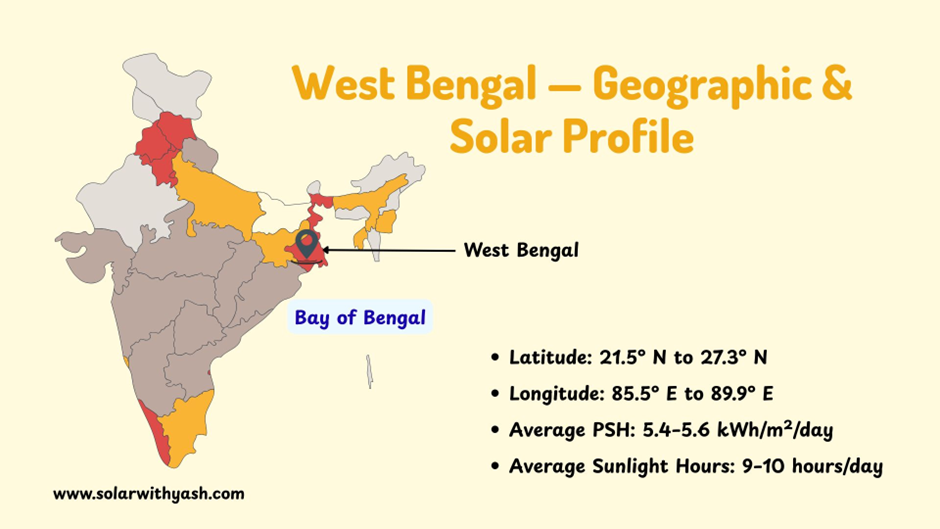
Understanding how each season affects solar generation, efficiency, and ROI helps homeowners plan their solar investment smartly.
Summer (March to June): Strong Sunlight, Slight Efficiency Drop
During the long, bright summer months, West Bengal enjoys the highest solar irradiation of the year.
- Average PSH: 5.4–5.6 kWh/m²/day
- Average sunlight hours: 9–10 hours/day
- Typical generation: ~145–155 kWh per kW/month
However, surface temperatures often rise above 35–38°C, especially in Kolkata, Durgapur, and Asansol.
While sunlight is abundant, high module temperatures reduce panel voltage and output slightly — roughly 0.4–0.5% power loss per °C rise above 25°C.
💡 ROI Impact:
Despite minor efficiency loss, summer still offers the maximum total energy yield of the year — contributing around 30–32% of the annual solar output. Systems generate more units, accelerating payback.
Monsoon (June to September): Cloudy Days and Reduced Generation
The southwest monsoon, fed by the Bay of Bengal, brings heavy rainfall and dense cloud cover across the state.
- Average PSH: 3.4–3.8 kWh/m²/day
- Average sunlight hours: 4–5 hours/day
- Typical generation: ~100–110 kWh per kW/month
Continuous rainfall reduces direct irradiance, and diffuse light dominates. Wind and storm events may occasionally interrupt generation or damage poorly mounted systems.
💡 ROI Impact:
Solar generation typically drops 25–30% during this season, slightly delaying short-term returns. However, annual ROI remains strong because the other eight months compensate easily.
Post-Monsoon & Autumn (October to November): Bright Recovery Period
After the rains withdraw, the sky clears, humidity reduces, and sunlight stabilizes.
- Average PSH: 4.8–5.0 kWh/m²/day
- Average sunlight hours: 7–8 hours/day
- Typical generation: ~135–145 kWh per kW/month
Temperatures stay moderate (~28–32°C), ideal for panel efficiency. This period bridges the summer and winter yields, offering balanced generation and excellent system stability.
💡 ROI Impact:
Post-monsoon production helps offset rainy-season losses. Many homeowners notice an immediate spike in generation and improved net metering credits during these months.
Winter (December to February): Shorter Days but Better Efficiency
Winters in West Bengal are mild, especially in the southern and central districts.
- Average PSH: 4.5–4.7 kWh/m²/day
- Average sunlight hours: 6–7 hours/day
- Typical generation: ~120–130 kWh per kW/month
Cooler panel temperatures boost efficiency, while slightly shorter days limit total energy.
Northern districts like Siliguri and Jalpaiguri experience morning fog, reducing sunlight hours for a few weeks.
💡 ROI Impact:
Overall generation remains steady and efficient — contributing about 23–25% of annual output. Cooler panels enhance performance, helping maintain consistent long-term ROI.
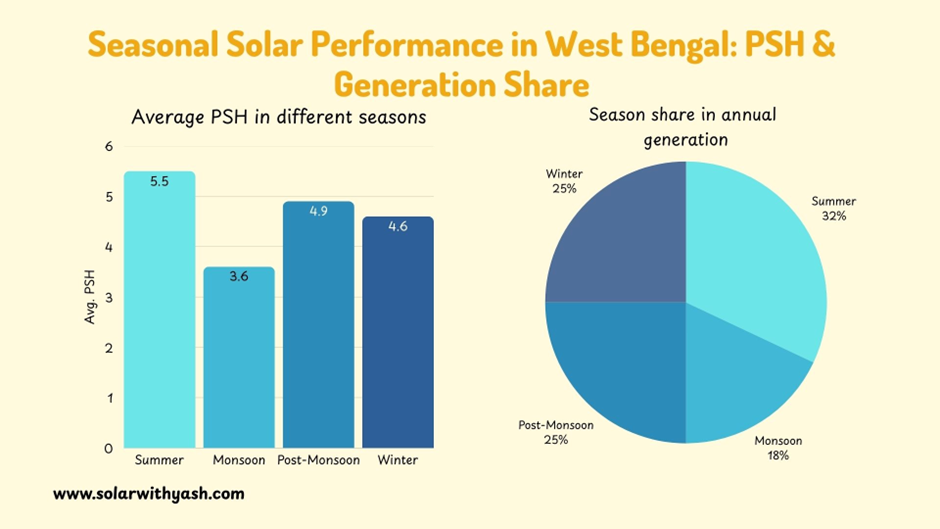
Summary: Seasonal Impact on Solar ROI (West Bengal)
| Season | Avg. PSH (kWh/m²/day) | Climate Effect | Share in Annual Generation | Impact on ROI |
|---|---|---|---|---|
| Summer (Mar–Jun) | 5.5 | High heat, long days | ~32% | Highest energy output; slightly lower efficiency |
| Monsoon (Jun–Sep) | 3.6 | Cloudy, humid, windy | ~18% | Reduced output; temporary ROI slowdown |
| Post-Monsoon (Oct–Nov) | 4.9 | Clear skies, moderate temp | ~25% | Excellent stability; improves payback consistency |
| Winter (Dec–Feb) | 4.6 | Mild, short daylight | ~25% | Cool panels = high efficiency; steady ROI |
Key Takeaway:
Even with weather variations, West Bengal receives 1,700–1,800 units/kW/year, which keeps the average payback within 4 years. Proper system design, cleaning during humid months, and cyclone-grade mounting ensure consistent ROI despite the region’s climatic diversity.
How Humidity, Temperature, and Wind Affect Solar Performance in West Bengal (2025)
West Bengal’s climate is heavily shaped by its proximity to the Bay of Bengal, leading to high humidity, intense summer heat, and occasional coastal winds or cyclones.
Each of these climatic factors influences solar performance — and ultimately, your ROI and payback period. Let’s break it down clearly.
Effect of Humidity on Solar Performance and ROI
Humidity is the invisible factor that many homeowners overlook.
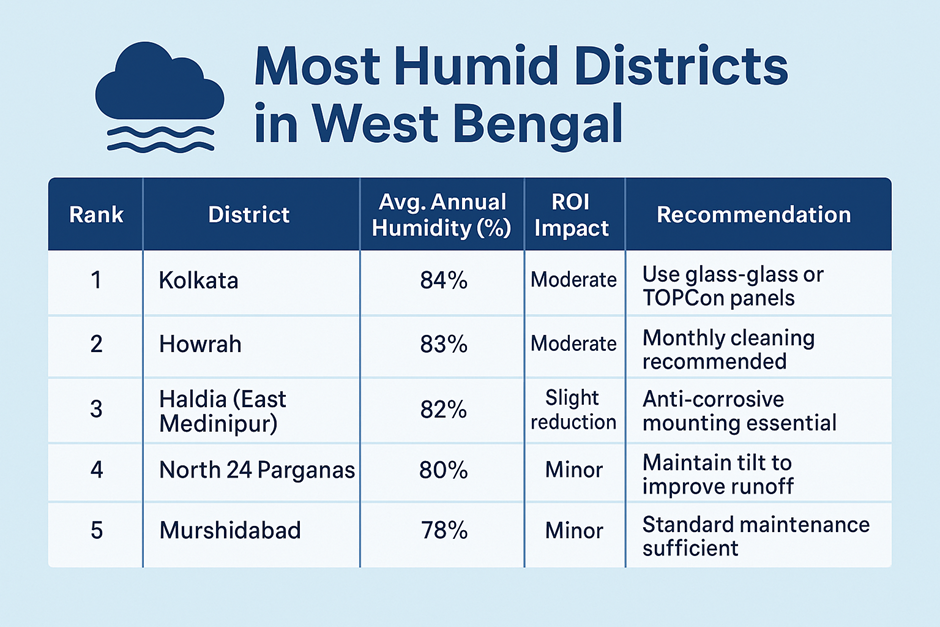
In West Bengal, average annual humidity ranges between 70% and 85%, one of the highest in India — especially in coastal districts like Kolkata, Howrah, and Haldia.
How it affects solar:
- Reduces direct irradiance: Water vapor and clouds scatter sunlight, lowering the amount of usable solar energy reaching panels.
- Increases soiling and corrosion: Moist air attracts dust and salt particles that settle on panels, reducing efficiency.
- Accelerates material degradation: Over the years, high humidity can slightly shorten module lifespan if poor-quality panels are used.
💡 ROI Impact:
High humidity can reduce annual energy generation by 3–5%, slightly extending the payback by 2–3 months if maintenance is ignored. Regular cleaning and glass-glass panels minimize this effect.
| Rank | District | Avg. Annual Humidity (%) | ROI Impact | Recommendation |
| 1 | Kolkata | 84% | Moderate | Use glass-glass or TOPCon panels |
| 2 | Howrah | 83% | Moderate | Monthly cleaning recommended |
| 3 | Haldia (East Medinipur) | 82% | Slight reduction | Anti-corrosive mounting essential |
| 4 | North 24 Parganas | 80% | Minor | Maintain tilt to improve runoff |
| 5 | Murshidabad | 78% | Minor | Standard maintenance sufficient |
Effect of High Temperatures on Solar Output and ROI
Hot summers across West Bengal’s plains can push ambient temperatures above 38–40 °C.
While sunlight is abundant, solar cells lose power and panel efficiency drops by ~0.4–0.5% for every °C above 25 °C.
Example:
At 40 °C, efficiency may drop by 6–7%. This is why cooler northern districts like Siliguri show slightly better year-round performance than hot plains like Asansol or Purulia.
💡 ROI Impact:
High temperatures don’t drastically reduce payback because total irradiation remains high, but they can cause slight seasonal dips in performance and faster inverter heating.
Hottest Districts in West Bengal (2025):
| Rank | District | Avg. Max Summer Temp (°C) | PSH (kWh/m²/day) | ROI Note |
| 1 | Purulia | 41 °C | 4.8 | Excellent PSH, but slightly lower efficiency |
| 2 | Bankura | 40 °C | 4.7 | Good yield, moderate losses |
| 3 | Asansol (Paschim Bardhaman) | 39 °C | 4.6 | High generation; keep the inverter well-ventilated |
| 4 | Durgapur | 38 °C | 4.8 | Balanced performance; good ROI |
| 5 | Birbhum | 37 °C | 4.7 | Slightly warm but manageable |
✅ Tip: Use panels with a temperature coefficient ≤ −0.30%/°C (like N-Type TOPCon or Mono-PERC) to minimize heat losses.
Effect of Wind and Storms on Solar System Safety and ROI
Being a coastal state, West Bengal occasionally faces cyclones and high-wind events that can impact rooftop solar systems — especially in South 24 Parganas, East Medinipur, and Howrah.
Wind speeds during cyclonic events can exceed 100–130 km/h, making system design, structural strength, and installation quality absolutely critical for long-term safety and ROI.
Two major cyclones in recent years —
- Cyclone Amphan (May 2020) and
- Cyclone Yaas (May 2021) — severely affected coastal districts like South 24 Parganas, East Medinipur, and Kolkata suburbs, highlighting the importance of cyclone-resistant mounting structures and robust panel anchoring.
How wind affects solar ROI:
- Poorly mounted panels risk physical damage, increasing maintenance or replacement costs.
- High winds can loosen clamps or wiring if not properly rated.
- However, moderate daily winds actually cool the panels, improving efficiency slightly.
💡 ROI Impact:
When installed using 150 km/h-rated structures, the effect on ROI is minimal. In fact, coastal winds can enhance cooling and yield during non-storm months.
Most Wind-Prone Districts of West Bengal (2025)“
| Rank | District | Avg. Peak Wind Speed (km/h) | Risk Level | ROI Tip |
|---|---|---|---|---|
| 1 | South 24 Parganas | 130 km/h | High | Use cyclone-rated mounting |
| 2 | East Medinipur (Haldia) | 120 km/h | High | Extra clamps & strong anchors |
| 3 | Howrah | 110 km/h | Moderate | Periodic inspection before monsoon |
| 4 | Kolkata | 100 km/h | Moderate | Secure wiring & junction boxes |
| 5 | Murshidabad | 90 km/h | Low | Normal maintenance sufficient |
West Bengal District-wise Climate Summary
| District | Avg. Humidity (%) | Max Temp (°C) | Avg. Wind Speed (km/h) | Key ROI Consideration |
| Kolkata | 84 | 38 | 100 | High humidity → clean regularly |
| Durgapur | 75 | 38 | 85 | Hot but stable climate = steady ROI |
| Siliguri | 78 | 32 | 70 | Cool climate = best efficiency |
| Haldia | 82 | 36 | 120 | Coastal winds = stronger mounting |
| Purulia | 60 | 41 | 75 | Very hot but low humidity = good yield |
| Howrah | 83 | 37 | 110 | Humid & windy → corrosion protection needed |
✅ Key Takeaways:
- Humidity affects sunlight penetration and panel cleanliness → clean panels monthly.
- Heat slightly lowers panel efficiency but can be offset with proper panel selection.
- Wind demands durable, cyclone-rated mounts but aids cooling for better performance.
Overall, with proper design and maintenance, West Bengal’s climate reduces annual ROI by less than 5%, while maintaining payback in around 4 years for most homes.
Top Solar Panels for West Bengal Homes (2025): Which Type Gives the Best ROI and Efficiency?
Choosing the right solar panel technology is one of the most important decisions homeowners in West Bengal can make.
Because of the state’s humid coastal air, high temperatures, and moderate PSH (4.5–5.0 kWh/m²/day), panel performance can vary widely depending on the technology and build quality.
In this section, we’ll compare the top solar panel types available in India — explaining which ones perform best in West Bengal’s tropical climate and offer the highest ROI for homeowners.
N-Type TOPCon Solar Panels (Best Overall for West Bengal)
Technology: Advanced N-Type Tunnel Oxide Passivated Contact (TOPCon) cells.
Efficiency Range (2025): 22%–23.5%
Temperature Coefficient: −0.29%/°C
Best For: Humid coastal and high-temperature regions (like Kolkata, Haldia, Howrah).
Why It’s Ideal for West Bengal:
- Performs better in high humidity and heat compared to P-Type panels.
- Lower power loss during summer (due to superior cell structure).
- PID-resistant and long lifespan (~25–30 years).
- Works well even on partly cloudy days due to low-light sensitivity.
💡 ROI Insight:
TOPCon panels may cost 5–8% more, but their higher generation (≈ +4–5%) and better longevity make them ideal for humid and coastal districts, leading to 3.8-year payback vs 4.1 years for standard panels.
Bi-Facial Glass–Glass Solar Panels (Best for Urban and Reflective Rooftops)
Technology: Bi-facial Panels capture sunlight from both sides — front and rear.
Efficiency Range: 21.5%–23% (effective gain up to 26% with reflection).
Best For: Urban homes with bright concrete or white-painted rooftops (Kolkata, Durgapur, Asansol).
Why It’s Ideal for West Bengal:
- Utilizes reflected light from rooftop surfaces, increasing energy yield.
- Glass–glass structure resists humidity, corrosion, and micro-cracks.
- Perfect for dense urban rooftops where cooling airflow is limited.
💡 ROI Insight:
Produces 5–10% more energy annually — translating to faster payback and better returns per kW.
With a small tilt optimization (20–25°), bi-facial panels deliver excellent long-term ROI in humid conditions.
Mono-PERC Solar Panels (P-Type) – Most Popular and Cost-Effective
Technology: Passivated Emitter and Rear Cell (PERC) for higher light capture.
Efficiency Range: 20.5%–21.8%
Best For: Homeowners seeking a balance between price and performance.
Why It’s Suitable for West Bengal:
- Performs decently in moderate humidity and heat.
- Affordable and widely available from major Indian and global brands.
- Ideal for semi-urban and rural homes where costs must be controlled.
💡 ROI Insight:
While Mono-PERC has a slightly lower efficiency, its lower upfront cost balances overall returns.
Average payback: 4.0–4.2 years for a 5kW system.
Thin-Film Solar Panels (For Shaded or Specialized Applications)
Technology: Uses thin layers of semiconductor material (CdTe, a-Si, CIGS).
Efficiency Range: 17%–19%
Best For: Roofs with partial shading, metal sheds, or high diffuse light areas.
Why It’s Ideal for Certain Cases:
- Performs better under cloudy skies or indirect sunlight.
- Lightweight, flexible, and easier to install on industrial sheds.
- Not ideal for small rooftops because it needs more space.
💡 ROI Insight:
Thin-film panels have lower output per area, so ROI is slower for compact homes. However, they’re useful for commercial or shaded sites in humid northern plains.
Recommended Solar Panel Features for West Bengal Homes (2025)
| Feature | Why It Matters in West Bengal |
|---|---|
| Glass–Glass Structure | Prevents moisture damage and corrosion |
| Anti-PID Technology | Protects panels from performance degradation in humidity |
| Low Temperature Coefficient (≤ −0.30%/°C) | Improves efficiency during hot summer days |
| High Salt Mist Resistance (IEC 61701 certified) | Essential for coastal districts like Haldia, Howrah |
| Hydrophobic Coating | Helps repel dust, salt, and water drops |
| 25-Year Performance Warranty | Ensures reliable returns and long-term ROI |
Solar Panel Recommendations by District Type in West Bengal (2025)
| District Type | Recommended Panel Type | Reason / ROI Advantage |
| Coastal (Kolkata, Haldia, Howrah) | N-Type TOPCon or Bi-Facial Glass–Glass | High humidity and salt exposure — best durability & ROI |
| Industrial (Durgapur, Asansol) | Bi-Facial Mono-PERC | Reflective rooftops = +5–8% more generation |
| Northern Hills (Siliguri, Jalpaiguri) | Mono-PERC (P-Type) | Cooler climate → best cost-to-performance ratio |
| Rural Plains (Malda, Birbhum) | P-Type Mono or Half-Cut Panels | Affordable with good year-round performance |
| Hot Dry Zones (Purulia, Bankura) | TOPCon or N-Type Mono | Handles high temperature well; maintains output |
Final Takeaway
For homeowners in West Bengal, N-Type TOPCon and Bi-Facial Glass–Glass panels offer the best combination of efficiency, durability, and ROI in 2025.
If you’re on a tighter budget, Mono-PERC (P-Type) panels are still a solid, value-driven choice — delivering reliable payback in around 4 years under average conditions.
✅ Pro Tip: Always check for BIS certification and salt-mist protection (IEC 61701) before buying — it’s the simplest way to secure your system’s long-term performance in humid West Bengal weather.
Cost of Solar in West Bengal (2025): Complete Price Breakdown for Homeowners
When you’re evaluating a rooftop solar system in West Bengal, the upfront cost, subsidy support, and final payback matter just as much as the generation numbers. This section gives you realistic installation costs, subsidy details, and a cost comparison so you can plan wisely.
Estimated Cost per kW (West Bengal, 2025)
Based on market data in West Bengal, here are typical cost ranges for residential grid-tied rooftop solar systems:
| System Size | Approx Cost (₹/kW) | Approx Total Cost* |
| Small (1 kW) | ₹90,000–₹1,30,000 | ₹90,000–₹1,30,000 |
| Medium (2 kW) | ₹70,000–₹90,000 (avg) | ₹1,40,000–₹1,80,000 |
| Standard House (3 kW) | ₹60,000–₹75,000 per kW | ₹1,90,000–₹2,30,000 |
| Common Scale (5 kW) | ₹55,000–₹60,000 per kW | ₹2,75,000–₹3,00,000 |
| Larger (10 kW) | ₹50,000 per kW (approx) | ₹5,00,000 |
*Costs include panels, inverter, BOS, installation, and GST.
Actual pricing varies by panel technology, installer, and roof type.
Sources:
Subsidy / Financial Assistance Available (2025)
Central Government Subsidy (PM Surya Ghar Muft Bijli Yojana)
Under MNRE norms, residential rooftop systems up to 3 kW qualify for government support.
- ₹30,000 subsidy for 1 kW
- ₹60,000 for 2 kW
- ₹78,000 for 3 kW and above
In West Bengal, for example, a 1 kW system costing ₹90,000–₹1.3 lakh receives a ₹30,000 subsidy, bringing the net cost down to ₹60,000–₹1,00,000 for homeowners.
State / Local Support
The West Bengal Renewable Energy Development Agency (WBREDA) also provides support for rural and semi-urban rooftop solar projects.
While the 2025 state subsidy structure is still being finalized, combined central + state incentives can reduce total system costs by 30–40% for eligible consumers.
Sources:
Cost vs Subsidy Table (West Bengal, 2025 Example)
| System Size | Without Subsidy (₹) | Approx Subsidy (₹) | Final Cost for Homeowner (₹) |
| 3 kW | ₹1,90,000 – ₹2,30,000 | ₹78,000 (Central) | ₹1,12,000 – ₹1,52,000 |
| 5 kW | ₹2,75,000 – ₹3,00,000 | ₹78,000 (Central) + possible State Share | ₹1,97,000 – ₹2,22,000 |
| 10 kW | ₹5,00,000 (approx) | ₹78,000 (Central only) | ₹4,22,000 (approx) |
*Costs include panels, inverter, mounting structure, installation, and GST.
Actual pricing varies by installer, panel brand, and roof type.
Sources:
Solar Cost Comparison: West Bengal vs a Higher PSH/Lower Cost State
| State | Avg PSH | 5 kW Payback Estimate* | Notes |
| West Bengal | ~4.7 kWh/m²/day | ~4.0 years (based on earlier ROI model) | Slightly moderate PSH but good generation potential |
| A state with higher PSH (e.g., Gujarat) | ~5.5 kWh/m²/day | ~3.6 years | Lower cost & higher PSH help faster payback |
*Based on ROI assumptions previously discussed in your post.
This highlights that West Bengal’s cost/subsidy structure still keeps solar payback very competitive.
📌 5. What Homeowners Should Check Before Installation
- Confirm the quote is clear about ₹/kW cost, brand of panels & inverter, BOS items, structure, and workmanship.
- Ensure the installer is MNRE-registered and panels/inverter have valid performance warranty & warranty certificates.
- Install in a good sunlight-exposure area, ensure minimal shading, and check roof strength for mounting.
- Apply for net-metering approval with West Bengal State Electricity Distribution Company Limited (WBSEDCL) or relevant DISCOM before or after installation—delays can affect payback.
- Plan maintenance: cleaning (especially during monsoon/humidity), inspections for wind/cyclone zones.
✅ Summary
In 2025, installing a rooftop solar system in West Bengal typically costs around ₹55,000–₹60,000 per kW (for a standard 5kW size) before subsidy. With central subsidy of up to ₹78,000 for a 3 kW+ system and additional state support, the effective cost drops significantly—often into the ₹2 lakh range for a 5kW system. With earlier ROI modeling (~4 years payback), this makes solar a strong investment for homeowners in West Bengal.
Solar Electricity Output in West Bengal – District-Wise Comparison (2025)
One of the best ways to understand solar returns is by looking at how much electricity your system can actually generate each year.
This depends primarily on solar irradiance, climate, and Peak Sun Hours (PSH) — which vary from district to district in West Bengal.
Average Solar Electricity Generation in West Bengal (2025)
Across most regions, 1 kW of solar capacity in West Bengal generates between 1,650 and 1,800 units (kWh) per year.
That’s slightly below India’s high-sunlight states (like Gujarat or Rajasthan), but still excellent for residential ROI because of higher electricity tariffs and subsidies.
Here’s how the state performs on average:
| Parameter | Typical Value | Comment |
| Average PSH (Peak Sun Hours) | 4.5 – 5.0 kWh/m²/day | Good sunlight levels |
| Average Annual Generation (1 kW system) | ~1,720 kWh | Standard flat-roof setup |
| Performance Ratio (PR) | 75–80% | With cleaning & shade-free roof |
| CO₂ Savings | ~1.6 ton/year per kW | Equivalent to planting 70 trees |
In simple words:
If your monthly electricity bill is around ₹2,500–₹3,000, a 3–5 kW rooftop solar system can almost eliminate it for 20+ years.
Seasonal Generation Pattern (Kolkata Example)
Let’s look at how solar generation changes through the year for a typical 5 kW rooftop system in Kolkata:
| Season | Avg. PSH (kWh/m²/day) | Monthly Generation (per kW) | 5 kW System (kWh/month) | Share of Annual Total | ROI Effect |
| Summer (Mar–Jun) | 5.5 | 150 | 750 | 32% | Highest output; faster payback |
| Monsoon (Jul–Sep) | 3.6 | 105 | 525 | 18% | Lower yield; temporary ROI dip |
| Post-Monsoon (Oct–Nov) | 4.9 | 140 | 700 | 25% | Strong rebound period |
| Winter (Dec–Feb) | 4.6 | 125 | 625 | 25% | Consistent & efficient generation |
Annual Total (approx.): 2,600–2,700 kWh per kW for well-optimized rooftops in Kolkata.
District-Wise Solar Generation and ROI Comparison (2025)
| District | Avg. PSH (kWh/m²/day) | Est. Annual Generation (1 kW) | Climate Notes | ROI Insight |
| Siliguri (Darjeeling) | 4.9 | ~1,780 kWh | Clear skies, cooler climate | Best efficiency & ROI |
| Durgapur (Paschim Bardhaman) | 4.8 | ~1,750 kWh | Hot summers, stable sunlight | High output; 3.9 yr payback |
| Kolkata | 4.7 | ~1,715 kWh | Humid, coastal | Slightly slower payback (~4.0 yrs) |
| Asansol | 4.6 | ~1,690 kWh | Industrial, warm | Minor heat loss |
| Malda | 4.5 | ~1,640 kWh | More cloudy days | Slightly lower yield |
| Purulia | 4.8 | ~1,750 kWh | Hot & dry | Excellent sunlight; minor temp loss |
| Howrah | 4.6 | ~1,690 kWh | Humid, coastal winds | Use corrosion-resistant mounts |
Payback and ROI in West Bengal 2025
Average Payback Across Districts in West Bengal is 3.8 – 4.3 years depending on climate, installation quality, and tariff zone.
District-Level Payback and ROI Summary Table:
| District | 5 kW System Cost (₹) | Annual Units | Est. Savings/Year (₹8/unit) | Payback (Years) | 20-Year ROI |
| Siliguri | ₹2.75 L | 8,900 | ₹71,200 | 3.8 yrs | ~500% |
| Durgapur | ₹2.75 L | 8,750 | ₹70,000 | 3.9 yrs | ~480% |
| Kolkata | ₹2.75 L | 8,575 | ₹68,600 | 4.0 yrs | ~470% |
| Asansol | ₹2.75 L | 8,450 | ₹67,600 | 4.1 yrs | ~460% |
| Malda | ₹2.75 L | 8,200 | ₹65,600 | 4.2 yrs | ~450% |
What These Numbers Mean for Homeowners
Even with small climatic differences, all major West Bengal districts deliver strong solar performance.
- Average generation: 1,700–1,800 units/kW/year
- Average payback: ~4 years
- 20-year savings for a 5kW system: ₹13 – 14lakh (including tariff escalation)
✅ Conclusion:
Whether you’re in Kolkata’s humidity or Purulia’s dry heat, solar energy in West Bengal delivers a solid ROI — especially when you combine smart system design, subsidy benefits, and regular maintenance.
West Bengal 7 kW Solar ROI Case Study (2025): How Mr. Basu from Kolkata Planned His Retirement with Solar Savings
When we talk about solar ROI, it’s not just about numbers — it’s about peace of mind.
That’s exactly what Mr. Anupam Basu, a 58-year-old resident of Salt Lake, Kolkata, wanted as he prepared for retirement.
Before Solar – Rising Electricity Costs After Retirement
Mr. Basu had worked as a bank manager for over 30 years.
With his children settled abroad and retirement approaching, he wanted his monthly expenses to be predictable and minimal.
But his electricity bills told another story.
💡 “Our monthly bill had crossed ₹4,800, and every year it kept going up. I realized my pension might not grow as fast as my electricity cost,” Mr. Basu shared.
He was consuming around 700 units/month, mostly from air conditioners, geysers, and kitchen appliances.
When he heard about the PM Surya Ghar Muft Bijli Yojana and saw solar rooftops spreading across Kolkata, he decided to explore it seriously.
System Installed: 7 kW Rooftop Solar (Grid-Tied)
| Parameter | Detail |
| System Capacity | 7 kW (grid-connected) |
| Panel Type | N-Type TOPCon Glass–Glass Modules |
| Inverter | 7 kW Hybrid Inverter (Wi-Fi monitoring) |
| Total Installed Cost (2025) | ₹3.85 lakh |
| Subsidy Received | ₹78,000 (central) |
| Net Cost to Homeowner | ₹3.07 lakh |
| Location | Salt Lake City, Kolkata |
| Average PSH | 4.7 kWh/m²/day |
After Solar – Electricity Bill Drops to ₹0 (Almost)
In the first 12 months, his system generated about 12,000 units — nearly matching his total annual consumption.
Net-metering credits balanced his usage across seasons.
| Scenario | Units/Month | Bill/Month |
| Before Solar | 700 units | ₹4,800–₹5,000 |
| After Solar | 30–50 units (net) | ₹150–₹200 (fixed charge) |
That’s an annual saving of nearly ₹58,000–₹60,000, with the system expected to last 25 years.
🗣️ “Now my rooftop pays for my electricity — and my peace of mind. I call it my ‘solar pension’,” Mr. Basu laughs.
Is Solar Worth It in West Bengal in 2025?
If you live in West Bengal, the short answer is — Yes, absolutely.
In 2025, going solar isn’t just an environmental choice anymore — it’s one of the best financial decisions a homeowner can make.
With 4.5–5.0 Peak Sun Hours (PSH), high grid tariffs (₹7–₹9/unit), and government subsidies under the PM Surya Ghar Muft Bijli Yojana, the numbers are now firmly in your favor.
A typical 5 kW solar system in West Bengal:
- Costs around ₹2.75–₹3.00 lakh (before subsidy)
- Saves ₹65,000–₹70,000 per year on electricity
- Pays back in 3.8 to 4.2 years
- Delivers free power for the next 16–20 years
Even in coastal districts like Kolkata, Howrah, and Haldia, where humidity is high, modern glass-glass or N-Type panels ensure consistent long-term performance.
In cooler northern regions like Siliguri or Jalpaiguri, panels perform even better — making solar systems one of the highest-return, lowest-risk assets you can own.
💬 In simple words:
You invest once, and for the next two decades, your rooftop keeps paying you back — every single month.
Real-World Returns in West Bengal (2025 Snapshot):
| System Size | Net Cost (After Subsidy) | Annual Saving | Payback | 20-Year ROI |
| 3 kW | ₹1.4 L | ₹38,000 | 3.8 years | ~470% |
| 5 kW | ₹2.3 L | ₹65,000 | 4.0 years | ~480% |
| 7 kW | ₹3.1 L | ₹90,000 | 3.9 years | ~500% |
Even with minor seasonal variations, solar continues to outperform most traditional investments when you look at returns vs. risk — and the best part: your savings start from Day 1.
Plan Your Own Solar ROI in Minutes
Curious to see how fast your rooftop solar can pay back?
A simple, ready-to-use tool that helps you:
- Estimate solar generation in your district (based on PSH data)
- Complete Solar Sizing based on your Energy needs
- Calculate ROI, payback, and lifetime savings
- Compare system sizes and subsidy impacts instantly
Whether you’re in Kolkata, Durgapur, Siliguri, or Malda, this spreadsheet will show your exact savings potential — so you can plan smart, invest confidently, and turn your sunlight into lifelong income.
Final Thought:
In 2025, solar is not just worth it — it’s inevitable for West Bengal homeowners who want to reduce bills, increase property value, and secure their energy independence.
The sooner you start, the faster the sun begins to work for you. 🌞
Frequently Asked Questions – Solar ROI & Payback in West Bengal (2025)
1. How much sunlight does West Bengal get?
The state receives about 4.5–5.0 Peak Sun Hours (PSH) daily. This allows most areas to generate 1,650–1,800 units per kW per year, ideal for home solar setups.
2. What is the average payback period?
Homeowners usually recover their investment in 3.8–4.2 years. After that, the system produces free electricity for 15–20 years, giving high returns with low risk.
3. How much does a 5 kW solar system cost in 2025?
A 5 kW grid-tied system costs ₹2.75–₹3.0 lakh before subsidy and around ₹2.0–₹2.2 lakh after the central subsidy.
4. What subsidy is available?
Under the PM Surya Ghar Muft Bijli Yojana, homeowners get
– ₹18,000 per kW for the first 2 kW, and
– ₹9,000 per kW for the next 3 kW,
totalling up to ₹45,000 for a 5 kW system.
5. Does humidity affect solar output?
Yes, slightly. High humidity can lower performance by 3–5 %, but N-Type TOPCon or glass-glass panels maintain efficiency if cleaned monthly.
6. How much can I save each year?
A 5 kW system saves about ₹65,000–₹70,000 per year at tariffs of ₹7–₹9/unit. A 7 kW setup can save up to ₹90,000 annually.
7. Can panels work well in Kolkata’s coastal climate?
Absolutely. With anti-corrosive mounting and regular cleaning during monsoon, systems in Kolkata, Howrah, and Haldia perform reliably.
8. What type of panels last longest?
Choose N-Type TOPCon or bi-facial glass-glass panels; they handle heat and humidity well and carry 25-year warranties.
9. Is solar worth it in West Bengal (2025)?
Yes — with 4–5 years payback, solid sunlight, and government incentives, solar remains one of the smartest investments for homeowners in the state.