How to Calculate Your Home Energy Needs for Solar (Step-by-Step)
Most homeowners overestimate or underestimate their energy needs. Here’s a simple way to find your real usage before sizing a solar system.
This guide explains two simple methods — one from your electricity bill, and another using your household appliances — to find your total energy requirement in kWh/day.
The first step for going solar is to know how much electricity your home actually uses.
Why Calculate Energy Needs
1. To Size the System Correctly
Your total energy decides how big your solar system should be. An undersized solar power system may not meet your energy needs, and you will remain dependent on the grid. You are not going to save much, and will get below-average ROI from solar.
If you overestimate, you will end up spending more on extra solar panels and a large inverter, which you don’t actually need.
That is why accurately estimating your energy needs is important – it ensures your solar system is perfectly sized to meet your requirements while delivering the best possible savings and ROI.
2. To know Your Daily Energy Consumption
Most electricity bills only show monthly units (kWh), but solar design depends on daily energy use.
By calculating your daily energy consumption, you can easily match it with the solar energy generation in your area (based on Peak Sun Hours).
It bridges the gap between your electricity bill and your solar design.
3. To Plan for Future Growth
Your energy usage changes — maybe you’ll buy an EV, add an AC, or shift to induction cooking.
Knowing your current baseline helps you plan for future loads so your solar system can handle tomorrow’s demand, too.
Today’s calculation helps tomorrow’s expansion.
4. To Estimate Savings & ROI Correctly
All solar financial calculations — like payback period or ROI — depend on your monthly consumption.
If your energy need is wrong, your payback calculation will also be wrong.
Accurate load = realistic savings estimate.
5. To Decide Between Grid-Tied, Hybrid, or Off-Grid
Your energy pattern tells whether you should go for:
- Grid-tied system: if your daily usage is high and grid power is available
- Hybrid/off-grid: if you want backup during outages or run heavy night loads
Your energy data guides the right system type.
6. To Identify Energy Efficiency Opportunities
When you list out your appliances and their wattage, you’ll notice which ones consume the most power — like old fridges or inefficient fans.
You can then replace them before going solar, reducing both energy waste and solar cost.
Measure → Optimize → Save even before solar!
7. To Communicate Clearly with Installers
When you already know your daily energy use and peak load, installers can immediately suggest the right system size and cost.
You’ll also appear more informed — avoiding overselling or wrong system recommendations.
Knowledge = control over your investment.
In Short:
“You can’t design what you don’t measure.”
Calculating your home energy needs is the foundation of your solar journey.
It ensures your system is neither too big nor too small — but just right for your lifestyle, usage, and budget.
Method 1 of Finding Home Energy Needs: From your Electricity Bills
- Take out your monthly electricity bills for the last 12 months.
- Note down the monthly consumption (in kWh or units)
Why do I need to note down the units for 12 months?
Isn’t 1 month of reading sufficient?
Friends, we need to note all 12 months’ units because consumption varies from month to month. It varies seasonally.
Sometimes you consume more, while other times it is less.
We use ACs in summer and heaters in winter. During autumn, when the weather is cool, we consume less. Therefore, a 1-month reading is not sufficient to obtain an accurate assessment of energy needs.
Step 1: Get the Last 12-month Energy Bills
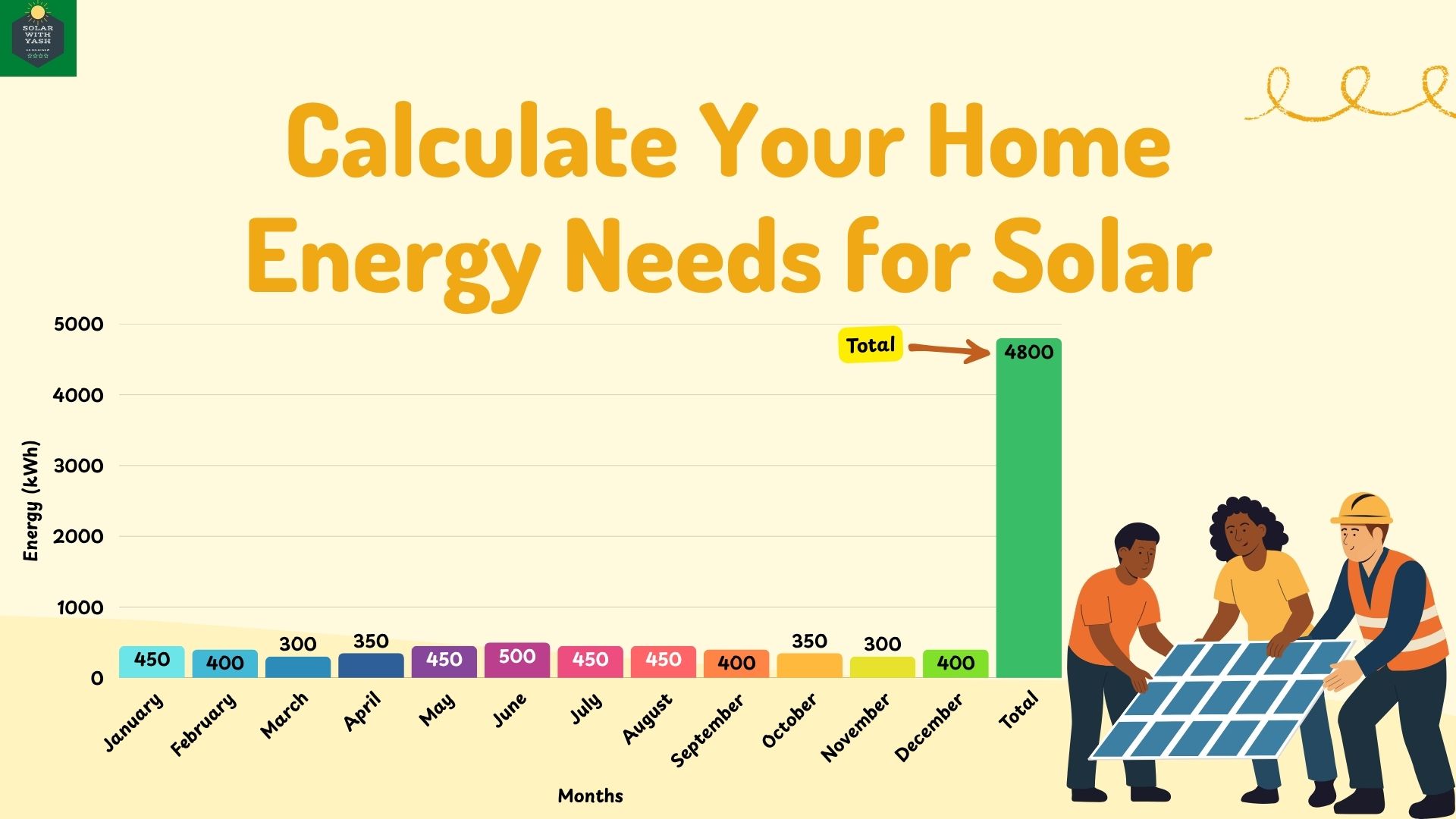
Let us take an example of calculating the average monthly and daily energy needs of a household. In my experience, a mid-size house in India consumes 400-600 units monthly.
| Month | Electricity Bill (kWh or units) |
|---|---|
| January | 450 |
| February | 400 |
| March | 300 |
| April | 350 |
| May | 450 |
| June | 500 |
| July | 450 |
| August | 450 |
| September | 400 |
| October | 350 |
| November | 300 |
| December | 400 |

Step 2: Find the Total Annual Energy Consumption (kWh)
Add all the 12-month energy bills to get the total annual energy consumption.

Step 3: Find Out the Monthly Average and Daily Energy Consumption
- Divide the sum by 12 to get the average monthly consumption:
Average Monthly Energy Needs = Sum of 12 months’ energy bills (kWh)/12

- Divide by 30 to get the daily average consumption or the energy needs.
Daily Energy Needs (kWh) = Average Monthly needs (kWh)/30
In this case, the daily energy needs = 400/30 = 13.3 units
This means your house consumes 13.3 units daily. It is the base that decides the sizing of the complete solar power system.
The Energy Consumption Scenario in a Table:
| Month | Electricity Bill (kWh or units) |
|---|---|
| January | 450 |
| February | 400 |
| March | 300 |
| April | 350 |
| May | 450 |
| June | 500 |
| July | 450 |
| August | 450 |
| September | 400 |
| October | 350 |
| November | 300 |
| December | 400 |
| Total | 4800 |
| Average Monthly (kWh) | 400 |
| Average daily Consumption (kWh | 13.30 |
Some homeowners give me the excuse that they don’t have all 12-month energy bills, or they find it cumbersome to get all 12 months’ bills in one place.
Can they take the average of the highest and the lowest consumption months to get the average consumption?
Believe me, this activity is worth doing and can save you thousands of rupees if done diligently.
Today, most electricity boards in India provide digital access to past bills — either through their official websites, mobile apps, or email/SMS notifications.
That means homeowners can easily download all 12 months’ bills in just a few minutes.
Using data from the entire year gives the most accurate picture of your home’s energy usage.
It automatically includes:
- High-consumption months (like summer with AC use)
- Low-consumption months (like Autumn)
- And the average pattern during moderate months
This helps you design a solar system that performs well year-round, not just for one season.
Even a 10–15% difference in estimated consumption can affect your system size, cost, and ROI.
So, instead of guessing or averaging just two months, it’s always better to take the 12-month average — especially since it’s now quick and digital.
Method 2: Appliance-Wise Calculation (Load Analysis)
You can use this method when you don’t have bills or want to check the new home loads. In this method, the wattage (watts) of each electrical appliance and its average usage (in hours) in the house is noted to find the energy consumption (kWh).
| Appliance | Power (W) | Hours/day | Energy (Wh) = Power x Hours/day |
|---|---|---|---|
| LED Lights (10 × 10 W) | 100 | 5 | 500 |
| Ceiling Fans (4 × 75 W) | 300 | 8 | 2,400 |
| TV | 100 | 4 | 400 |
| Refrigerator | 200 | 24 | 4,800 |
| Laptop | 60 | 6 | 360 |
| Washing Machine | 500 | 1 | 500 |
| Miscellaneous | — | — | 500 |
| Total | — | — | 8,960 Wh = 8.96 kWh/day |

So, your daily energy need in this case = 8960 Wh or ~9 kWh/day
Monthly = 9 × 30 = 270 kWh/month
Next Step: Find out Peak Load
Peak load means the maximum power (in watts or kilowatts) your home draws at any one time — that is, when the maximum number of appliances are ON together.
Example:
If your fridge (300 W), washing machine (500 W), lights (200 W), and AC (1,200 W) all run at once,
your peak load = 2,200 W = 2.2 kW.
Your daily energy need (in kWh) tells how much energy you use in a day,
but your peak load tells how much power you need at one moment.
Why Identifying Peak Load Matters in Solar Sizing
It Decides Your Inverter Capacity
Your inverter must be able to handle your maximum simultaneous load.
If your peak load is 4 kW but your inverter is rated only 3 kW,
then whenever heavy appliances run together, the inverter will trip or shut down.
✅ So your inverter size should be ≥ your home’s peak load.
It Avoids Underperformance & Future Upgrades
If you only calculate average energy use (kWh/day) but ignore the peak load,
you might install a smaller inverter or cable system that struggles during high demand.
Later, you’ll have to upgrade, which is expensive and avoidable.
Identifying peak load saves you from underperforming systems.
Example:
| Appliance | Power (W) | Expected to Run Together? |
|---|---|---|
| 1.5 Ton AC | 1,500 | ✅ |
| Fridge | 200 | ✅ |
| Lights + Fans | 400 | ✅ |
| TV | 100 | ✅ |
| Washing Machine | 500 | ❌ (runs separately) |
Peak load = 1,500 + 200 + 400 + 100 = 2,200 W = 2.2 kW
So, the inverter rating should be ≥ 2.5 kW to safely run these loads together.
In short:
Energy need (kWh/day) tells how much you consume in a day.
Peak load (kW) tells how much you draw at once.
Both are essential:
- Energy need → solar array size
- Peak load → inverter capacity
Together, they ensure your solar system works smoothly and safely all year.
Conclusion
Calculating your home energy needs is the very first and most important step in your solar journey.
It tells you exactly how much electricity your home consumes and helps you plan a solar system that’s the right fit — not too small, not oversized.
You can calculate it in two simple ways:
- Using Electricity Bills:
Download your last 12 months’ electricity bills from your DISCOM’s website or app.
Find the average monthly units (kWh) and divide by 30 to get your daily energy use (kWh/day). - Using Appliance Data:
List your household appliances, note their wattage and daily usage hours, and multiply them to find total daily consumption.
You can use my free Home Energy Calculator Excel sheet to make this quick and easy.
Once you know your daily energy use and peak load, you can confidently plan your solar setup.
It helps you:
- Choose the right solar system size for your home
- Get the best ROI and shortest payback
- Prepare for future loads like EV charging or new ACs
- Talk confidently with solar installers and verify their proposals
Remember — “A perfectly sized solar system starts with accurately knowing your energy needs.”
Next Step: Check Your Solar Feasibility
Now that you know how much electricity your home uses, the next step is to find out how much solar power you actually need and how much you can save.

This smart spreadsheet will help you instantly:
- Estimate your ideal solar system size (kW)
- Calculate energy generation based on your district’s PSH
- Know your expected savings and payback period
- See your solar ROI before investing
Designed by Yash — your personal solar educator, with over 10 years of experience in helping homeowners go solar confidently.
FAQ: How to Calculate Your Home Energy Needs
1. How do I calculate my home energy needs for solar?
You can calculate it using your electricity bills or appliance list.
- From bills: Add up the energy used (kWh) in the last 12 months, divide by 12 to get monthly average, then divide by 30 for daily energy (kWh/day).
- From appliances: Multiply each appliance’s wattage × daily usage hours × quantity, then add up all to get total kWh/day.
2. Why should I calculate my home energy needs before going solar?
Because your energy consumption decides the system size.
- If you underestimate, your system won’t meet your needs.
- If you overestimate, you’ll overspend.
- Accurate calculation ensures maximum savings and correct ROI.
3. Can I calculate energy needs without 12 months of bills?
Yes, but 12 months gives the most accurate result.
If you can’t access all bills, use the average of your highest and lowest consumption months as a quick estimate.
4. What is peak load, and why does it matter?
Peak load is the maximum power (in watts or kW) your home uses at one time.
It helps decide your inverter size — the inverter must handle your highest load to prevent tripping or shutdown.
5. What should I do after calculating my energy needs?
Once you know your daily energy use, check your solar feasibility using tools like the Solar Feasibility Spreadsheet on SolarWithYash.com. It helps you find the ideal solar system size, savings, and payback period.


