Solar Payback in Maharashtra: Is It Worth the Investment?
Are you a homeowner in Maharashtra, thinking about whether installing solar panels is a smart financial decision? With rising electricity bills, attractive government subsidies, and abundant sunlight, solar energy in Maharashtra offers both economic and environmental benefits. This guide breaks down solar potential, system costs, savings, and payback in Maharashtra, specifically for a 5-kW residential rooftop system.
Maharashtra at a Glance

Maharashtra is India’s third-largest state by area and the second-most populous. With a mix of urban cities like Mumbai and Pune, and vast rural belts, the state faces high power demands. The combination of ample rooftop space and strong sunlight makes it ideal for residential solar power systems.
- Average annual temperature: 25°C–30°C
- Climate type: Tropical monsoon (hot, humid in coastal; dry in inland)
- Power demand: High due to AC usage and urban development
Solar Potential in Maharashtra
Maharashtra lies within the latitude range of 15.6⁰ N to 22.02⁰ N and receives an average of 5.5 to 6.2 kWh/m²/day of solar radiation. Cities like Jalgaon, Nagpur, and Aurangabad have excellent solar potential due to relatively stable weather and less cloud cover for most of the year.
| District | Average PSH (kWh/m²/day) | Remark |
| Nagpur | 5.5 – 5.8 | Excellent |
| Jalgaon | 5.4 – 5.7 | Excellent |
| Aurangabad | 5.3 – 5.6 | Excellent |
| Nashik | 5.2 – 5.5 | Strong |
| Pune | 5.1 – 5.4 | Strong |
| Solapur | 5.1 – 5.3 | Strong |
| Ahmednagar | 5.0 – 5.3 | Good |
| Kolhapur | 4.8 – 5.1 | Good |
| Mumbai | 4.7 – 5.0 | Moderate |
| Ratnagiri | 4.6 – 4.9 | Moderate |
| Thane | 4.5 – 4.8 | Moderate |
| Satara | 4.8 – 5.0 | Good |
| Chandrapur | 5.3 – 5.7 | Excellent |
| Akola | 5.2 – 5.6 | Strong |
PSH Category Scale (approximate):
- Excellent: ≥ 5.5 kWh/m²/day
- Strong: 5.2 – 5.4
- Good: 5.0 – 5.1
- Moderate: 4.6 – 4.9
- Poor: < 4.5 (rare in Maharashtra)
These Peak Sun Hours numbers indicate that a well-sized and well-oriented solar system can generate consistent power throughout the year.
🧭 Want to check your rooftop’s solar potential?
Losses due to climate conditions

Solar panels need sunlight to produce electricity, but other climate conditions can reduce their performance. In dry and dusty areas, dust and dirt settle on the panels, blocking sunlight and causing up to 3–4% energy loss. In hot places, high temperatures lower the efficiency of solar panels by 5–7%, even if there’s plenty of sunlight. This is because solar panels work best at cooler temperatures.
Humidity is another problem. In very humid regions, moisture in the air can impact the panel surface and connections, reducing efficiency by 5–6%.
Additionally, the system loses power through wires and the inverter, which converts solar DC to usable AC electricity, resulting in an additional 8–10% loss.
When we combine all these factors—dust, heat, humidity, inverter, and wiring losses—the total loss can go up to 25%. So, even in sunny areas, real solar output is often less than the rated capacity due to these climate and system factors.
So, even if the theoretical production is high, real-world output needs to consider these losses.
💡 Worried about losses? Use our free calculator to find realistic output and payback for your area.
Best Solar Panels for the Maharashtra Climate
Maharashtra has strong sunlight (4.5–5.5 kWh/m²/day), but also high temperatures and humidity, especially in coastal areas like Mumbai. For this kind of climate, solar panels must handle heat well and resist moisture.
Monocrystalline panels are the best choice for most homes in Maharashtra. They are more efficient and perform better in limited roof space. Look for half-cut cells and PERC technology—these features help panels work better in hot weather.
Top panel brands like RenewSys, Waaree, Adani, Vikram, offer good quality, high-efficiency panels made for Indian conditions. Also, check the panel’s temperature coefficient—lower is better. A value of around -0.35%/°C or better is good for high heat areas.
For humid areas, ensure the panels are PID-resistant (Potential Induced Degradation) and have IP67-rated junction boxes to prevent moisture damage.
Always install with good ventilation under the panels and use trusted installers to avoid wiring or structure issues from humidity.
In short: Use good-quality monocrystalline PERC panels with strong protection against heat and moisture. They will give the best performance and longer life in Maharashtra’s diverse climate.
5-kW solar system output in Maharashtra
A 5 kW solar system in Maharashtra can generate about 10,000 units (kWh) per year in ideal conditions. But in real life, there are some losses due to system efficiency, wiring, inverter, dust, shadow, and weather. We usually take 25% losses, which brings the actual output to around 7,500 units/year or about 20 units/day. This much electricity is enough for a typical Indian household that uses a fridge, washing machine, fans, lights, TV, and even an AC for a few hours daily. Maharashtra gets good sunlight, but in monsoon months, generation drops due to cloudy weather, high humidity, and less sunlight.
Cost of 5-kW solar system in Maharashtra
Let’s break down the current pricing:
| Item | Cost |
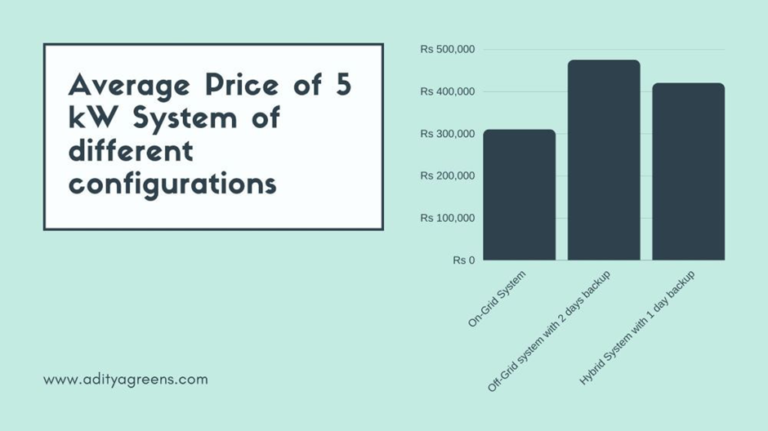
| Average Gross cost (5 kW @ ₹65–70/W) | ₹3,30,000 |
| MNRE Subsidy (₹14,588/kW for 3 kW + ₹7,294/kW for next 2 kW) | ₹78,000 |
| Net cost after subsidy | ₹2,52,000 |
This estimate assumes you’re eligible under the Rooftop Solar Programme Phase II through a DISCOM-registered vendor.
💰 Avoid overpaying or undersizing your solar system.
Grid electricity rate in Maharashtra
The state has slab-wise tariff rates, with average residential tariffs around ₹8–10/unit. Here’s a sample from MSEDCL:
- 0–100 units: ₹4.50
- 101–300 units: ₹9.50
- 300+ units: ₹11.50
Net metering allows you to export extra solar electricity to the grid and offset your bill.
Annual Savings from a 5-kW solar system in Maharashtra
- Expected annual generation: 7,500 units (kWh)
- Average electricity rate: ₹9 per unit
- Annual savings = 7,500 × ₹9 = ₹67,500
If you use most of the energy directly (self-consumption) and export the extra units to the grid through net metering, your overall savings could be even higher.
This depends on your electricity slab—especially if you’re currently in a higher slab (₹10–₹12/unit), solar can save you more money each year.
The Payback Period
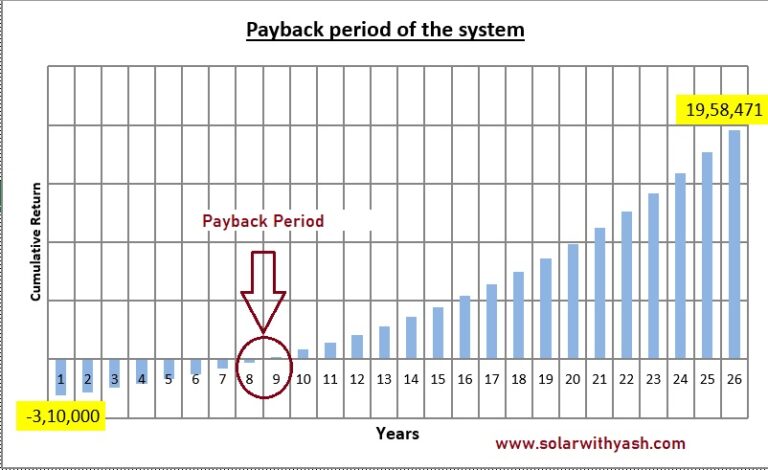
If you invest ₹2.52 lakh in a 5 kW grid-tied solar system in Maharashtra and save ₹67,500 per year on electricity bills, here’s the math for payback period:

- Simple payback period = ₹2,52,000 ÷ ₹67,500 ≈ 3.7 years
- Return on Investment (ROI) = ₹67,500 ÷ ₹2,52,000 ≈ 26.8% annually
So, your system pays for itself in under 4 years. After that, for the next 20+ years, you get almost free electricity.
Even with small yearly maintenance costs (around ₹2,000), your savings are massive. Considering rising electricity tariffs and good sunlight in Maharashtra, solar gives strong long-term returns.
In short:
✅ Investment = ₹2.52 lakh
✅ Annual saving = ₹67,500
✅ Payback = ~4 years
✅ Free power = 20+ years
✅ ROI = 22–27% per year
Solar isn’t just green—it’s smart money too.
Real case study – U.P.

I am sharing with you my real solar story. We installed a 5-kW grid-tied solar system on August 22, 2023. We have saved over ₹ 98,000 in 21+ months without making any lifestyle changes in our energy consumption. Maharashtra’s solar potential is even better, so if you have a similar setup, your savings can be as good—or better!
Conclusion – Should you go solar in Maharashtra?
Yes — and here’s why!
Maharashtra has strong sunlight, which means your solar panels will generate more electricity every day. That’s more savings for you! The electricity rates in the state are high, so by generating your power, you avoid paying huge bills. Plus, the government offers subsidies, which lower your initial cost.
Humidity and high temperatures are common in Maharashtra, but modern solar panels are built to handle this weather. With proper installation and ventilation, they work efficiently even in hot and humid conditions.
You can expect a payback period of just 4–5 years, and after that, the electricity you generate is practically free for the next 20 years or more.
So if you have a shadow-free roof, going solar is not just good for the planet — it’s a smart money move for your home!
🔋 Ready to Go Solar? Here’s Your Next Step:
- Download the FREE Solar Snap Tool – Check the solar potential of your rooftop
- Use the Solar Feasibility Calculator – Know how much you can save
- Get My eBook: Size Your System Right – Avoid costly mistakes and size smart
- Take My Solar Masterclass – Learn everything from basics to designing and saving big!
Got questions? Leave a comment or contact me for a 1:1 consultation. Let’s help you power your home with the sun.