5kW Solar System Cost in Uttar Pradesh (2026): Price, Subsidy, ROI & Payback
5kW Solar System Cost in Uttar Pradesh (2026)
Are you thinking about installing a 5kW solar system in Uttar Pradesh in 2026?
This guide is updated for 2026 with the latest solar prices, MNRE subsidy details, and realistic ROI and payback assumptions for Uttar Pradesh.
You’re not alone.
With rising electricity bills and increasing awareness about clean energy, thousands of homeowners and small businesses in UP are turning to solar power as a smart investment.
A 5kW solar system is ideal for medium—to large-sized homes. It offers significant savings, long-term energy independence, and a reduced carbon footprint.
But before you decide, it’s important to understand the real system cost, applicable subsidies, and the actual payback period in Uttar Pradesh.
In this blog post, we’ll explain everything you need to know—from system pricing in UP, the latest subsidy updates under PM Surya Ghar Yojana, to how long it takes to recover your investment through electricity savings.
Let’s break down how much a 5kW solar system costs in Uttar Pradesh—and whether it truly makes financial sense in 2026.
👉Not sure how much sunlight your home gets?
5kW Solar Cost Components in Uttar Pradesh (2025)
- Solar Panels
- Grid-tied solar inverter
- Mounting Structure
- BOS
- AC and DC Cables
- MC4 connectors
- Junction Box
- Earthing kit and lightning arrestor
- Installation & labour charges
- Net-Metering and Government approvals
Solar Panel Cost (2025): Technology, Price & Efficiency

Working, Technology & Function of Solar Panels
Solar panels are the heart of a solar power system. They work on the photovoltaic (PV) effect, where sunlight is absorbed by PV cells, typically made of silicon, and converted into direct current (DC) electricity.
Most modern systems use Mono PERC (Passivated Emitter and Rear Cell) or Half-Cut Mono Crystalline panels, known for their high efficiency (18–21%) and better performance in partial shading and high temperatures.
These panels are mounted at an optimal angle and orientation to capture maximum sunlight throughout the day.
Technical and cost details of Solar Panels
| Specification | Details |
| Technology Used | Mono PERC / Half-Cut Mono Crystalline |
| Power Output per Panel | 500-535Wp |
| Number of Panels (5 kW) | 10 panels |
| Lifespan | 25 years (performance warranty) |
| Top Indian Brands | Vikram Solar, Waaree, RenewSys, Adani Solar, Tata Power Solar |
| Estimated Cost | ₹1,40,000 |
| Share of Total Cost | ~40–45% of total 5 kW system cost |
| Cost per Watt | ₹28 per Wp |
Inverter Cost for 5kW Solar in Uttar Pradesh
The Price of the inverter depends on its technology, rating, and its salient features.
Function of the Inverter
A grid-tied inverter is a critical component of any on-grid solar power system. Its main function is to convert the DC electricity generated by the solar panels into AC (alternating current) electricity, which is what your home appliances use.
Grid-tied inverters also ensure that the solar energy system stays synchronized with the utility grid.
Modern inverters come with features like MPPT (Maximum Power Point Tracking), which maximizes energy conversion efficiency, and remote monitoring to track system performance in real-time.
Technical and cost details of the Inverter (5kW in UP)
| Specification | Details |
| Type | String Inverter (commonly used), Microinverter (optional) |
| Technology | MPPT, Wi-Fi/remote monitoring, safety protections |
| Power Rating | 5 kW |
| Lifespan | 10–12 years (can be extended with care) |
| Top Brands | Growatt, Sungrow, GoodWe, Luminous, Sofar, Enphase (micro), Polycab |
| Estimated Cost | ₹41,000 |
| Share of Total Cost | ~15–20% of total 5 kW system cost |
| Warranty | Typically, 5 years (extendable up to 10 years) |
Mounting Structure: Design, Material & Durability
The mounting structure holds the solar panels securely in place, ensuring the correct tilt angle and orientation to maximize sunlight exposure throughout the year.
These structures are designed to withstand wind loads, rain, and harsh weather conditions, and they can be customized for different types of rooftops (RCC, sloped, or tin shed).
Most commonly, structures are made from hot-dip galvanized iron (GI) or aluminum to prevent rust and ensure long-term durability.
Technical and Cost Details of the Mounting Structure
| Specification | Details |
| Material Used | Hot-Dip Galvanized Iron (GI) / Aluminum |
| Design | Fixed-tilt (customized for roof type & location) |
| Compatibility | RCC flat roofs, metal sheets, tin sheds, etc. |
| Corrosion Resistance | Yes – anti-rust coating |
| Estimated Cost | ₹ 41,500 |
| Share of Total Cost | ~7–10% of total 5 kW system cost |
| Lifespan | 20+ years (with minimal maintenance) |
BOS (Balance of System)
The Balance of System includes all the electrical and safety components that connect and protect the solar setup. It includes DC and AC cables that transmit power, MC4 connectors to link panels, junction boxes for distribution and protection, earthing kits, and lightning arrestors to ensure safety from power surges and electrical faults.
While these components may not generate electricity, they are vital for system performance, safety, and compliance with standards.
Cost Details for BoS for 5kW Solar in UP
| Component | Included Items |
| Cables | DC (solar) cable (₹ 1,700), AC cable (copper) (₹ 5,400) |
| Connectors | MC4 connectors |
| Protection | DC & AC junction boxes (₹ 7,000), SPD (surge protectors) |
| Safety Systems | Earthing kit (₹8,000), Lightning arrestor (₹ 2,000) |
| Estimated Cost | ₹25,000 – ₹35,000 |
| Share of Total Cost | ~8–10% of the total 5 kW system cost |
| Lifespan | 10–15 years (depending on component quality) |
Installation, Commissioning, and Net-metering Cost for 5kW Solar in UP
This component covers the physical installation of the system—panel mounting, electrical wiring, inverter setup, and system testing.
It also includes net metering setup, where the utility provider installs a bi-directional meter to measure both imported and exported electricity, allowing you to earn credits for excess solar power sent to the grid. Proper documentation, DISCOM approvals, and inspections are part of this process.
Technical and Cost Details
| Service | Details |
| Installation | Panel mounting, cabling, inverter connection, testing (₹ 20,000) |
| Net Metering | Bi-directional meter, DISCOM approval, site inspection (₹ 9,000) |
| Documentation | Application forms, load sanction, and electrical drawings (₹ 5,000) |
| Estimated Cost | ₹20,000 (Installation) + ₹ 9,000 (Metering) + ₹ 5,000 |
| Total Combined Cost | ₹ 34,000 |
| Share of Total Cost | ~7–10% of the total 5 kW system cost |
| Time for Completion | 15–30 days (including DISCOM approval) |
Installer Administrative and Support Charges for 5kW Solar
In a typical 5 kW grid-tied solar system, administrative and support charges form an essential part of the overall project cost. These services ensure the smooth execution, legal compliance, and long-term performance of the system.
In addition, administrative and liaisoning fees, usually ₹5,000 to ₹10,000, account for documentation, DISCOM approvals, and facilitating net metering permissions—this process can be time-consuming and requires coordination with government or utility officials.
Furthermore, support charges include post-installation customer support, guidance on system usage, warranty claim assistance, and sometimes basic troubleshooting.
Together, these components contribute to about 10–15% of the total system cost, offering peace of mind and professional oversight to ensure the solar installation delivers optimal performance throughout its lifespan.
The approximate cost is Rs. 21,000.
The Total Cost Table of 5kW Solar in Uttar Pradesh


The Subsidy on 5 kW Solar in Uttar Pradesh
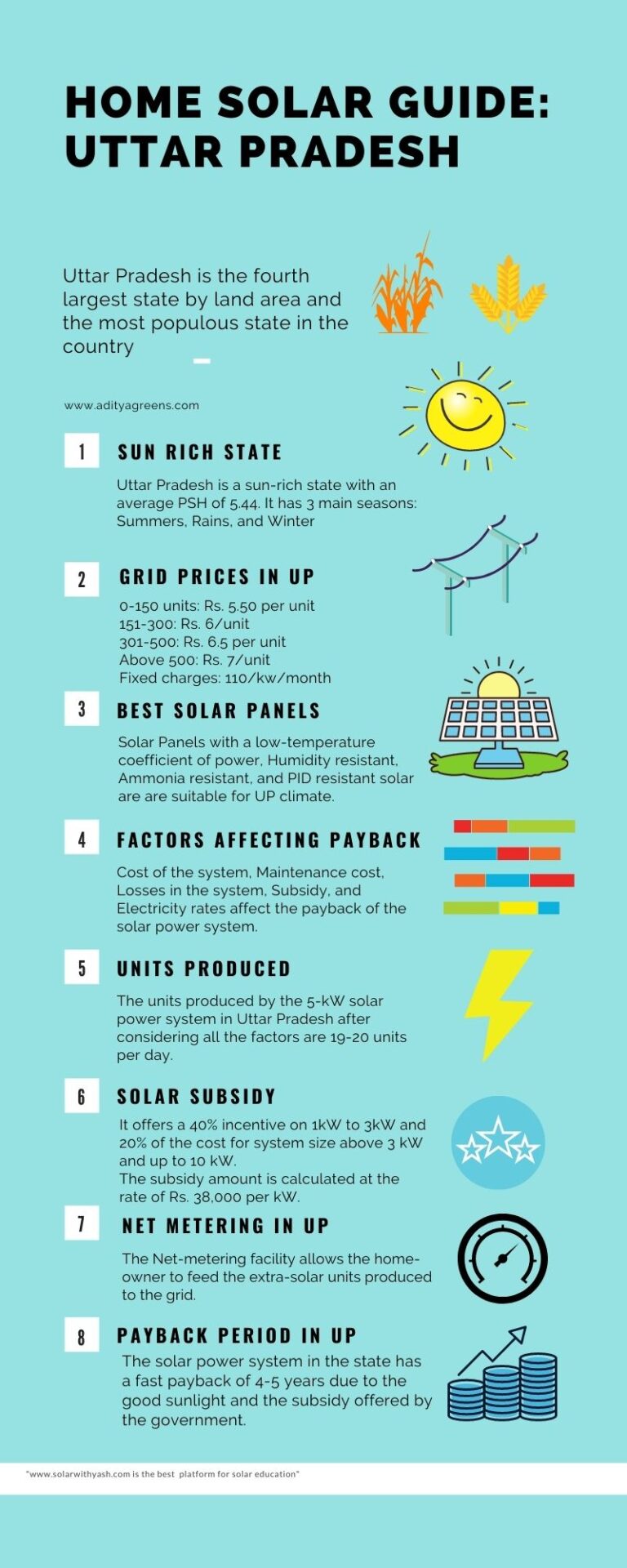
In 2025, homeowners in Uttar Pradesh can avail of significant financial support when installing a 5-kW grid-tied rooftop solar system, thanks to the PM Surya Ghar: Muft Bijli Yojana and additional state-level subsidies.
Under this scheme, a central subsidy of ₹78,000 is provided for systems above 3 kW capacity. On top of this, the Uttar Pradesh government offers a state subsidy of ₹30,000 for a 5-kW solar installation, making the total subsidy ₹1,08,000.
This brings down the net cost of a 5-kW system to approximately ₹2.0 to ₹2.8 lakh, depending on the quality of components and installation.
These subsidies make solar adoption highly affordable while encouraging clean energy and long-term electricity savings.
Want exact numbers for your home?
Total Losses in the 5kW Solar when Installed in UP
A system with more losses tends to produce fewer solar units, leading to fewer savings and hence longer payback.
Let us see the losses and the system, and how they affect the overall system performance.
i) Temperature Loss:
Solar panels generate less power as they heat up. While they need sunlight, excessive heat reduces their efficiency. Typically, panel output drops by 0.4–0.5% for every 1°C rise above 25°C (standard test condition). So, in hot regions like India, panels can lose 5–10% output due to heat. This is called temperature loss.
How to minimize:
- Use high-efficiency, low-temperature coefficient panels (e.g., Mono PERC).
- Ensure good air circulation under panels with proper mounting.
- Avoid installing directly on metal sheds without insulation.
ii) Shading loss
Even partial shading (from trees, buildings, or poles) can drastically reduce output by up to 20–40%, as shaded cells affect the current of the entire panel or string. Shading reduces sunlight reaching the PV cells, causing a mismatch and energy drop.

How to minimize:
- Use a shadow-free area for installation.
- Design panel layout carefully using solar design software.
- Use microinverters or power optimizers to isolate shaded panel impact.
iii) Inverter Inefficiency loss
Inverters convert DC electricity (from panels) to AC (for home use), but not with 100% efficiency. A typical string inverter has 95–98% efficiency, so 2–5% of energy is lost during conversion. Lower-quality inverters may lose even more.

How to minimize:
- Choose inverters with >97% efficiency and MPPT technology.
- Properly size the inverter to match the panel output.
- Install in a shaded, ventilated area to avoid overheating.
iv) Dirt loss and soiling loss
Dust, bird droppings, and pollution reduce the amount of sunlight hitting the panel surface, decreasing output by 5–20%, especially in dry or dusty areas.

How to minimize:
- Clean panels regularly (every 1–2 weeks or monthly, depending on dust levels).
- Use water and a soft brush—no chemicals or hard scrubbing.
- Consider anti-soiling coatings (if available) or tilt angle adjustment for self-cleaning.
v) Tolerance loss
Solar panels have a power tolerance range (e.g., -0% to +5%), which indicates their real output may be slightly less than rated. If tolerance is negative or not guaranteed, actual output can be lower than expected.
How to minimize
- Choose panels with positive or zero negative tolerance (e.g., 0% to +5%).
- Buy panels from reputed manufacturers with verified test certificates.
- Avoid mixing panels with different tolerances in the same string.
vi) Conversion loss
This includes energy lost during voltage conversions, especially in MPPT trackers, inverters, or battery charging (if a hybrid system). Even top-quality equipment incurs a 2–3% conversion loss.
vii) Transmission loss (cable loss)
When electricity flows through cables, a small portion is lost as heat due to resistance. This loss depends on cable length, size, and current, typically 1–3%.
How to minimize
- Use appropriately thick copper cables (low resistance).
- Keep cable lengths as short as practically possible.
- Follow standard cable sizing guidelines based on system current.
These losses can eat up to 33% of the total output of the system. But with the right design, latest technology, and proper maintenance, these losses can be minimised. In my case, these losses are 17%, and the maximum is the shading loss due to the apartment west of the solar panels, preventing sunlight from 5:45 to sunset.

Total Losses: In my case, these are 17% of the total output of the system.

Annual Savings and Payback Period of 5kW Solar
A 5 kW Grid-tied solar power system in Uttar Pradesh (Ghaziabad) produces:
System size x Peak Sun hours – losses
5 kW x 5*(1- 17%)
= 20 units per day
Working: Payback Period Estimation
The unit rate when you consume 400 units or more is ₹ 8 per unit.
Therefore, daily savings = 20 x 8 = Rs. 160
Monthly savings = 160 x 30 days = Rs. 4,800
Annual savings = Rs. 4,800 x 12 months = Rs. 57,600
Payback = cost of the system after subsidy/annual savings
= Rs. 2,12,000/57,600
= 3.7 years
The payback period in solar typically assumes that the savings in the first year will remain roughly the same each year throughout the payback period — this is a simplified approach used for ease of calculation.
But in reality:
- Electricity tariffs often increase every year (by 3–5%), so your savings usually increase over time.
- The system’s performance degrades slightly each year (~0.5% per year), slightly reducing annual generation.
So, in a more accurate (discounted or real payback model):
Real Payback = 4.84 years
Summary
Installing a 5kW rooftop solar system in Uttar Pradesh is a smart investment for homeowners looking to reduce their electricity bills and adopt clean energy.
The average total system cost is ₹3.20 lakh, depending on equipment quality and installer charges.
Thanks to government support, the effective cost drops significantly:
- Central subsidy (PM Surya Ghar Yojana): ₹78,000
- State subsidy (UP): ₹30,000
- ✅ Total subsidy: ₹1,08,000
After subsidies, the net cost comes down to around ₹2.0 to ₹2.7 lakh.
With average monthly electricity savings of over ₹4,000, the real (discounted) payback is around 4.5 to 5.5 years.
After payback, homeowners continue to enjoy 20+ years of free or nearly free electricity, making rooftop solar a highly rewarding, low-risk investment in UP.
👉 Ready to master solar design and financial feasibility? Enroll in my Solar Energy Masterclass and learn how to size, design, and profit from solar systems.